What should I do when sewage backs up into my basement?
Stop using water, keep people and pets away from the sewage, and plug the low drains if you can reach them without touching it. Then find out whose pipe is blocked: if neighbors are affected or sewage rises while nothing is running, call your sewer utility first; if it only happens when you use fixtures, call a licensed plumber. Photograph the damage and call your insurer.
Free to ask. Local shops send quotes, and you pay only when you book one.
By Kasra Taheri, Founder, LoclisUpdated
Researched and drafted with AI, then checked claim by claim against the sources listed below before it was published. Prices and rules change; the dates beside each source say when it was last checked.
This is a job for a licensed pro in Virginia
This page explains what the work involves, the permits, what a licensed pro does and what drives the cost. It does not give step-by-step instructions, because this work needs a licence, a permit or both, and doing it wrong can injure someone. Before you hire, check the licence on Virginia's DPOR record.
The short version
A sewage backup is two problems at once: a blocked pipe somewhere between your house and the treatment plant, and contaminated water in your home. In the first hour your job is to stop adding water, keep everyone away from the sewage, and work out whether the blockage is in your own line or the public sewer, because that decides who you call and, usually, who pays.
In the first few minutes
Stop using water. Every flush, shower or load of laundry upstairs goes down the same pipe and comes out at the lowest drain. The City of Salem's advice is to shut off any running water and not to pour anything down the drain until the backup has receded;[1] chemical drain cleaners are not likely to help and can cause additional damage.[1]
Keep away from the water. Salem warns that the wastewater can contain harmful bacteria and chemicals, and asks residents to protect themselves, other people and pets from contact with it.[1] Fairfax County notes that raw sewage can carry bacteria, viruses, molds and fungi.[2] Close the basement door and keep children and pets upstairs.
Close the low drains if you can reach them safely. Fairfax County tells residents to close all drain openings with stoppers or plugs, and notes that ceramic fixtures are fragile and that tub, sink and floor drains may need extra weight to stay sealed.[2] Salem points out that backups enter through the lowest drains first,[1] and that toilets can be plugged with wads of rags or a string mop.[1] If doing this means standing in sewage, skip it.
Sump pump. If the basement has a sump pump, Salem's advice is to turn it off, because sump pumps are meant to pump clear water to a green space or storm drain.[1] Pumping sewage out into the yard spreads the problem. Only do this if you can reach the switch or plug from a dry floor. FEMA's flood guidance warns of the risk of electrocution and says not to touch electrical equipment if it is wet or if you are standing in water.[7] If reaching the pump means wading in, or water has reached its outlet or cord, leave it alone and stay out of the basement.
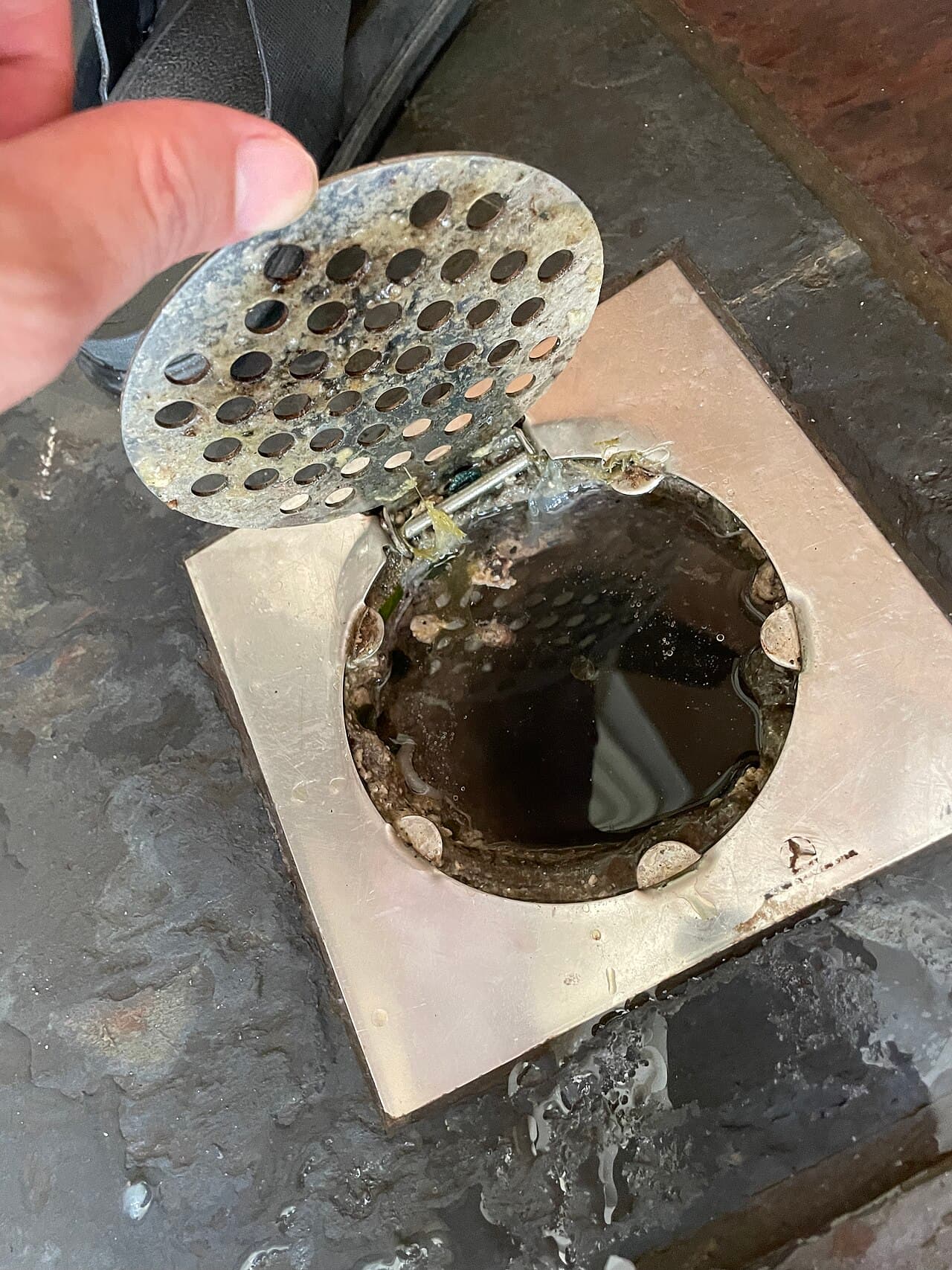
Your pipe or the public sewer?
Your house drains into a private pipe, the lateral, which runs to the public sewer main. Fairfax County explains the difference this way: if the backup occurs only when fixtures such as the toilet, tub, washer or sinks are used, "it is possible that you need a plumber." If sewage backs up when you are not using any of them, "it is possible that there is a problem in the county main line."[2]
Fairfax County asks residents to call the county before a plumber when they believe the problem is in the county main line, on its 24-hour line at 703-323-1211 (TTY 711).[2] Fairfax then sends a Wastewater Collection Division representative to check the county line. If the county line is operating normally, the county says "indications are" that the private lateral is the cause, and advises the owner to contact a plumber.[2] In Fairfax County, maintaining the private lateral is the property owner's responsibility.[2] Elsewhere, rules differ from one utility to the next, so ask your own sewer utility how it handles a backup and keep its emergency number somewhere you can find it.
Ask a neighbor or two whether their drains are working. If several buildings are affected, Salem asks residents to call the Salem Water Department immediately at 540-375-3029; if only one building is affected, it recommends a licensed plumber.[1]
When the blockage is in your line
A plumber will usually look for the sewer cleanout first. A cleanout is a vertical pipe from the buried lateral to the surface, usually 4 inches across with a tight-fitting cap, and a plumber can help find one that is buried under dirt.[3] From there the line can be cleared with a drain machine or water jetter, and many plumbers will run a camera afterwards to see what caused the blockage.
Ask for that camera look if this is not the first backup. Broken laterals can let in tree roots or debris, which cause blockages and backups.[3] A line that keeps backing up may need a repair rather than another cleaning; our guides to the signs of a broken sewer line and who is responsible for the line to the street explain the next steps.
Cleaning up
Clearing the line does not clean the basement, and the cleanup is a separate job, usually for a sewage cleanup company. In Salem, the building owner is responsible for the cleanup as well as for the lateral on private property, and the city suggests considering a reputable clean-up service.[1] A company's work can include wet vacuuming, mopping, removing solids, disinfecting, steam cleaning, sanitizing ductwork, flushing the plumbing fixtures, and removing heavily soiled porous materials such as carpet or drywall.[1]
Ask for a written scope before work starts: which rooms and surfaces are included, what will be thrown away, and whether ductwork is part of the job. Photograph anything before it is removed, for the insurer.
Until it is done, Salem's guidance is to avoid direct contact with wastewater and wetted surfaces, ventilate the area, and sanitize skin and clothing after any contact.[1] Never mix bleach with ammonia; Salem warns that the combination creates a deadly gas.[1]
Insurance and the paperwork
Photograph the water line, the damaged items and the drain it came from before anything is moved, and keep receipts for every call-out. Then call your insurer. According to the City of Salem, most homeowners' insurance will not pay for damage unless specific sewer backup coverage has been added to the policy, and most will not pay for mitigation.[1] Fairfax County describes backup coverage as optional coverage that can generally be added to a policy if requested, and advises owners with fixtures below grade to look into it.[2]
If you believe the public sewer caused the backup, write down the date and time and ask the utility for its report. Under Virginia law, a negligence claim against a county, city or town is barred unless a written statement of the claim, with the time and place of the injury, is filed within six months.[4] Our guide to who pays for a sewer backup covers this in more detail.
If your home is on a septic system, Salem's advice is to call your local health department about how to dispose of the water and sewage.[1] Our guide to why a septic system backs up covers the causes.
When to call a licensed pro
Call the same day whenever sewage comes up through a drain and the utility has ruled out its main. Choose a plumber you can look up on DPOR. Virginia's Board for Contractors regulates plumbers as tradesmen, and state certification of the trade is mandatory, not optional.[5] For a larger job, check the firm as well: Virginia's contractor law defines Class C contractors as those working on a single contract or project worth over $1,000 but less than $30,000, and the Board requires a master tradesman licence as a condition of licensure for plumbing contractors.[6]
If the lateral has to be repaired or replaced rather than cleared, ask whether the work needs a permit. Under the Uniform Statewide Building Code, a permit is required for installations or alterations involving the sanitary drainage system.[8] Some ordinary repairs are exempt, such as replacing plumbing fixtures without altering the drainage system, along with repair work the building official deems minor and ordinary.[8] For emergency work, the application can be submitted by the end of the first working day after the work starts, and either the owner or the contractor can apply.[8] Agree in writing who will apply.
Get help from a licensed pro
Loclis lists licensed businesses from Virginia's DPOR register. Find plumbers in Blacksburg, book drain cleaning, or read more plumbing repair answers. When you are ready, describe the backup once and licensed local businesses quote it.
Common questions
- Should I call the city or a plumber first?
- If neighbors have the same problem, or sewage rises while nothing in your house is running, call your sewer utility first, because the blockage may be in the public main. Fairfax County, for example, asks residents to call it before a plumber in that case and says it will take corrective action when the problem is in its sewer. If the backup only happens when you run water, a licensed plumber is more likely the call.
- Can I use drain cleaner on a sewer backup?
- No. The City of Salem says chemical drain cleaners are not likely to help and can cause additional damage. Leave the drains alone until a plumber or the utility has cleared the line.
- Who cleans up after a sewer backup?
- A sewage cleanup company, hired by the owner in most cases. The City of Salem makes the building owner responsible for cleanup and suggests considering a reputable clean-up service. Ask for a written scope that lists what will be cleaned, disinfected and thrown away, and photograph everything before it is removed.
- Does homeowners insurance cover a sewer backup?
- Often not unless you added it. The City of Salem says most homeowners' insurance will not pay for damage unless specific sewer backup coverage has been added to the policy. Call your insurer before you throw anything away, and photograph the damage first.
Sources
- [1] Water & Sewer: Backup vs. Overflow, City of Salem, Virginia. Checked October 26, 2026.
- [2] Wastewater Management: Sanitary Sewer Emergencies and Backups, Fairfax County Department of Public Works and Environmental Services. Checked October 26, 2026.
- [3] Utilities: Sanitary Sewer Lateral, Spotsylvania County, Virginia. Checked October 26, 2026.
- [4] Code of Virginia § 15.2-209, Notice to be given to counties, cities, and towns of tort claims for damages, Code of Virginia, Legislative Information System. Checked October 26, 2026.
- [5] Tradesmen Program, Virginia Department of Professional and Occupational Regulation. Checked October 26, 2026.
- [6] Code of Virginia § 54.1-1100, Definitions, Code of Virginia, Legislative Information System. Checked October 27, 2026.
- [7] Floods, Ready.gov, U.S. Department of Homeland Security and FEMA. Checked October 27, 2026.
- [8] 13VAC5-63-80, Virginia Uniform Statewide Building Code, Section 108 Application for permit, Virginia Administrative Code, Legislative Information System. Checked October 26, 2026.
Want a pro to handle it?
Describe the job once. Licensed local businesses send quotes, and you pay only when you book one.
Get a quote for Plumbing Repair