How do I prevent sewer backups in my basement?
Keep grease, wipes and other trash out of your drains, keep roots and rainwater out of your sewer lateral, and know where your cleanout is. If your basement has backed up during heavy rain, ask a licensed plumber about a backwater valve or backflow preventer, which closes when the public sewer surcharges. Add sewer backup coverage to your insurance either way.
Free to ask. Local shops send quotes, and you pay only when you book one.
By Kasra Taheri, Founder, LoclisUpdated
Researched and drafted with AI, then checked claim by claim against the sources listed below before it was published. Prices and rules change; the dates beside each source say when it was last checked.
This is a job for a licensed pro in Virginia
This page explains what the work involves, the permits, what a licensed pro does and what drives the cost. It does not give step-by-step instructions, because this work needs a licence, a permit or both, and doing it wrong can injure someone. Before you hire, check the licence on Virginia's DPOR record.
The short version
Two common sources of basement backups are a blockage in your own sewer lateral and a public sewer that is overloaded by rainwater. You prevent the first with what goes down your drains and how you look after the lateral. You protect against the second with a backwater valve or backflow preventer, installed by a licensed plumber, and with insurance for the backup that still gets through.
Watch what goes down the drain
Grease. The City of Salem's advice is to never pour fats, oils or grease down the drain, even if they are liquid at room temperature.[1] Alexandria's version is to pour grease into a can, cool it in the freezer and throw it in the trash, and to wipe pans out with a paper towel before washing them.[2]
Wipes and other trash. Even the wipes labeled "flushable" build up in pipes, causing blockages.[1] Salem also lists diapers, sanitary napkins, tampons, paper towels, cardboard and cloth as things never to flush.[1] Toilet paper and human waste are what the toilet is for.
Food. Both Salem and Alexandria advise using a garbage disposal sparingly,[1][2] and Alexandria suggests strainers on sinks to catch food scraps for the trash.[2] Our guide to keeping drains from clogging has more on the inside drains.
Grinder pumps. If your home is on a low-pressure sewer with a grinder pump, the list is longer. Fairfax County's grinder pump guidance begins: "Never put any of the following materials into sinks, toilets or drains"[5] and goes on to glass, metal, plastic, cloth, grease, strong chemicals and fuels.
Look after the lateral
Your lateral is the pipe from the house to the public sewer, and how much of it you look after depends on where you live. In Fairfax County, maintaining the private lateral is the property owner's responsibility.[5] In Spotsylvania County, the owner is responsible for the upper, private lateral, from the house to the property line.[4] In Colonial Heights, where there is an approved cleanout at the property line, the city claims ownership of the lateral from that cleanout to the main and is responsible for its maintenance and repairs; without one, the owner is considered to own the whole lateral.[6] Ask your utility where your part ends.
Broken laterals can let tree roots or debris into the pipe, causing blockages and building backups.[4] Salem advises removing trees and woody plants from around the sewer lateral.[1] If you are planting, keep new trees well away from the line's path. Our guide to keeping tree roots out of a sewer line covers what a plumber does when roots are already in.
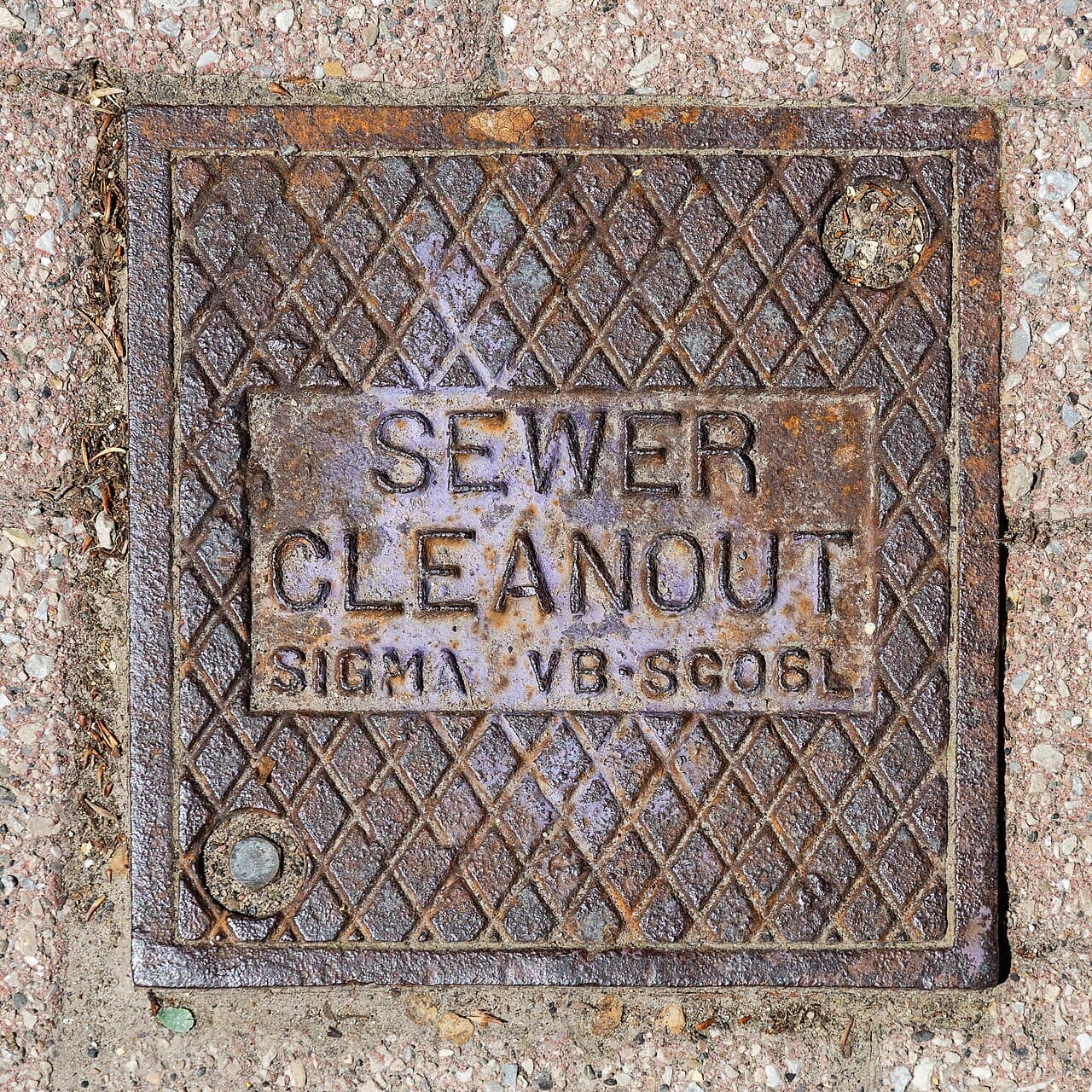
Know where your cleanout is. In Spotsylvania County's description, a cleanout is a point of access where the lateral can be serviced, usually 4 inches across with a tight-fitting steel or plastic cap.[4] If you cannot find yours, it may be buried under dirt or you may not have one, and a plumber can help locate it.[4] Keeping the cap on and in good shape keeps out rain and debris that can cause blockages, backups or overflows.[4] A mower can crack a cap that sits proud of the lawn, so check it each spring.
Keep rainwater out of the sanitary sewer
In Alexandria's words, "If the amount of rainwater entering the sanitary sewers is excessive, the street sewers become overloaded and can back-up into the basements of homes and businesses."[3] Spotsylvania County says defects and prohibited connections let rainwater into its public sewer, where it may overload the system and cause overflows.[4] Spotsylvania County lists roof downspouts, groundwater sump pumps, foundation drains, and drains from window wells and driveways as improper connections[4] that let rainwater into the public system. If your downspouts discharge into a pipe in the ground, or you have an outside basement stairwell drain, and your home was built before 1970, Alexandria says they may be connected to the sanitary sewer.[2] Ask your utility whether it can check. In Alexandria, city staff will help assess whether a downspout is connected to the sanitary sewer and discuss options for disconnecting it.[2] Our guide to why a floor drain backs up when it rains explains the mechanism.
Location matters as well. Salem notes: "Homes that are subject to flooding are also more likely to experience a backup."[1]
Backwater valves and backflow preventers
If your basement has backed up when the public sewer surcharged, a valve on your line is the main defence. In the City of Alexandria's description, a backflow preventer can be installed in the plumbing to shut the house off from the street sewer during a backup.[3] It can work automatically or be operated by hand, and an automatic one can have a battery-operated light that shows whether it is open or closed.[3] To protect the house it must be closed during the overload, which generally lasts 2 to 6 hours.[3]
There are trade-offs. Alexandria points out that you cannot use your plumbing while the device is closed, and you cannot have a sump pump or downspout discharging upstream of it.[3] Salem recommends placing the valve outside the home on the owner's lateral, and notes that a basement installation is much more expensive if concrete has to be removed.[1] Salem says the owner has to maintain the valve for it to work properly.[1] Salem also cautions that a backwater valve does not rule out every backup.[1]
Alexandria suggests consulting a plumber licensed by both the state and the city, and requires installation permits.[3] Under Virginia's Uniform Statewide Building Code, a permit is required for installations or alterations involving the sanitary drainage system.[8] Ask the plumber to confirm in the quote who will apply for it.
Some localities help with the cost. When we checked on October 26, 2026, Alexandria reimburses approved homeowners up to 50 percent of the installation cost, to a maximum of $2,000,[3] and Salem offers up to $750 if its Water Department Director approves.[1] Ask your utility whether it has a program before the work is booked.
Insure for what still gets through
The City of Salem says most homeowners' insurance will not pay for damage unless specific sewer backup coverage has been added to the policy.[1] Fairfax County advises owners with below-grade fixtures to look into sewer backup coverage, which can generally be added to a policy if requested.[5] Prevention lowers the odds; the endorsement pays when it is not enough. Our guide to who pays for a sewer backup explains how the costs split.
When to call a licensed pro
Call a plumber when drains anywhere in the house are slow at the same time, when the lowest drain gurgles as upstairs fixtures run, or after any backup, for a camera inspection of the lateral. For work on the lateral or a valve installation, choose a plumber you can look up on DPOR. Virginia's Board for Contractors regulates plumbers as tradesmen, and state certification of the trade is mandatory, not optional.[7] Check the licence on DPOR before you hire.
Get help from a licensed pro
Loclis lists licensed businesses from Virginia's DPOR register. Find plumbers in Blacksburg, book drain cleaning, or read more plumbing repair answers. When you are ready, describe the job once and licensed local businesses quote it.
Common questions
- Are flushable wipes safe for my sewer line?
- No. The City of Salem says even the wipes labeled "flushable" build up in pipes and cause blockages, and Alexandria lists them among the non-degradable items to keep out of the toilet. Put them in the trash.
- Is a backwater valve worth it?
- It can be, if your basement has backed up during heavy rain. A backflow preventer shuts the house off from the street sewer while the public line is overloaded. It needs regular maintenance, you cannot use the plumbing while it is closed, and it does not rule out every backup, so pair it with backup insurance.
- How often should I have my sewer line cleaned?
- There is no set schedule. A line with no history of trouble may never need it. If you have had root blockages, ask your plumber for a camera inspection and a cleaning interval based on what they find, and consider repairing the joints where roots get in.
- Can a downspout cause a sewer backup?
- It can, if it drains into the sanitary sewer. Spotsylvania County says these connections let rainwater into its public sewer, where it may overload the system and cause overflows, and Alexandria says excess rainwater can overload the street sewers and back up into basements. In Alexandria, city staff will help check whether a downspout is connected; ask your own utility whether it does the same.
- Will insurance cover a backup if I install a valve?
- A valve does not change what your policy covers. The City of Salem says most homeowners' insurance will not pay for damage unless specific sewer backup coverage has been added to the policy, so ask your insurer about a water or sewer backup endorsement whether or not you install a valve.
Sources
- [1] Water & Sewer: Backup vs. Overflow, City of Salem, Virginia. Checked October 26, 2026.
- [2] Sanitary Sewers, City of Alexandria, Virginia. Checked October 26, 2026.
- [3] City Assistance Program for Sewer Backflow Prevention, City of Alexandria, Virginia. Checked October 26, 2026.
- [4] Utilities: Sanitary Sewer Lateral, Spotsylvania County, Virginia. Checked October 26, 2026.
- [5] Wastewater Management: Sanitary Sewer Emergencies and Backups, Fairfax County Department of Public Works and Environmental Services. Checked October 26, 2026.
- [6] City Cleanout Permit Application, City of Colonial Heights, Virginia. Checked October 26, 2026.
- [7] Tradesmen Program, Virginia Department of Professional and Occupational Regulation. Checked October 26, 2026.
- [8] 13VAC5-63-80, Virginia Uniform Statewide Building Code, Section 108 Application for permit, Virginia Administrative Code, Legislative Information System. Checked October 26, 2026.
Want a pro to handle it?
Describe the job once. Licensed local businesses send quotes, and you pay only when you book one.
Get a quote for Plumbing Repair