Why are my hardwood floors gapping in winter?
Winter gaps are usually the boards shrinking in dry indoor air. Wood swells in humid air and shrinks in dry air, and heating season is the driest time. Keep indoor humidity steady, around 35 to 55 percent, and wait a season before filling. Gaps that stay open, widen, or come with cupping or soft spots point to moisture or movement below.
Free to ask. Local shops send quotes, and you pay only when you book one.
By Kasra Taheri, Founder, LoclisPublished
Researched and drafted with AI, then checked claim by claim against the sources listed below before it was published. Prices and rules change; the dates beside each source say when it was last checked.
Step by step
Read when to stop and call a pro, further down this page, before you start.
Step 1: Check the humidity
Put a hygrometer in the room and read it over a few days; hardwood does best between 35% and 55%.[2]
Step 2: Add moisture in the heating season
If the room reads below that range in the heating season, run a humidifier and keep the reading steady.
Step 3: Stay under 60%
Keep the reading below the level where fungi grow.[3]
Step 4: Wait out a full season
Leave the gaps unfilled until the floor has spent a season at steady humidity, so you can see which ones stay open.
Step 5: Vacuum the open gaps
Clean dust and grit out of the gaps that remain, using a brush attachment.
Step 6: Fill what stays open
Press in a flexible wood-floor filler or glue in a thin sliver of matching wood, and wipe off the excess right away.
Winter gaps are the wood shrinking
The cause is almost always dry indoor air. Dry wood undergoes small changes in dimension with normal changes in relative humidity.[1] More humid air will cause slight swelling, and drier air will cause slight shrinkage.[1] Each board gives up a hair's width, and across a whole room those hairlines add up to visible gaps.
That is why gaps tend to open in January and close again by summer. Changes that occur because of seasonal variation, although gradual, tend to be of more concern.[1] Heating makes it worse, because warming indoor air in winter leaves it very dry unless something adds moisture back.
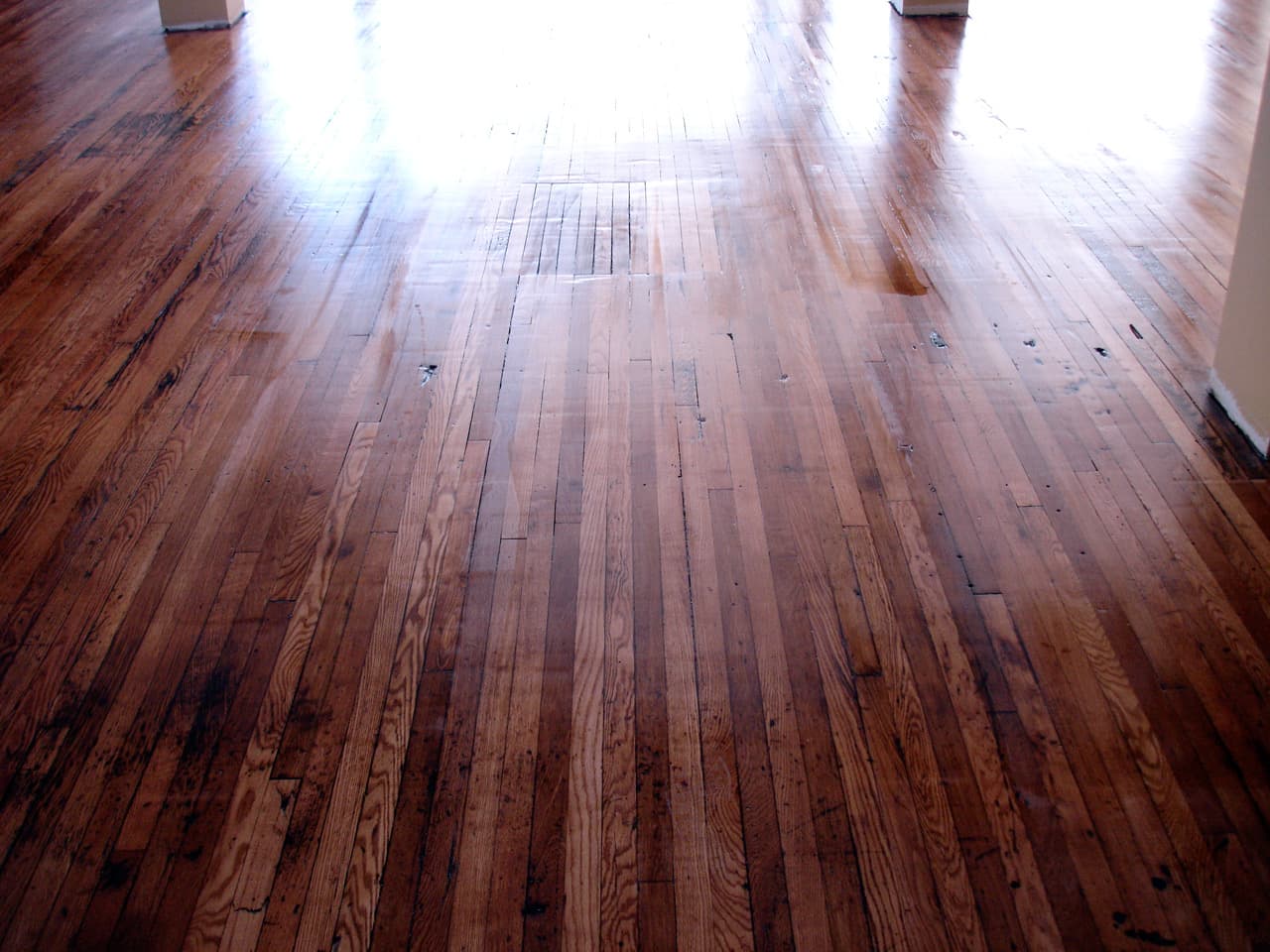
A finish does not stop this. Protective coatings can retard dimensional changes in wood but do not prevent them.[1] A freshly refinished floor still moves with the seasons.
What a normal gap looks like
Seasonal gaps are thin, fairly even from board to board, and strongest along the widest boards and the rooms with the driest heat. They narrow on their own when the air turns humid. A floor that gaps every winter and closes every summer is behaving normally.
Gaps that stay open all year, keep widening, appear in one patch, or come with cupped edges, soft spots or a bouncy feel are a different problem, usually moisture or movement underneath.
Measure the humidity
A small hygrometer, a few dollars at a hardware store, tells you what the room is doing. For hardwood, Shaw Floors advises: maintain consistent humidity levels (35-55%) to prevent warping.[2] That matches the comfort range from Virginia Cooperative Extension: people are most comfortable at 35% to 55% relative humidity.[3]
In the heating season, a humidifier can add back moisture when the reading drops below the range. Do not overshoot. Fungi (molds) grow in air over 60% relative humidity,[3] so aim for the middle of the range and keep it steady rather than chasing a high number.
Fix the gaps in the right order
Humidity comes first, filling second. If you pack a gap with filler in the dry months, the boards have nowhere to go when they swell, and the filler pops out or pushes the boards into a ridge. Give the floor a full season at steady humidity, then fill only what stays open. Many homeowners leave seasonal gaps alone, and that is a reasonable choice.
For gaps that remain, vacuum them clean and press in a flexible wood-floor filler made for the job, or glue in a thin sliver of matching wood. Wipe off the excess at once. A floor with gaps throughout is often better handled at its next sanding and finish; see how to refinish hardwood floors, what refinishing costs in Virginia and whether to refinish or replace.
Stop and call a pro if
- The boards are cupped, crowned or lifting. That points to moisture from below, such as a damp crawl space, a leak or wet slab, not winter air.
- The gaps are uneven, widening or limited to one patch. A flexing subfloor or a sagging joist can open seams along a line.
- The floor feels soft, springy or smells musty. Fungi (molds) grow in air over 60% relative humidity,[3] so find the moisture source before any cosmetic fix.
- Gaps stay wide after a full season of steady humidity. A flooring pro can say whether filling, repair or a new finish makes sense.
Getting help in Virginia
If the floor needs more than a humidifier, browse flooring answers and flooring pros on Loclis, or read why floorboards gap for the general case.
When you want a pro to look at it, describe the floor and local flooring businesses will quote it.
Common questions
- Are gaps in hardwood floors in winter normal?
- Usually yes. Dry wood undergoes small changes in dimension with normal changes in relative humidity, and drier air causes slight shrinkage.[^fpl-drying] Thin, even gaps that close in humid weather are normal.
- What humidity should I keep for hardwood floors?
- Shaw Floors advises a consistent 35-55%.[^shaw-hardwood] Stay below 60%, where fungi (molds) grow.[^vce]
- Will a new finish close the gaps?
- No. Protective coatings can retard dimensional changes in wood but do not prevent them.[^fpl-drying] Refinishing can include filling gaps, but the boards will still move with the seasons.
- Should I fill gaps in winter?
- It is better to wait. Filler packed in during the dry months can pop out or push boards into a ridge when they swell back. Fix humidity first and fill only the gaps that stay open after a full season.
- When is a gap a sign of real damage?
- When it stays open all year, keeps widening, shows up in one patch, or comes with cupping, soft spots or a musty smell. Those point to moisture or movement below the floor.
Sources
- [1] Wood Handbook, Chapter 13: Drying and Control of Moisture Content and Dimensional Changes (FPL-GTR-190), USDA Forest Service, Forest Products Laboratory. Checked October 27, 2026.
- [2] Hardwood Care, Shaw Floors. Checked October 27, 2026.
- [3] ENERGY SERIES: What about Moisture? (2908-9020), Virginia Cooperative Extension, Virginia Tech. Checked October 27, 2026.
Want a pro to handle it?
Describe the job once. Licensed local businesses send quotes, and you pay only when you book one.
Get a quote from a local pro