Why are my sprinkler heads not popping up after winter?
Usually the head is buried in grass or debris, the stem is stuck or damaged, or the zone is not getting enough water. Make sure the ground has thawed and the main valve is open, clear around the head, then run the zone by hand. One dead head means replace it. A whole dead zone points to the valve.
Free to ask. Local shops send quotes, and you pay only when you book one.
By Kasra Taheri, Founder, LoclisPublished
Researched and drafted with AI, then checked claim by claim against the sources listed below before it was published. Prices and rules change; the dates beside each source say when it was last checked.
Step by step
Read when to stop and call a pro, further down this page, before you start.
Step 1: Confirm the ground has thawed
Check that the soil is frost-free at least 12 inches deep before you run the system, because starting it on frozen ground can burst pipes.[1]
Step 3: Clear around the stuck heads
Trim grass and clear dirt, sand and rocks from around each head so the stem can rise.[1]
Step 4: Run the zone by hand
Set the controller to manual and run the zone on its own, then note which heads rise and which do not.[1]
Step 5: Sort one head from the whole zone
One or two dead heads point to those heads; every head dead in a zone points to the valve or the water supply.
Step 6: Check a dead head
Look for a cracked or chipped cap, a stem that will not rise or retract, and a damaged riser underneath.[2]
Step 7: Replace a damaged head
A head with a stem that will not pop up or retract properly usually needs replacing; see the guide linked below.
Step 8: Check the flow
If a whole zone is weak, look for a flow control stem turned down on the valve and for other areas using the same water at once.[4]
Step 9: Check the pressure
Use a pressure gauge on a hose faucet to see whether the system sits between 45 and 75 psi.[1]
Start with the simple causes
Heads that stay down in spring are usually one of three things: the head is buried, the stem or cap is damaged, or not enough water is reaching the zone. Rain Bird puts the winter risk plainly: "Pipes may have frozen, seals may have cracked".[1] Work from the easiest cause to the hardest, and treat one dead head differently from a whole dead zone.
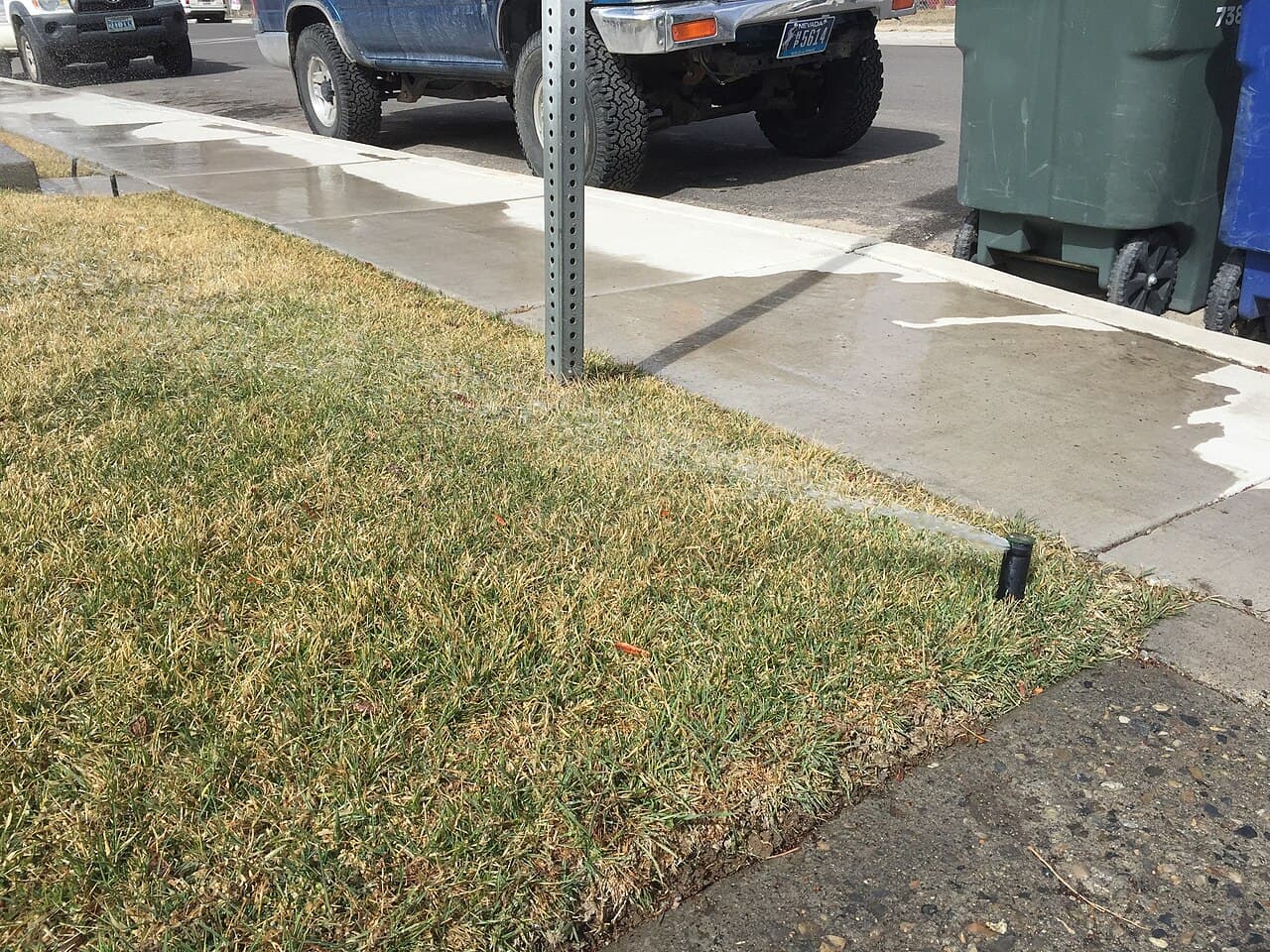
Is the ground thawed and the water on
Before blaming the heads, confirm the ground has thawed. Rain Bird tells homeowners to "check if the soil around your lawn is completely frost-free at least 12 inches deep".[1] It adds that "Starting your system when the ground is still frozen can cause pipes to burst".[1] If the soil is still hard, wait before you run the zones.
Then check the supply. Rain Bird's valve guide lists "System gate or master valve is not fully open."[4] as a cause of low flow. When you open the main valve, "Open the valve slowly and gradually to pressurize the system"[1] so a pressure surge does not damage pipes and valves. If you have just done that, heads may still be filling the lines, so give each zone a minute.
Buried or blocked heads
Heads that sat unused all winter get overgrown. Grass grows up around them, and "the sprays and rotors can accumulate dirt and can be covered or hidden by grass, sand, and rocks".[1] A stem that has to push through a mat of sod or a clump of soil may only rise partway, or not at all.
Clear the area around each head. Rain Bird's advice is: "Use pruning shears to trim around the head, allowing the stem to pop up easily."[1] Then run the zone again. The EPA's WaterSense program tells homeowners to "Look for heads that do not pop up fully or are tilted"[3] because they can spray the wrong areas, so a head that rises halfway is worth fixing, not ignoring.
A damaged or stuck head
If a head is clear but still down, look at it. Lawn mowers, snow clearing and frost heave all crack caps and bend stems. Rain Bird lists the symptom directly: "The sprinkler's stem will not pop up or retract properly."[2] The fix is usually to replace the head, and the manufacturer suggests you "Check the threaded riser or other connector under the head."[2] If the riser is damaged too, it needs replacing.
Flag the bad head with a stake or a pin flag as you go. The EPA gives the same advice: "If you find a broken head, place a flag next to the broken sprinkler so you will be able to work on it later."[3] Our guide to replacing a broken sprinkler head covers the swap, and how to keep heads from breaking covers the mower and the snowplow.
Not enough water reaching the zone
When every head in a zone stays down, or only rises weakly, look at the water instead. Rain Bird's troubleshooting guide for its zone valves names these causes of low flow: "Flow control stem is turned down."[4] and "Water pressure is being used elsewhere on the site."[4] A third: "Too many sprinklers are operating at one time."[4] If the flow control stem is the cause, the fix is to "Adjust flow control stem by turning counter-clockwise in order to allow the diaphragm to open further."[4]
Pressure matters too. "Most automatic sprinkler systems operate best between 45-75 PSI."[1] A gauge on a hose faucet tells you where you are. Low pressure from the street, a partly closed shut-off or a leak in the zone can all keep heads from rising fully.
Stop and call a pro if
- A whole zone does nothing and the valve is silent. Rain Bird's guide starts with "Controller not supplying power to valve."[4] and, if power reaches the controller but not the valve, concludes "then a power wire is broken or damaged".[4] Testing wires and solenoids is work for a pro.
- Water pools or bubbles up somewhere. The EPA notes that "Leaks can occur at the joints between sprinklers and the piping."[3] A wet patch between runs can mean a cracked pipe from winter.
- Several zones are weak and the valves look fine. Rain Bird lists "Obstruction in the mainline pipe."[4] among the causes, and finding it means opening the line.
- The pressure reads outside 45 to 75 psi. A regulator or supply problem is not a heads problem.
- The backflow device is cracked or leaking. Do not open or test it yourself; leave testing to a certified tester, covered in whether Virginia requires annual backflow testing.
Where to go next
If the heads come up after the fix, run through the rest of the season's list in how to turn your sprinkler system back on in spring, and if you would rather have someone do it, see what spring startup costs in Virginia. Browse more irrigation answers or irrigation businesses.
When you want a licensed contractor to find the fault, describe the sprinkler problem once and local irrigation contractors can quote it.
Common questions
- Is it normal for a few heads to stay down after winter?
- It happens often enough to plan for. Rain Bird notes that the sprays and rotors can accumulate dirt and can be covered or hidden by grass, sand, and rocks, and that pipes may have frozen and seals may have cracked over winter. Test every zone by hand in spring and flag any head that stays down.
- Could frozen ground be the reason?
- Yes. Rain Bird says to check that the soil is frost-free at least 12 inches deep before you start, and warns that starting the system on frozen ground can cause pipes to burst. If the ground is still hard, wait and test again before running the zones.
- One whole zone stays down but the others work. What does that mean?
- The problem is probably at that zone's valve or on its pipe, not at the heads. Rain Bird's valve guide lists a flow control stem turned down, a master valve that is not fully open, and an obstruction in the mainline among the causes of low or no flow. If the valve gets no power from the controller, that is a job for a pro.
- Does it matter how fast I open the main valve?
- Yes. Rain Bird says to open the valve slowly and gradually to pressurize the system, because a sudden surge of pressure can damage pipes and valves. Rushing it can also leave you chasing new leaks on top of the heads that did not rise.
- Should I replace a head or the whole zone?
- Start with the head. A stem that will not pop up or retract, or a cracked cap, is fixed by replacing that head, usually without touching the underground pipe. If several heads in one zone fail the same way, the cause is more likely water supply or the valve, and a licensed contractor can find it faster than swapping heads.
Sources
- [1] Is Your Sprinkler System Ready for Spring? Here's How to Get Started, Rain Bird Corporation (manufacturer). Checked October 28, 2026.
- [2] 3 Simple Repairs and Upgrades for Your Pop-Up Sprinklers This Spring, Rain Bird Corporation (manufacturer). Checked October 28, 2026.
- [3] Sprinkler Spruce-Up, U.S. Environmental Protection Agency, WaterSense. Checked October 28, 2026.
- [4] PEB & PESB Valve Installation and Operating Instructions Troubleshooting Guide, Rain Bird Corporation (manufacturer). Checked October 28, 2026.
Want a pro to handle it?
Describe the job once. Licensed local businesses send quotes, and you pay only when you book one.
Get a quote from a local pro