Why didn't my grass seed come up after overseeding?
Usually one of five things: the seed never reached the soil, the seedbed dried out or stayed soggy, a crabgrass or weed preventer applied in the last few months stopped it, it was sown in the wrong season, or it has not had time yet. Tall fescue needs 4 to 7 days to germinate and Kentucky bluegrass 10 to 14.
Free to ask. Local shops send quotes, and you pay only when you book one.
By Kasra Taheri, Founder, LoclisPublished
Researched and drafted with AI, then checked claim by claim against the sources listed below before it was published. Prices and rules change; the dates beside each source say when it was last checked.
Step by step
Read when to stop and call a pro, further down this page, before you start.
Step 1: Check the calendar
Count the days since seeding and compare them with the germination time for the grass on the seed label before deciding it failed.[3]
Step 2: Look at the soil
Scratch the surface in a bare spot; seed still sitting on top of thatch or hard soil means it never made contact with the soil.
Step 3: Review what was sprayed
List every weed or crabgrass product used on the lawn in the past four months and read each label for seeding restrictions.[4]
Step 4: Check the moisture
Feel the top half inch of soil each afternoon; it should stay moist, not dry and not puddled, until seedlings are up.[1]
Step 5: Note the light
Check whether the failed areas are in shade, where tall fescue and especially Kentucky bluegrass struggle and fine fescue does better.[3]
Step 6: Prepare the soil again
If the season still allows, loosen bare spots with a core aerator, dethatcher or hard rake before reseeding.[2]
Step 7: Reseed at the right rate
Sow roughly 10 to 15 tall fescue seeds per square inch on bare soil, about half that where some grass remains.[2]
When overseeding fails, the cause is usually one of a short list: the seed never touched the soil, it dried out or stayed soggy, a herbicide put down earlier blocked it, it went in at the wrong time of year, or it simply has not had long enough. Go through them in that order and you will usually find the answer by looking at the lawn and the shed shelf.
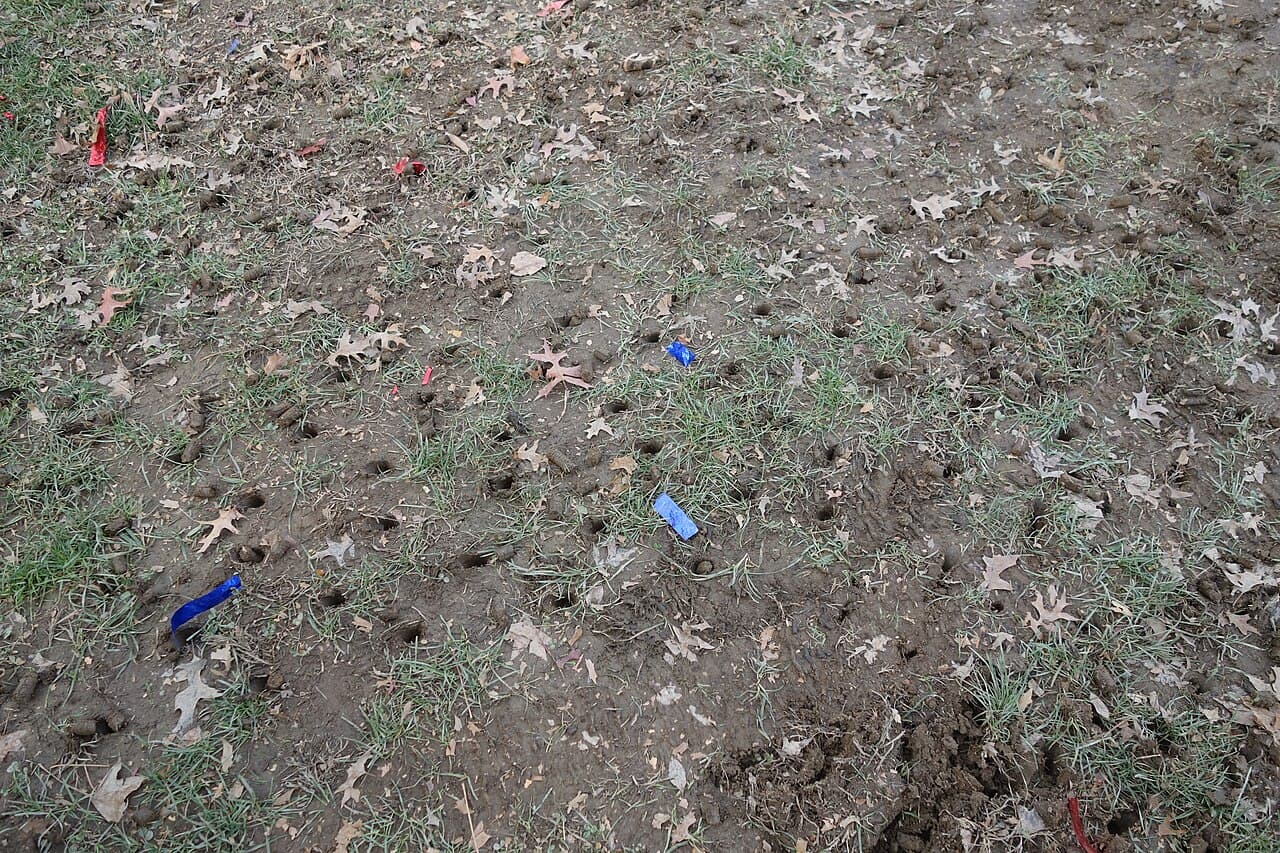
1. It has not had long enough
Grass seed is slower than people expect. Virginia Tech's turf publication says tall fescue and perennial ryegrass germinate in about 4 to 7 days, while most Kentucky bluegrass cultivars need 10 to 14 days.[3] Centipedegrass can take 14 to 28 days.[3] EPA's seeding guidance gives a similar range: grasses should emerge within 4 to 28 days of seeding.[7] Those times assume steady moisture and warm soil. A blend with bluegrass in it can look patchy for the first two weeks while the fescue comes up first.
2. The seed never reached the soil
This is a very common cause. Virginia Tech is blunt about it: "Simply applying seed over the top of an existing turf without any soil preparation usually does nothing more than feed birds and wildlife."[1] Seed has to sit in loose soil so that when the germinating seed sends down its root, the plant quickly has access to water and nutrients.[2]
Scratch the surface in a bare spot. If you find seed lying on thatch, on hard dry clay or in a layer of leaves, that is your answer. A single pass of an aerator on dry ground leaves too few holes to make a difference.
3. It dried out, or it stayed too wet
New seed needs constant moisture at the surface. Seedlings and lawns less than a year old have little to no drought tolerance,[6] and one dry, windy afternoon after germination can kill a whole flush of seedlings. Virginia Tech's advice is to water lightly and frequently until the seed has germinated, avoiding so much water that seed washes away or drowns.[1] Newly seeded lawns need more frequent watering for the first three to four weeks.[6]
Too much water does its own damage. Germinating seedlings are very susceptible to several soil-borne fungi that thrive in wet conditions,[1] and Virginia Tech recommends fungicide-treated seed to combat seedling damping-off.[1] Low spots where water sits after rain often fail even when the rest of the lawn fills in.
4. A weed preventer blocked it
Crabgrass preventers work by stopping seeds from germinating, and they cannot tell crabgrass seed from grass seed. Of the common products, Henrico County's Extension office warns: "All of these products, with the exception of Tupersan®, will also prevent turf grass seed from germinating."[5]
The wait can be long. Virginia Tech's pest management guide says seeding may be restricted for 60 to 120 days after a crabgrass preventer,[4] most herbicides require a 30-day wait before seeding,[4] and seeding must be delayed two to four months after a preemergence herbicide for annual bluegrass.[4] Over-application makes it worse: excessive rates of a preemergence herbicide can persist for several months and prevent seedling establishment.[4]
Check "weed and feed" bags too, and ask your lawn company for its application records if you have one. A uniform failure across a whole treated area, with seed still visible and unsprouted, points here.
5. Wrong season or wrong spot
For cool-season grasses, Virginia Tech's guidance is plain: "Late summer to mid-fall is the best time to establish cool-season turfgrass."[1] Spring seedings often come up and then lose to weeds and heat: seeding in fall avoids summer annual weeds, like crabgrass, choking out turfgrass seedlings.[4] Warm-season seed is the opposite: warm-season grasses should not be planted in the fall.[1]
Shade is the other location problem. Kentucky bluegrass has poor shade tolerance, tall fescue moderate shade tolerance, and the fine fescues the best shade tolerance of the cool-season grasses.[3] A sun mix under a maple usually thins out within a season.
6. The rate was off, or disease took the seedlings
Too little seed gives a sparse stand, but more is not better: too much seed is a waste of money and will similarly result in establishment failure.[2] Virginia Tech's visual guide is roughly 10 to 15 seeds per square inch for tall fescue on bare soil, and about half that where grass remains.[2]
If seedlings came up and then collapsed in a warm, wet September, suspect disease. Virginia Tech notes that the timing of severe gray leaf spot outbreaks has coincided with fall overseeding in recent years, and seedlings are more susceptible.[4] Some newer tall fescue varieties are resistant to gray leaf spot,[4] so check the cultivar when you buy seed.
Fallen leaves can smother late seedlings as well. Henrico's guidance is to rake or vacuum leaves in fall so they do not pack down the grass over winter.[5]
Fixing it
Once you know the cause, reseed only what failed, after fixing that cause. Loosen the soil again, sow at the right rate, then cover lightly with a quarter inch of compost or a light straw mulch, about one square bale of small grain straw per 1,000 square feet.[2] If it is already late October, the better plan is often to wait for next September. Our guides to aerating and overseeding step by step and the best time to overseed in Virginia cover the details, and bare patches in a lawn covers spots that fail year after year.
Stop and call a pro if
- A herbicide is the likely cause and you cannot tell from the labels how long to wait.
- The failed areas stay wet, or water runs across the lawn in rain; drainage comes first.
- Seed fails in the same spots every year, which points to compaction, buried debris or shade too deep for grass.
- The lawn is now mostly weeds and needs a full renovation.
Browse more lawn and landscaping answers, compare aeration and overseeding services, or find lawn businesses near Blacksburg. To have the reseeding done, describe the job once and local businesses quote it.
Common questions
- How long should I wait before deciding the seed failed?
- Allow the full germination time for every grass in the mix, with steady moisture, before judging. Tall fescue and perennial ryegrass usually show in 4 to 7 days and Kentucky bluegrass in 10 to 14, and cool weather slows all of them.
- Can I reseed right away?
- Only if the cause was moisture, seed contact or birds and there is still time before cold weather. If a preemergence herbicide is the cause, wait out the interval on its label, which can be months. Seeding again over the same barrier wastes the seed.
- Did birds eat my grass seed?
- They eat seed that sits on the surface. Seed pressed into aeration holes or loosened soil, or covered with a little compost or straw, is much less exposed.
- Why did the seed come up and then die?
- Seedlings have shallow roots and almost no drought tolerance, so a hot or windy day without water can kill them. Soggy soil invites damping-off fungi, and in a wet, warm early fall, gray leaf spot can hit seedlings hard.
- Why did seed grow in the sun but not under my trees?
- Shade. Tall fescue has only moderate shade tolerance and Kentucky bluegrass poor. Fine fescues tolerate shade best among cool-season grasses, and in deep shade a groundcover or mulch may work better than any lawn grass.
- Is it too late to reseed in late October?
- Usually for this year. Henrico County's Extension office puts the overseeding window at September 1 to October 15, so a late-fall failure is often best fixed next September.
Sources
- [1] Fall Lawn Care (430-520), Virginia Cooperative Extension, Virginia Tech. Checked October 27, 2026.
- [2] Cool-season Lawn Recovery Following Summer Stress (SPES-353), Virginia Cooperative Extension, Virginia Tech. Checked October 27, 2026.
- [3] Selecting Turfgrass for Virginia (SPES-748), Virginia Cooperative Extension, Virginia Tech. Checked October 27, 2026.
- [4] 2026 Pest Management Guide: Home Grounds and Animals, Chapter 5: Lawn (456-018, ENTO-634-E), Virginia Cooperative Extension, Virginia Tech. Checked October 27, 2026.
- [5] SMART Lawns: A Residential Lawn Care Program to Protect Water Quality (revised March 2022), Virginia Cooperative Extension, Henrico County Office. Checked October 27, 2026.
- [6] Summer Lawn Management: Watering the Lawn (430-010), Virginia Cooperative Extension, Virginia Tech. Checked October 27, 2026.
- [7] Stormwater Best Management Practice: Permanent Seeding (EPA-832-F-21-028FF), U.S. Environmental Protection Agency. Checked October 27, 2026.
Want a pro to handle it?
Describe the job once. Licensed local businesses send quotes, and you pay only when you book one.
Get a quote from a local pro