How much does lawn aeration cost in Virginia?
There is no official Virginia price list, so the real answer is a quote. Aeration is priced mostly by lawn size, the number of passes and whether seed, fertilizer and lime are included. Materials are small lines: in its March 2022 booklet, Henrico's Extension office priced one feeding at $3.19 to $10.75 per 1,000 square feet, and an overseeding uses 2 to 3 pounds of seed per 1,000.
Free to ask. Local shops send quotes, and you pay only when you book one.
By Kasra Taheri, Founder, LoclisPublished
Researched and drafted with AI, then checked claim by claim against the sources listed below before it was published. Prices and rules change; the dates beside each source say when it was last checked.
Step by step
Read when to stop and call a pro, further down this page, before you start.
Step 1: Measure the lawn
Measure the turf area in square feet, leaving out beds, driveway and house, since quotes and seed rates are per 1,000 square feet.
Step 2: Test the soil
Send a routine soil test to the Virginia Tech lab so lime and fertilizer are priced to what the lawn needs.[5]
Step 3: Work out the seed
Multiply the area by 2 to 3 pounds of seed per 1,000 square feet for an overseeding, more for bare patches.[1]
Step 4: Decide what is included
Choose aeration alone, or aeration with seed, starter fertilizer and lime, so every quote prices the same job.
Step 5: Ask for written quotes
Get two or three itemized quotes listing passes, seed variety and rate, materials and who waters afterward.
Step 6: Check any spraying licence
If the job includes weed control, confirm the company holds a VDACS pesticide business license.[8]
Lawn aeration in Virginia has no official price list, so the useful answer is what the price is made of and how to get a quote you can compare. Two things set most of it: the size of the lawn and what is included. Aeration alone is one visit with one machine. Aeration with overseeding adds seed, usually starter fertilizer and lime, and often a second pass or a separate seeder.
You can also do it yourself. Most lawn care operators offer renovation services with the specialized equipment, and do-it-yourselfers can often reserve core aerators and power seeders at equipment rental stores.[2] Which is cheaper depends on your lawn and your time.
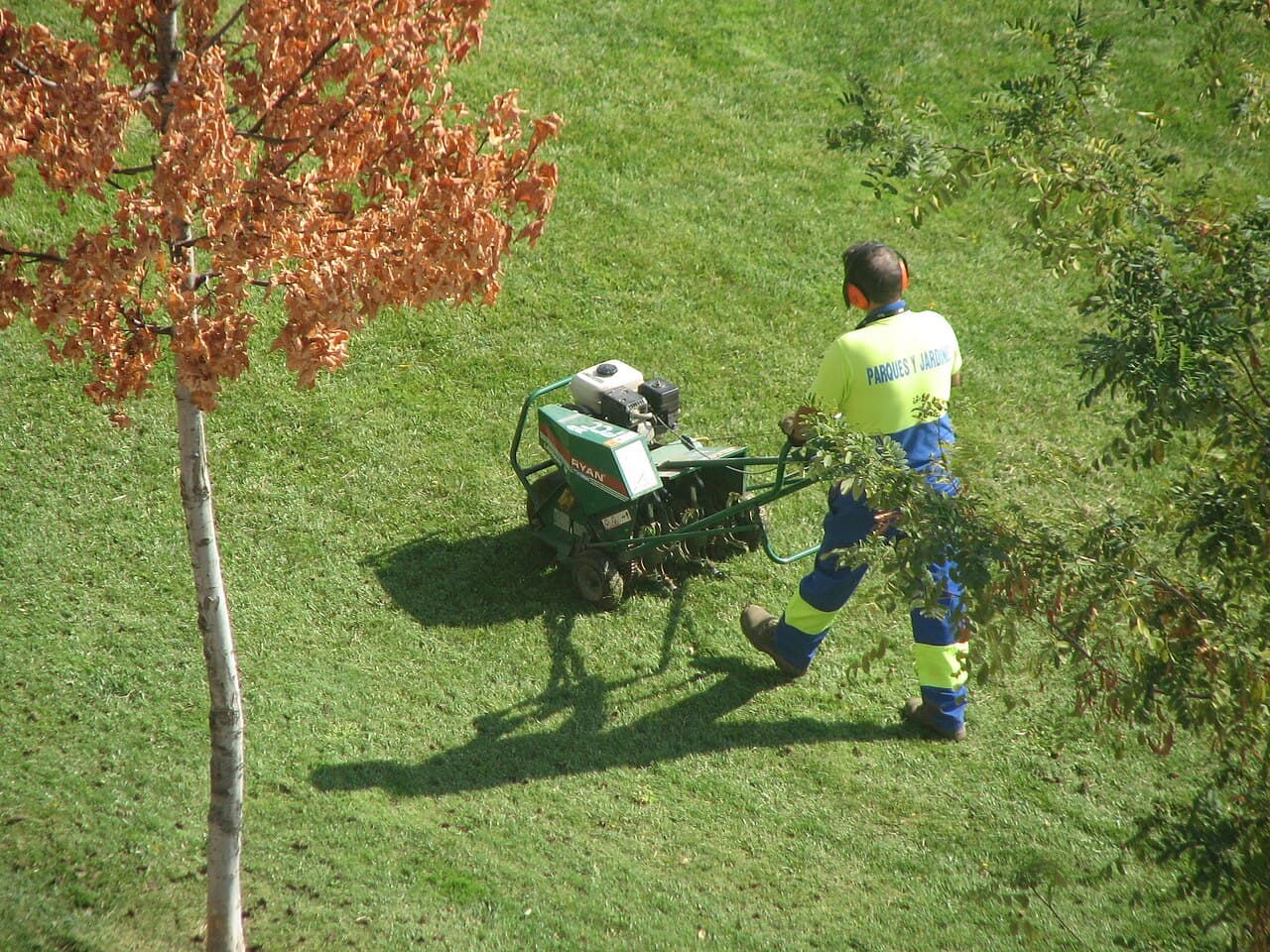
What drives the price
Lawn area. Companies often price per 1,000 square feet or by lot size, with a minimum charge. A small townhouse yard can cost more per square foot than a half-acre lot because the setup is the same.
Number of passes. One pass leaves widely spaced holes. Virginia Tech's turf specialist recommends making multiple passes with a core aerator before seeding,[2] and each pass is more machine time. Ask how many passes the price includes.
Seed. For overseeding a fescue lawn, Henrico County's Extension office uses 2 to 3 pounds of seed per 1,000 square feet,[1] so a 5,000-square-foot lawn needs about 10 to 15 pounds. Bare areas need a new-lawn rate, which Virginia Tech puts at 6 to 8 pounds of tall fescue seed per 1,000 square feet.[4] The seed itself varies most in price by quality: improved cultivars from Virginia Tech's recommended list cost more than generic blends, and fungicide-treated seed costs a few pennies more per pound and helps protect seedlings from damping-off.[3]
Spot work versus the whole lawn. Virginia Tech notes that most lawns will likely have problem spots of 50 to 150 square feet surrounded by healthy grass,[2] and seeding only those areas costs far less than treating everything.
Fertilizer and lime. In a cost comparison in its SMART Lawns booklet, revised March 2022, Henrico's Extension office worked out that one feeding of 0.9 pound of nitrogen per 1,000 square feet cost from $3.19 with a conventional 32-0-4 product to $10.75 with an organic 18-0-3 product, the highest of the products it compared.[1] Lime depends on your soil. A soil test settles both: at the Virginia Tech Soil Testing Lab, the routine test cost $10.00 per sample for Virginia residents when we checked on October 27, 2026.[5]
Site conditions. Slopes, tight gates, many beds and trees to work around, irrigation heads to flag, and hard dry soil that needs watering first all add time. A rocky or root-filled yard wears tines.
Season. Early fall is the busy season for cool-season lawns, so booking early often matters more than haggling.
What renting involves
A rental core aerator is a heavy machine. Bobcat's AE19 walk-behind, for example, weighs 260 to 270 pounds dry and 296 to 306 pounds with water in its drum, depending on the version,[6] with a 19-inch aeration width and a maximum aeration depth of 2.8 inches.[6] On top of the rental, add the vehicle or trailer to move it, help loading it, the seed and spreader, and your time for several passes. Our comparison of renting an aerator versus hiring a lawn service goes through it.
Costs that are not on the quote
Water. Newly seeded lawns need more frequent watering for the first three to four weeks,[7] and that usually falls to you. The other hidden cost is failure: seed that dries out or goes down after a crabgrass preventer has to be paid for twice. Our guide to why overseeded grass does not come up covers the usual causes.
What a good written quote includes
- The area in square feet and the price per 1,000 square feet or for the whole lawn.
- The number of aeration passes and the machine used.
- The grass species, cultivar names and pounds of seed per 1,000 square feet.
- Lime and fertilizer, with products and rates, ideally based on your soil test.
- Any weed control, the product and whether it affects seeding.
- Who waters, for how long, and what happens if areas fail to come up.
If any chemicals are part of the job, ask about licences. A pesticide business license is required for any person or business operating in Virginia that sells, stores, distributes, mixes, applies or recommends pesticides in exchange for compensation.[8] For fertilizer, VDACS's program requires certification for licensees and contractor-applicators engaged in the commercial application of fertilizers to non-agricultural lands.[9]
How often you pay depends on how the lawn is kept. Henrico's SMART Lawns program suggests fall aeration every year for a high-maintenance lawn and every two to three years for a regularly maintained one.[1]
Stop and call a pro if
- The lawn is mostly weeds or bare soil; price a full renovation instead, as in what it costs to redo a lawn.
- The yard needs grading or drainage work before seeding.
- A slope is too steep to hold a heavy walk-behind machine across safely.
- You want weed control applied, which needs a licensed pesticide business.
Browse more lawn and landscaping answers, see aeration and overseeding services, or find lawn businesses near Blacksburg. When you want real prices for your yard, describe the job once and local businesses quote it.
Common questions
- Is aeration priced per square foot or per visit?
- Either, depending on the company. Many price per 1,000 square feet or by lot size bracket, with a minimum charge because the crew and machine come out either way. Ask for the price of your measured area so quotes can be compared.
- Does overseeding cost much more than aeration alone?
- It adds the seed, usually a starter fertilizer, and a little more labor. Seed for an overseeding is 2 to 3 pounds per 1,000 square feet, so on most lawns the bigger difference is the seed quality and cultivar, not the quantity.
- Is renting an aerator cheaper than hiring?
- Often, for the rental itself, but add the truck or trailer to move a machine of roughly 300 pounds, your time for several passes, and the seed and spreader. Our guide on renting versus hiring compares the two.
- How often will I pay for aeration?
- Henrico County's SMART Lawns program suggests fall aeration every year for a high-maintenance lawn and every two to three years for a regularly maintained one. Overseed when the lawn is thin, not on a fixed schedule.
- Why do aeration prices vary so much between companies?
- Lawn size, number of passes, slopes, obstacles, seed quality and whether lime, fertilizer and weed control are bundled in. Two quotes only compare when they describe the same work.
Sources
- [1] SMART Lawns: A Residential Lawn Care Program to Protect Water Quality (revised March 2022), Virginia Cooperative Extension, Henrico County Office. Checked October 27, 2026.
- [2] Cool-season Lawn Recovery Following Summer Stress (SPES-353), Virginia Cooperative Extension, Virginia Tech. Checked October 27, 2026.
- [3] Fall Lawn Care (430-520), Virginia Cooperative Extension, Virginia Tech. Checked October 27, 2026.
- [4] Maintenance Calendar for Cool-Season Turfgrasses in Virginia (430-523), Virginia Cooperative Extension, Virginia Tech. Checked October 27, 2026.
- [5] Sample Submission: Virginia Tech Soil Tests and Their Cost, Virginia Tech Soil Testing Laboratory. Checked October 27, 2026.
- [6] AE19 Walk-Behind Aerator, Bobcat Company. Checked October 27, 2026.
- [7] Summer Lawn Management: Watering the Lawn (430-010), Virginia Cooperative Extension, Virginia Tech. Checked October 27, 2026.
- [8] Pesticide Business License, Virginia Department of Agriculture and Consumer Services. Checked October 27, 2026.
- [9] Certified Fertilizer Applicator (CFA) Program, Virginia Department of Agriculture and Consumer Services. Checked October 27, 2026.
Want a pro to handle it?
Describe the job once. Licensed local businesses send quotes, and you pay only when you book one.
Get a quote from a local pro