Why do weeds keep coming back in my lawn?
Usually because the lawn is thin enough to give the seed already in your soil room to sprout, or because each treatment missed that weed's season. Fall feeding, mowing fescue at 3 to 4 inches and a crabgrass preventer around mid-March address the first; identifying the weed and timing the herbicide address the second.
Free to ask. Local shops send quotes, and you pay only when you book one.
By Kasra Taheri, Founder, LoclisPublished
Researched and drafted with AI, then checked claim by claim against the sources listed below before it was published. Prices and rules change; the dates beside each source say when it was last checked.
Step by step
Read when to stop and call a pro, further down this page, before you start.
Step 1: Identify the weeds
Match each weed to a photo in the Virginia Tech weed identification guide, or ask your local Extension office, before you buy anything.[1]
Step 2: Test the soil
Send a soil sample for a lawn test every 3 to 4 years and apply lime or nutrients only as the results say.[1]
Step 3: Mow tall and often enough
Keep fescue at 3 to 4 inches and take off no more than one third of the blade at a time.[2]
Step 4: Feed in fall
On cool-season grass, apply fertilizer in September, October and November rather than loading up in spring.[2]
Step 5: Aerate if the soil is packed
If the lawn is on heavy clay or sees a lot of traffic, core-aerate it in fall while the soil is moist but not wet.[2]
Step 6: Overseed thin areas
Seed bare and thin patches in late summer to mid-fall so grass fills in before weeds do.[5]
Step 7: Time the crabgrass preventer
Apply a crabgrass preventer without fertilizer in mid-March, after the forsythias bloom and before the dogwoods do, and follow the label for any repeat application.[2]
Step 9: Walk the lawn after each treatment
Note what survived or came back so the next season's timing or product can change.
Weeds keep coming back for three main reasons: the lawn is thin enough to give seed already in the soil room to sprout, the weed is a perennial that regrows from its roots, or the treatment missed that weed's season. Spraying alone clears space for the next batch. A thicker lawn plus correct timing is what stops the cycle.
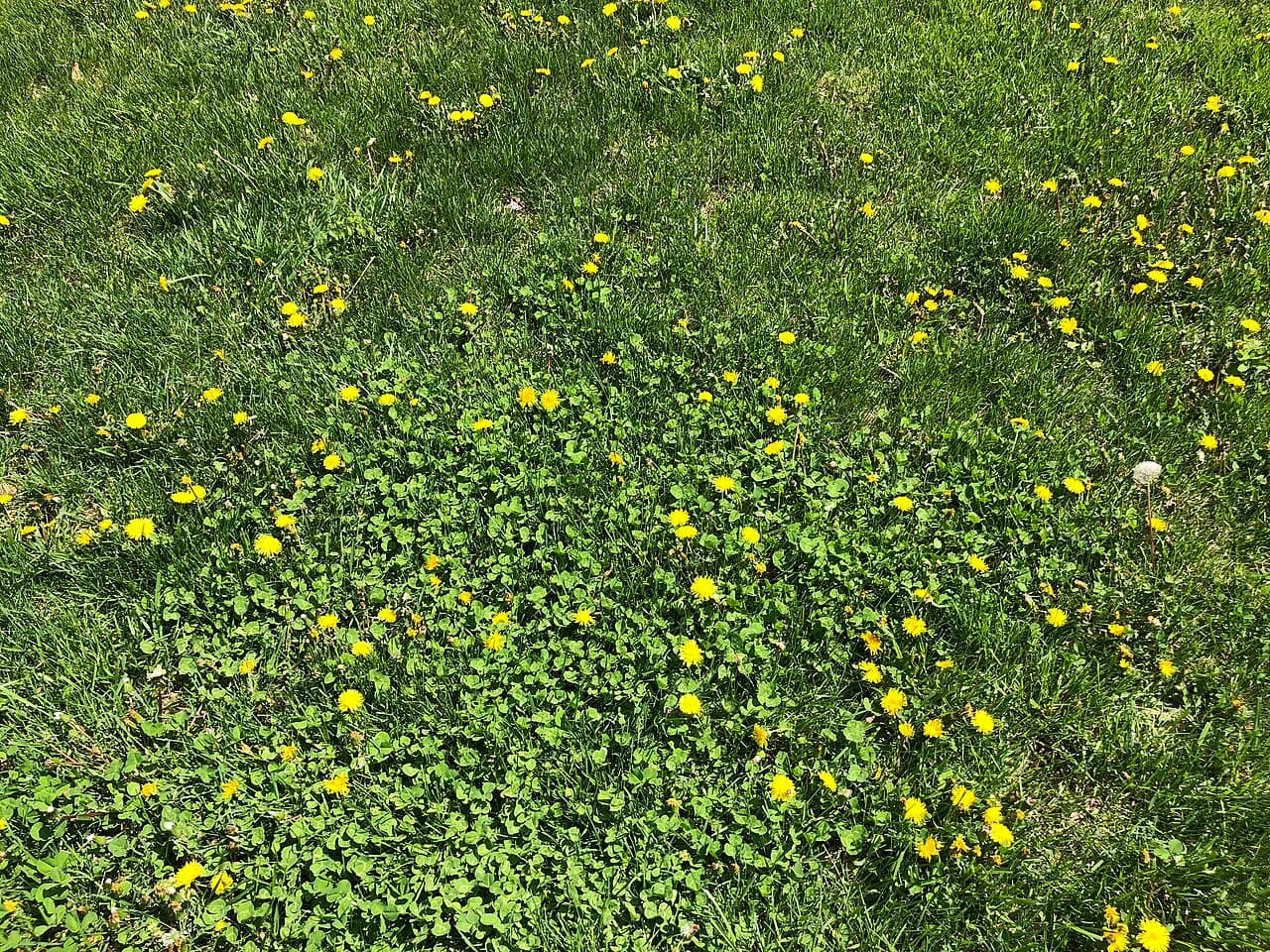
The seed is already there
Every lawn holds a bank of dormant weed seed, and bare or thin spots let it sprout. Your clippings are not the culprit: Virginia Tech's pest management guide says the seed in the soil far outnumber weed seeds deposited by mowing.[3] Keep returning clippings.
So the lasting fix is turf density. Strong roots also produce a denser, thicker turf that helps crowd out weeds.[2] For tall fescue, the grass on most Virginia lawns, that means feeding in the right season. Henrico County's Extension office says fall, not spring, is the best time to fertilize cool-season grasses like tall fescue,[2] and Virginia Tech warns that very aggressive spring nitrogen programs are counter-productive and increase the injury potential to lawns from summer disease and drought.[4] The full calendar is in our yearly lawn care schedule.
Mowing matters as much. Henrico County's Extension office sets the mowing height for fescue lawns at 3 to 4 inches and says to remove no more than one third of the leaf blade at each mowing.[2] Tall grass shades the soil and gives sprouting seeds less light.
Compacted soil is a quieter cause. Heavy clay or heavy traffic can compact soil, which makes it very difficult for turfgrass roots to survive, and fall is the best time to aerate.[2] Thin turf over hard soil is a weed nursery.
Every weed has its own season
A herbicide applied in the wrong month does nothing, and that is the most common reason people feel they are "always" fighting weeds.
- Crabgrass. It is a summer annual: it begins germinating when sustained soil temperatures are 55 degrees F and moisture is available.[6] The preventer goes on beforehand, after the forsythias are in bloom but before the dogwoods are, about March 15.[2] Many products require a second application.[2] Pair it with what to do about crabgrass if it is already up.
- Annual bluegrass. Henrico County's Extension office says annual bluegrass is controlled by a pre-emergent herbicide applied in late August.[2]
- Winter annual broadleaves. Winter annuals like henbit, bittercress and chickweed make their appearance in the fall, so Henrico County's Extension office says to treat them in October and November.[2]
- Summer annual broadleaves. Summer annuals like lespedeza and spurge should be treated in April and May.[2]
- Perennial grassy weeds. Perennial grassy weeds, such as wiregrass (common bermudagrass), are not controlled by pre-emergent herbicides.[2] Preventers cannot touch a plant that is already established.
One more catch: preventers and reseeding do not mix. All of these products, with the exception of Tupersan, will also prevent turf grass seed from germinating, and should not be applied when over-seeding.[2] Late summer to mid-fall is the best time to establish cool-season turfgrass,[5] so time your fall preventer and your seeding around each other.
Sprays need a growing weed. Weeds must be actively growing to achieve control with postemergence herbicides, and for cool-season weeds that means treating when temperatures are 50 degrees F or higher.[1] Spraying a dormant or drought-stressed weed wastes product.
Identify, then treat
Proper identification of the weed is critical in selecting appropriate control strategies.[1] A dandelion, a clump of crabgrass and a patch of clover need different answers; for the last, see how to get rid of clover. Take a photo or a sample to your local Extension office if the weed guide leaves you unsure.
Read the whole label before any application. Pesticide labels are legally enforceable, and all of them carry the statement that it is a violation of federal law to use the product in a manner inconsistent with its labeling.[7] Choosing a product labeled for both the weed and your grass type avoids most damage. Take care near trees and shrubs too: dicamba is soil-mobile and may move a short distance through the soil and be taken up by the roots of nearby trees and shrubs.[2]
Then test the soil. Virginia Tech recommends that you test home lawn soils every 3 to 4 years,[1] because a lawn short of lime or potassium stays thin no matter how often you spray.
Stop and call a pro if
- Weeds cover most of the lawn. When the turf is mostly weeds and bare soil, spot treatment will not fix it. Read how to fix a lawn that is mostly weeds and bare spots and consider a renovation.
- You cannot identify the weed, or the same weed returns in a few weeks after correct treatment.
- The weed is wiregrass or another perennial grass spreading through the lawn. Killing it takes a non-selective product, and glyphosate will kill any vegetation it touches, including desirable grasses.[2]
- The area is near trees, shrubs, a pond or a stream. Product drift or runoff is hard to control in these spots.
- You want someone else to apply the products. Under the Code of Virginia, no person may apply or recommend for use any pesticide commercially without a pesticide business license and the employment of a certified commercial applicator.[8] Our guide on whether a lawn care company needs a licence explains what to ask.
Getting help in Virginia
If you would rather hand off the timing, compare what a lawn treatment program costs in Virginia and whether treatment programs are worth it. Loclis lists local lawn pros: browse lawn and landscaping providers or more lawn and landscaping answers.
When you are ready, describe your lawn once and local pros quote it.
Common questions
- Do my grass clippings spread weed seed?
- Not enough to matter. Virginia Tech's pest management guide says the seed already in the soil far outnumbers weed seeds deposited by mowing, so you can keep returning clippings to the lawn.
- When should I put down crabgrass preventer in Virginia?
- Around mid-March, after the forsythias bloom and before the dogwoods do. Crabgrass starts germinating once sustained soil temperatures reach 55 degrees F, which comes earlier on the coastal plain than in the mountains. Many products need a second application, so follow the label.
- Why do weeds come back after I spray them?
- Three common reasons: the weed is a perennial that regrows from its roots, the spray went on when the weed was not actively growing, or the thin spot it left was refilled by seed already in the soil. Treating at the right time and thickening the lawn in fall deals with all three.
- Can I use crabgrass preventer when I am overseeding?
- Generally no. Henrico County's Extension office says that apart from Tupersan, these products also prevent turfgrass seed from germinating. Either skip the preventer on the seeded area or seed first and treat later, following your product label.
- Is it worth hiring a lawn company to keep weeds down?
- It can be if you want the timing handled for you. Compare what a program includes in our guides on whether lawn care treatment programs are worth it and what they cost in Virginia, and ask about the applicator's certification.
Sources
- [1] Maintenance Calendar for Cool-Season Turfgrasses in Virginia (430-523), Virginia Cooperative Extension, Virginia Tech. Checked October 28, 2026.
- [2] SMART Lawns (revised March 2022), Virginia Cooperative Extension, Henrico County Office. Checked October 28, 2026.
- [3] 2026 Pest Management Guide: Home Grounds and Animals, Chapter 5: Lawn (456-018, ENTO-634-E), Virginia Cooperative Extension, Virginia Tech. Checked October 28, 2026.
- [4] Lawn Fertilization in Virginia (430-011), Virginia Cooperative Extension, Virginia Tech. Checked October 28, 2026.
- [5] Fall Lawn Care (430-520), Virginia Cooperative Extension, Virginia Tech. Checked October 28, 2026.
- [6] Large (hairy) crabgrass, Digitaria sanguinalis: weed profile, Virginia Tech Weed Identification Guide. Checked October 28, 2026.
- [7] Introduction to Pesticide Labels, U.S. Environmental Protection Agency. Checked October 28, 2026.
- [8] Code of Virginia § 3.2-3924. Annual business license required, Virginia General Assembly (Legislative Information System). Checked October 28, 2026.
Want a pro to handle it?
Describe the job once. Licensed local businesses send quotes, and you pay only when you book one.
Get a quote from a local pro