How do I get rid of clover in my lawn?
Pull small patches after a rain, mow cool-season grass at three to four inches so it stays dense, and spot-treat what remains with a broadleaf lawn herbicide whose label lists clover. Spray when clover is actively growing, in calm, dry weather, and follow the label exactly.
Free to ask. Local shops send quotes, and you pay only when you book one.
By Kasra Taheri, Founder, LoclisPublished
Researched and drafted with AI, then checked claim by claim against the sources listed below before it was published. Prices and rules change; the dates beside each source say when it was last checked.
Step by step
Read when to stop and call a pro, further down this page, before you start.
Step 1: Confirm it is clover
Look for low, creeping plants with three-part leaves. Identify the weed before choosing a product, since some products work better on certain weeds.[2]
Step 2: Pull small patches
Pull by hand after a rain or a watering, and bag the plants instead of leaving them on the lawn.[1]
Step 3: Raise the mower
Mow tall fescue and other cool-season grasses at three to four inches so the turf stays dense.[1]
Step 7: Keep traffic off
Keep people and pets off the treated area until after rain or irrigation has washed it in.[1]
Step 9: Thicken the turf
Feed in September, October and November and overseed bare spots in early fall so clover has less room to return.[2]
Pull it, mow higher, and spot-treat what is left with a broadleaf lawn herbicide at the right time of year. That sequence clears most clover from a Virginia lawn without harming the grass, as long as you follow the product label and leave the sprayer for days that are mild, calm and dry.
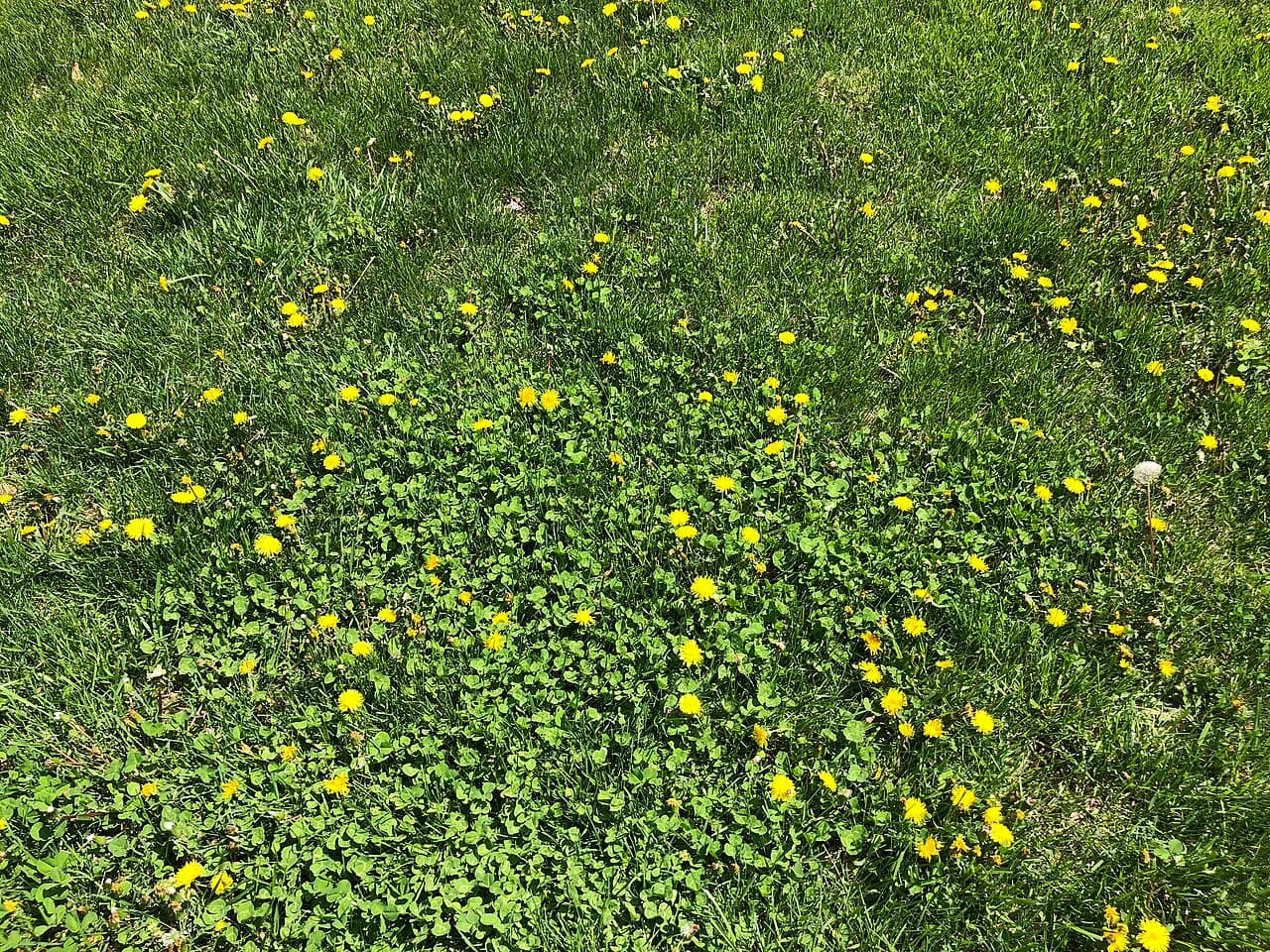
Start by pulling and by mowing higher
For a few patches, pull by hand. Wait until after a rain or a watering, because the plants come up more easily then.[1] Clover is a creeper, and Virginia Tech's Pest Management Guide says creeping weeds such as white clover are harder to pull than upright ones like dandelion or plantain.[1] Pulling will not finish the job, but even for creeping perennials it still limits how far the weed spreads.[1] Bag what you pull instead of leaving it on the lawn, because pulled plants can keep growing, and stem fragments from some weeds can take root.[1]
The longer-term fix is the mower. The same guide traces most lawn weed problems to one habit: "mowing the lawn too short."[1] For tall fescue and the other cool-season grasses common in Virginia, it recommends a minimum of three inches, and raising the blade to three to four inches in mid-to-late spring.[1] Grass that stays dense leaves clover less room to spread into.
Spot-treat what is left
Extension's guidance is to treat weeds with a postemergence broadleaf product, which kills them without harming the turf. The homeowner products most often sold contain 2,4-D, MCPP, MCPA, dicamba, triclopyr or carfentrazone, and the liquid forms are best for spot application.[2] Virginia Tech's guide lists MCPA and MCPP as postemergence broadleaf herbicides for clovers, and dicamba among those used on clover and other broadleaf weeds.[1] Read the front panel to confirm clover is on the label and that the product is safe for your grass, since some herbicides that are safe on one turfgrass injure another.[1]
Timing matters more than strength. Weeds must be actively growing for a postemergence herbicide to work, and for cool-season weeds Extension's calendar says to treat when temperatures are 50 degrees F or warmer.[3] Henrico County Extension's simple weed plan calls for spot applications of a broadleaf product in April and May and again in October and November, as needed.[2] Fall is the usual choice for stubborn perennials, since perennial broadleaf weeds are best treated in the fall when they are moving energy reserves to their roots.[1]
Expect patience. A chemical spray takes one to three weeks to work,[1] and a thick mat may need a second pass later in the season.
Apply it safely
The label is not a suggestion. Pesticide labels are legally enforceable, and every one carries the statement that it is a violation of federal law to use the product in a manner inconsistent with its labeling.[4] Beyond that:
- Skip windy days. Avoid spraying when wind is above five miles per hour if you can, because broadleaf herbicides can harm shrubs and flowers.[1]
- Skip soggy ground. Do not apply to saturated soil, since rain right after can carry the product into storm drains.[1]
- Watch your trees and shrubs. Dicamba is soil-mobile and can be taken up by the roots of nearby trees and shrubs, so follow the label closely near them.[2]
- Keep traffic off. Most herbicides are rain-fast within four to eight hours, and the guide advises keeping traffic off the treated area until after rainfall or irrigation.[1]
- Sweep strays back. If granules land on a sidewalk, sweep them back onto the lawn, and never pour leftovers down a drain.[1]
Keep clover from coming back
Clover fills in where grass is thin, so the real cure is density. Feed cool-season grass in the fall, not the spring: Extension recommends three feedings in September, October and November.[2] Excessive spring nitrogen reduces summer stress tolerance and can increase weed and disease pressure.[1] Overseeding bare spots in early fall also helps, as covered in when to overseed a lawn in Virginia.
Stop and call a pro if
- Clover covers most of the lawn. At that scale, a lawn renovation or a licensed treatment program may cost less in time than patching. See how to fix a lawn that is mostly weeds.
- You are not sure what the weed is. Virginia Tech's guide says proper identification is essential, and some broadleaf weeds need special active ingredients for complete control.[1]
- You do not want to apply pesticide yourself. Virginia Tech's rule of thumb is that if you do not enjoy working in your lawn, hire a professional.[1] A company that applies weed killer for pay needs a Virginia pesticide business licence and a certified commercial applicator.[5]
- The weeds are near a well, stream or storm drain, or the herbicide has to be applied near valuable shrubs and trees.
Getting help in Virginia
For the wider picture, read how to get rid of weeds in a lawn without killing the grass and browse more lawn and landscaping answers or the lawn and landscaping directory. To check a company's credentials first, see whether a lawn care company needs a licence.
When you would rather hand it off, describe the lawn once and local lawn care businesses quote it.
Common questions
- Is clover bad for a lawn?
- It is a weed by Extension's standards, listed among the broadleaf weeds the common lawn herbicides control. Many people tolerate a little of it; the question is whether it is crowding out grass that you want.
- Will a weed and feed kill clover?
- Henrico County Extension's weed plan says to consider weed and feed formulations in October and November, when broadleaf weeds are being controlled. Check that the label lists clover and your grass type, and follow its rate exactly.
- When is the best time to spray clover in Virginia?
- Spray when clover is actively growing and cool-season weeds are in air at 50 degrees F or warmer. Extension's plan puts spot applications in April and May and again in October and November, and fall is best for perennial broadleaf weeds.
- Why does clover keep coming back after I spray?
- Creeping weeds are hard to pull out completely, and a thin lawn leaves room for new plants. A second treatment and denser turf from fall feeding and higher mowing usually do more than a stronger product.
- Can I hand-pull clover instead of spraying?
- For small areas, yes. Pull after rain or irrigation and bag the plants. Because clover creeps, expect to repeat the job.
Sources
- [1] 2026 Pest Management Guide: Home Grounds and Animals, Chapter 5: Lawn (456-018, ENTO-634-E), Virginia Cooperative Extension, Virginia Tech. Checked October 27, 2026.
- [2] SMART Lawns (revised March 2022), Virginia Cooperative Extension, Henrico County Office. Checked October 27, 2026.
- [3] Maintenance Calendar for Cool-Season Turfgrasses in Virginia (430-523), Virginia Cooperative Extension, Virginia Tech. Checked October 27, 2026.
- [4] Introduction to Pesticide Labels, U.S. Environmental Protection Agency. Checked October 27, 2026.
- [5] Code of Virginia § 3.2-3924. Annual business license required, Virginia General Assembly (Legislative Information System). Checked October 27, 2026.
Want a pro to handle it?
Describe the job once. Licensed local businesses send quotes, and you pay only when you book one.
Get a quote from a local pro