Why does my garbage disposal smell?
Usually because food is building up in the grinding chamber or under the rubber splash guard, often helped along by grease. Scrub the underside of the splash guard, flush the unit with baking soda and warm water, grind ice and citrus, and run cold water longer after each use. A sewage smell from several drains is a trap or vent problem instead.
Free to ask. Local shops send quotes, and you pay only when you book one.
By Kasra Taheri, Founder, LoclisPublished
Researched and drafted with AI, then checked claim by claim against the sources listed below before it was published. Prices and rules change; the dates beside each source say when it was last checked.
Step by step
Read when to stop and call a pro, further down this page, before you start.
Step 1: Cut the power
Turn the disposal off and unplug it, or switch off its breaker if it is wired in, before you lift out the splash guard or look inside.[1]
Step 2: Clean the splash guard
If the rubber baffle lifts out, scrub its underside with a scouring pad, rinse it and press it back into the sink opening.[2]
Step 3: Look, do not reach
Shine a flashlight into the chamber and use long-handled tongs for anything stuck there, never your fingers.[1]
Step 4: Flush with baking soda
Plug the sink, fill it halfway with warm water mixed with 1/4 cup of baking soda, then plug the unit back in or switch its breaker back on, turn it on and pull the stopper.[1]
Step 5: Grind ice and citrus
Run a medium stream of cold water, turn the disposal on and feed in ice cubes mixed with lemon or lime wedges.[2]
Step 6: Degrease if it persists
If the smell comes back quickly, use a disposer cleaner or degreaser made for the purpose, following its label.[1]
Step 7: Check under the sink
Wrap dry paper towels around the sink flange, discharge elbow and dishwasher connector, drain a full sink and look for wet spots.[3]
Step 8: Test the other drains
If the smell is sewage rather than old food, Fairfax County advises adding water to seldom-used sinks, toilets and floor drains so their traps stay full.[4]
Step 9: Change the habit
Use the disposal often, run cold water for several seconds after grinding, and put grease in the trash instead of the sink.[1]
A smelly garbage disposal usually comes down to food that has not made it all the way down the drain. InSinkErator says "An odor from the disposer is usually a sign of food buildup,"[1] and food particles can collect in the grind chamber and in the baffle, the rubber splash guard in the sink opening.[1][2] Grease makes it worse by holding that food in place. Cleaning it out is a short job, and a couple of habits keep it from coming back.

The usual cause: food under the splash guard
Turn the disposal off first, and unplug it or switch off its breaker if it is wired in.[1] Then lift the rubber splash guard with your fingers and look at its underside. That is often where the film of old food is. InSinkErator's cleaning advice starts with taking out the sink baffle and cleaning its underside with a scouring pad,[2] then putting it back.
Do not put your fingers or hands into the disposal; turn the power off and use long-handled tongs or pliers to take anything out.[1] A flashlight shows you what is down there without reaching in.
Flush the chamber
With the splash guard clean, flush the grinding chamber. InSinkErator's manual gives a simple method: fill the sink halfway with warm water, mix in 1/4 cup of baking soda, then turn the disposal on and pull the stopper at the same time.[1] The rush of water carries loose particles down the drain.
Follow that with ice. InSinkErator suggests running a medium stream of cold water and feeding ice cubes mixed with lemon or lime wedges into the running disposal.[2] The ice scours the chamber and the citrus freshens it. InSinkErator also suggests grinding citrus peels to freshen drain smells.[1]
When grease is behind it
If the smell comes back within days, grease is the likely culprit. InSinkErator recommends a disposer cleaner, degreaser or deodorizer for odors caused by grease buildup.[1] Then stop feeding it grease. The King George County Service Authority explains why: "When mixed in small amounts with hot water, F.O.G. flows easily. But once it cools, it hardens inside pipes."[6] Fats, oils and grease coat the chamber and the drain, and food sticks to them.
Skip the chemical drain opener. InSinkErator lists caustic drain cleaners among the things never to put in a disposer.[1]
Habits that stop the smell coming back
- Run more cold water. InSinkErator says to turn on the cold water first, then the disposal, and keep the cold water running for several seconds after grinding is done to flush the drain line.[1]
- Use it regularly. Using the disposal often also helps clear scraps that would otherwise sit in the chamber.[2]
- Grind until it is quiet. InSinkErator says not to turn the disposal off until grinding is complete and you hear only the motor and water.[1]
- Keep grease out. Wipe greasy pans with a paper towel and put the towel in the trash.
There is a longer list in what you should never put down a garbage disposal.
Other places the smell comes from
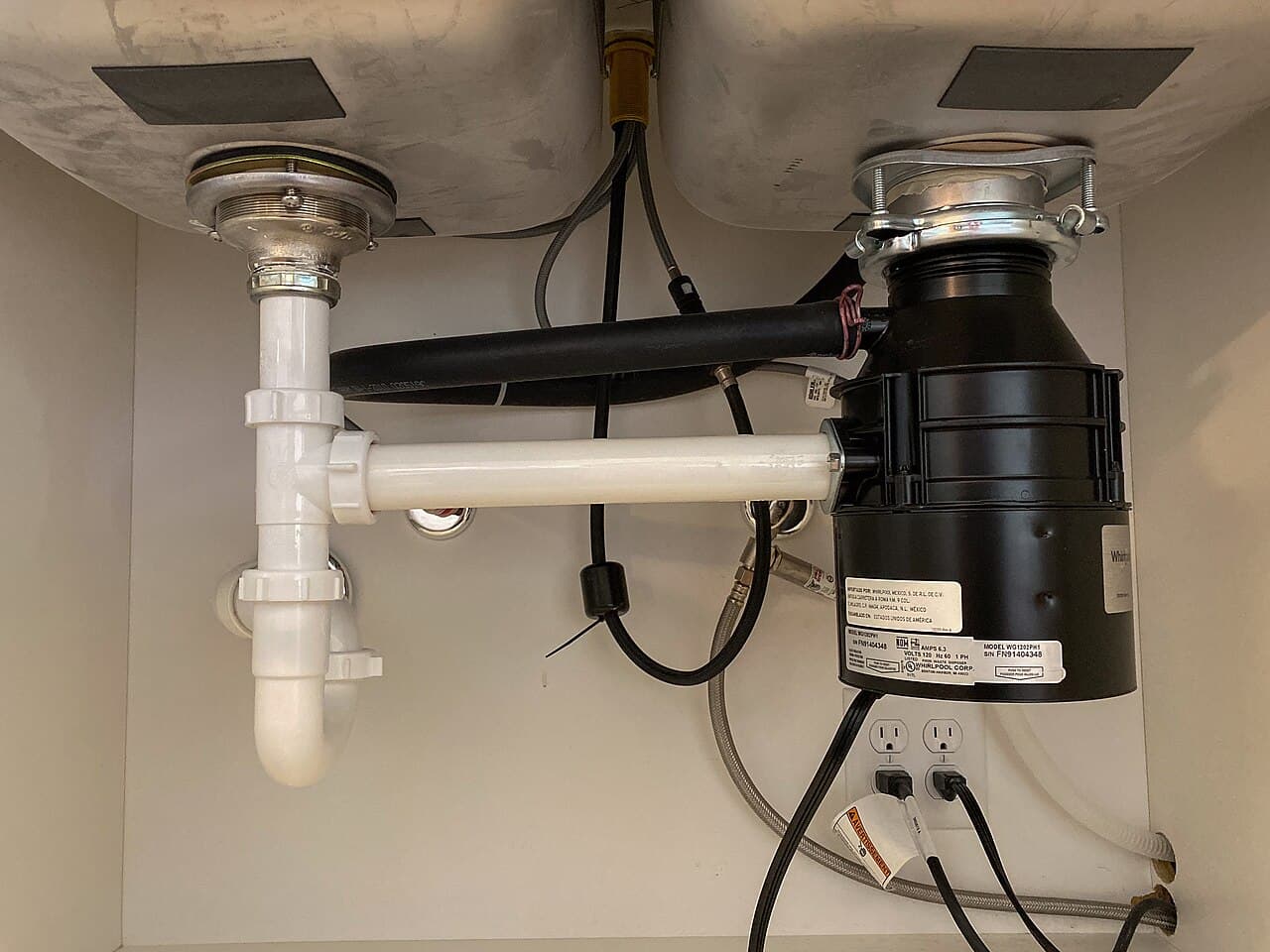
Standing water. If water stays in the disposal after it runs, the drain may not be sloped enough. InSinkErator says the drain line should slope at least 1/4 inch per foot from the disposal to the drain connection, and that standing water left in the unit can cause early corrosion or leaks.[1] Fixing the slope means changing the drain piping.
A slow leak. A drip at the mount or discharge tube can soak the cabinet floor, and that smells musty, not like food. To find it, fill the sink, wrap dry paper towels around the sink flange, the discharge elbow and the dishwasher connector, and let the water drain. If any towel is wet, the leak is at that connection.[3]
The dishwasher. If the dishwasher drains through the disposal, its food passes through too. Clean the dishwasher's filter as its manual directs.
Sewer gas. A sewage smell, especially one that also comes from other drains, is not the disposal. Fairfax County's wastewater staff say sewer gas can get into a home when a fixture goes unused long enough for the water in its trap to evaporate.[4] The county advises adding water regularly to seldom-used sinks, toilets and floor drains.[4] If the traps are full and the odor stays, the county says the problem could be the plumbing vent, which can be plugged by leaves or birds' nests.[4] The county notes that vent carries sewer gas out through the roof,[4] so clearing it is not a ladder job to take on yourself.
Natural gas. A rotten-egg smell in the kitchen may not be the drains at all. Virginia Natural Gas adds an odorant called mercaptan that gives natural gas "an odor often associated with rotten eggs."[5] If you smell gas, or the smell is near a gas range, water heater or furnace, leave the house straight away without touching light switches or anything that could spark, and call 911 and your gas utility once you are outside.[5] Do not try to find the leak yourself.[5]
For a smell that is in the tap water itself, see why water smells like rotten eggs.
Stop and call a pro if
- You smell gas, or a rotten-egg smell is near a gas range, water heater or furnace. Leave the house and call 911 and your gas utility from outside.
- The smell is sewage and stays after you have refilled every trap. A blocked vent or a drain problem needs a plumber.
- Water backs up into the other sink bowl or stands in the sink. See why a drain keeps clogging.
- The cabinet floor is wet, soft or stained. Find the leak and stop using the sink until it is fixed; fixing a leaking pipe under the sink covers the joints.
- You smell burning or hot plastic. Switch it off, unplug it or switch off its breaker, and have the unit or circuit checked before you use it again.
- The disposal hums, jams or trips the breaker as well as smelling. It may need repair or replacing.
Getting help on Loclis
Licensed plumbers on Loclis repair and replace disposals. Browse garbage disposal repair, garbage disposal services, find plumbers in Blacksburg, or see every plumbing answer.
If cleaning has not fixed it, describe the problem once and licensed local businesses quote it.
Common questions
- Can I pour bleach or drain cleaner down a smelly disposal?
- Skip the drain cleaner. InSinkErator lists caustic drain cleaners among the things never to put in a disposer, and asks owners to avoid harsh cleaning products. Baking soda and warm water, ice with citrus, or a cleaner made for disposals are the maker's suggested fixes.
- Why does it smell like sewage and not old food?
- A sewage smell that comes from several drains is usually sewer gas, not food. Fairfax County's wastewater staff point to traps that have dried out in seldom-used fixtures, and to plumbing vents plugged by leaves or nests. Refill the traps first; call a plumber if the smell stays. A rotten-egg smell near a gas appliance is different: leave the house and call 911 and your gas utility from outside.
- Does hot water help clean the disposal?
- Not while grinding. InSinkErator says not to use hot water when grinding food waste, though draining hot water between grinding is fine. Grease that melts in hot water hardens again further down the pipe as it cools.
- How often should I clean the disposal?
- Clean the splash guard and give it a baking soda flush whenever you notice a smell. Daily use with plenty of cold water, and keeping grease out of it, is what stops the smell coming back.
- Could the smell be coming from the dishwasher?
- It can. If the dishwasher drains through the disposal, food from the dishwasher passes through it too. Clean the dishwasher's filter as its manual directs, and check that the drain hose connection under the sink is tight and dry.
Sources
- [1] Badger Series Installation, Care and Use Manual, InSinkErator. Checked October 26, 2026.
- [2] FAQs: Garbage Disposal Support and Advice, InSinkErator. Checked October 26, 2026.
- [3] Leak Underneath: Existing Garbage Disposal, Moen. Checked October 26, 2026.
- [4] Wastewater Collection: sewer emergencies, odors and grinder pumps, Fairfax County, Virginia. Checked October 26, 2026.
- [5] Emergency Information, Virginia Natural Gas. Checked October 26, 2026.
- [6] Fats, Oils & Grease, King George County Service Authority, Virginia. Checked October 26, 2026.
Want a pro to handle it?
Describe the job once. Licensed local businesses send quotes, and you pay only when you book one.
Get a quote for Plumbing Repair