Why is my air conditioner blowing warm air?
Usually something is stopping the cooling cycle or the airflow: the thermostat is set wrong or its fan is on "On", the air filter is clogged, the indoor coil has frozen, the outdoor unit is dirty or not running, a blocked condensate drain has shut the system down, or refrigerant is leaking. The thermostat and filter are yours to check; the rest needs a licensed technician.
Free to ask. Local shops send quotes, and you pay only when you book one.
By Kasra Taheri, Founder, LoclisPublished
Researched and drafted with AI, then checked claim by claim against the sources listed below before it was published. Prices and rules change; the dates beside each source say when it was last checked.
This is a job for a licensed pro in Virginia
This page explains what the work involves, the permits, what a licensed pro does and what drives the cost. It does not give step-by-step instructions, because this work needs a licence, a permit or both, and doing it wrong can injure someone. Before you hire, check the licence on Virginia's DPOR record.
An air conditioner blows warm air when something stops the cooling cycle or starves it of air. Bryant lists the usual causes as a dirty air filter, incorrect thermostat settings, a refrigerant leak, a clogged condensate drain line, or a problem with the outdoor unit.[2] Two of those you can check in a few minutes without opening anything. The others need a licensed HVAC technician.
Start with the easy checks, because they are common and they cost nothing.
Causes you can rule out yourself
The thermostat is set wrong. Check that the thermostat is set to "Cool" and that the target temperature is below the current room temperature.[2] Then look at the fan setting. If the fan is set to ON, it will blow warm, unconditioned air even when the air conditioner isn't running.[4] Setting it to Auto lets the fan run only while the system is cooling. If a battery-powered thermostat's screen is blank, the batteries may need replacing.[4]
The air filter is clogged. ENERGY STAR lists one job for homeowners to do themselves: inspect, clean, or change air filters once a month.[5] Lennox puts the effect plainly: "A very dirty or misplaced air filter could restrict airflow so much that the fan continues to run but no cool air comes out of the vents."[3]
Vents are blocked. Bryant notes that furniture, drapes and rugs can block supply vents, and restricted airflow reduces cooling.[2]
Only some rooms are warm. If the air is cool in some rooms but not in others, there could be an issue with clogged or damaged ductwork, sending cool air into the attic instead of the living space.[3] That is a duct problem rather than a failed air conditioner, and an HVAC technician can test and seal the ducts.
If the thermostat is right, the filter is clean and the house is still warm, the cause is inside the equipment.
Causes that need a technician
A frozen indoor coil. If airflow is restricted or refrigerant is low, the indoor evaporator coil can freeze and stop the cooling.[1] You may see frost on the copper lines near the indoor unit or outside. Carrier's advice: "If you see ice, shut the system off immediately to prevent compressor damage."[1] Turn it off at the thermostat and call.
A dirty outdoor unit. The outdoor coil gets rid of the heat taken out of your house. Leaves, dirt and grass clippings on it get in the way of that heat transfer and cut cooling performance.[2] Keeping the area around the unit clear of debris helps.[2] For a complete coil cleaning, American Standard says to call an HVAC professional.[4]
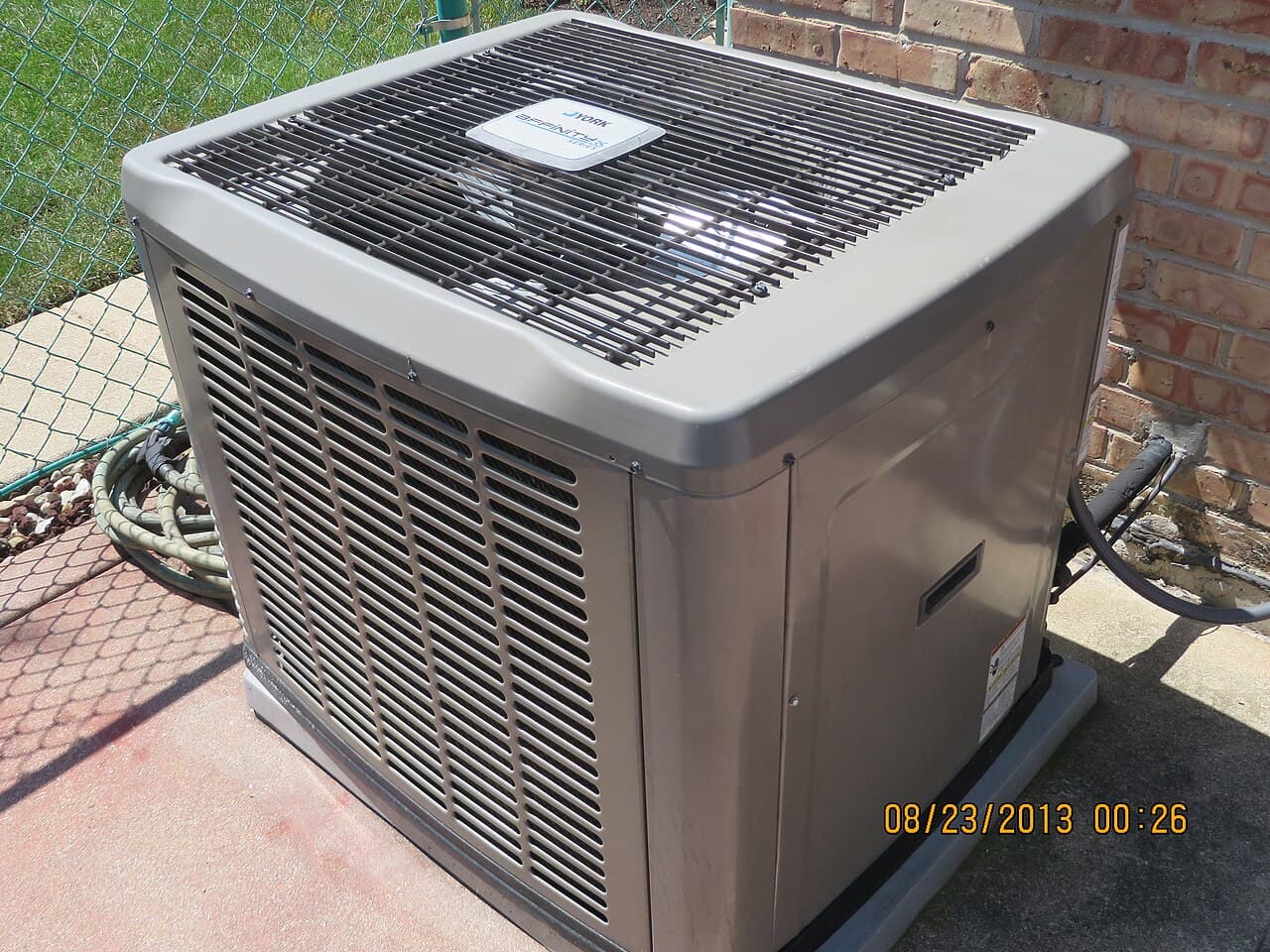
The outdoor unit is not running. Stand next to it while the system calls for cooling. When the indoor unit blows but the outdoor unit is not running, the air is not cooled.[2] A failed capacitor, fan motor, compressor or other electrical part can stop the outdoor unit from finishing the cooling cycle.[2] Bryant's guidance on those parts: "These repairs require professional diagnosis and should not be attempted by homeowners."[2] Your AC needs a dedicated circuit.[1] If the breaker trips again, leave the system off; repeated trips can point to an electrical or mechanical problem that needs professional service.[2][1]
A clogged condensate drain. Cooling pulls water out of the air and drains it away through a condensate line. When that line clogs, a float switch may shut the system down to help prevent water damage.[2] Standing water near the indoor unit or a system that stops on humid days are the signs. Loclis has a separate guide to clearing a clogged condensate drain line.
Low refrigerant from a leak. An air conditioner does not use up refrigerant the way a car uses fuel, so low refrigerant generally means a leak.[2] Bryant lists the signs as weak or warm airflow, ice on the refrigerant lines, hissing sounds, or longer cooling cycles.[2] If you think you have a leak, Lennox says to turn off your AC and call a professional, because refrigerant leaks can be toxic and make you sick.[3]
Refrigerant is not a homeowner job. EPA requires Section 608 certification to recharge an air conditioner.[6] EPA asks homeowners to have technicians locate and repair leaks instead of "topping off" a leaking system.[6] Be wary of cheap substitutes for older systems: R-22a has been falsely marketed as an HCFC-22 replacement; it is a flammable hydrocarbon blend and not an acceptable alternative for a home AC system.[6]
What to tell the technician
A clear description shortens the visit. Note whether the outdoor unit runs, whether the fan blows strongly or weakly, whether there is ice or water, any noise or smell, and whether a breaker tripped. Have the make and model of both units and the date of the last service ready. For what happens next, see what an AC repair technician checks first.
When to call a licensed pro
Call once the thermostat and filter are ruled out and the air is still warm, and straight away when:
- There is ice on the copper lines or the indoor coil.
- The outdoor unit is silent, hums without starting, or makes grinding or squealing noises.
- A breaker trips again after it is reset.
- You hear hissing near the lines or suspect a refrigerant leak.
- Water is collecting around the indoor unit.
Virginia's Code says no individual may do HVAC work as a tradesman without a licence, unless working under the supervision of a tradesman licensed in that specialty.[7][8] You can check a business on DPOR's License Lookup.[9] For what the repair is likely to cost, read what AC repair costs in Virginia.
Getting it fixed
Loclis lists DPOR-licensed HVAC businesses with their licence number and class. Look up HVAC businesses in Blacksburg or another town, see AC not cooling repairs, or read more heating and cooling answers.
If your air conditioner is blowing warm air, describe the problem once and licensed local HVAC businesses quote it.
Common questions
- Why is my AC blowing warm air only some of the time?
- A common reason is the thermostat fan set to "On" instead of "Auto": the fan keeps blowing between cooling cycles, so you feel unconditioned air when the compressor rests. If the fan is on Auto and it still happens, the outdoor unit may be stopping and starting, which needs a technician to diagnose.
- Should I turn off an air conditioner that is blowing warm air?
- If you see ice on the lines or the indoor coil, yes: Carrier says to shut the system off immediately to prevent compressor damage. Bryant also advises turning the system off until the problem is diagnosed and repaired, so a failing part is not run harder.
- Can I add refrigerant myself?
- No. EPA says Section 608 certification is required to recharge appliances, and refrigerant for stationary appliances is only sold to certified technicians or the companies that employ them. Low refrigerant also usually means a leak, which needs to be found and repaired.
- The indoor fan runs but the outdoor unit is silent. What does that mean?
- The air will not be cooled if the outdoor unit is not running. Common causes include a tripped breaker or a failed capacitor, fan motor or compressor. A breaker that trips again after it is reset, or any part inside the cabinet, is work for a licensed technician.
- Can a clogged drain make my AC blow warm air?
- It can stop the cooling. When the condensate line clogs, a float switch may shut the system down to help prevent water damage, and American Standard notes that some indoor units have a drain pan safety switch that shuts down the indoor unit if the water level in the pan rises. Signs include standing water, higher humidity or an unexpected shutdown. Loclis has a separate guide to clearing a clogged condensate drain line.
Sources
- [1] Troubleshoot an Air Conditioner: 6 Steps to Fix an AC Not Working, Carrier. Checked October 26, 2026.
- [2] Why Is My AC Blowing Hot Air?, Bryant. Checked October 26, 2026.
- [3] What to do when your AC is not blowing cold air, Lennox. Checked October 26, 2026.
- [4] Why is My Home AC Not Blowing Cold Air?, American Standard Heating & Air Conditioning. Checked October 26, 2026.
- [5] Maintenance Checklist, ENERGY STAR, U.S. Environmental Protection Agency. Checked October 26, 2026.
- [6] Homeowners and Consumers: Frequently Asked Questions, U.S. Environmental Protection Agency. Checked October 26, 2026.
- [7] Va. Code § 54.1-1129, Necessity for licensure, Code of Virginia, Virginia General Assembly. Checked October 26, 2026.
- [8] Va. Code § 54.1-1128, Definitions, Code of Virginia, Virginia General Assembly. Checked October 26, 2026.
- [9] License Lookup, Virginia Department of Professional and Occupational Regulation. Checked October 26, 2026.
Want a pro to handle it?
Describe the job once. Licensed local businesses send quotes, and you pay only when you book one.
Get a quote for HVAC Repair