Why is my boiler making banging noises?
Banging from inside a hot-water boiler can be kettling: water overheating in the heat exchanger and forming steam bubbles, whose pressure can cause a rumbling or banging noise. Scale restricting flow, low system pressure, trapped air, a pump problem or a faulty thermostat are the causes to check. Banging out in the pipes instead points to the piping. Either way it needs a licensed technician.
Free to ask. Local shops send quotes, and you pay only when you book one.
By Kasra Taheri, Founder, LoclisUpdated
Researched and drafted with AI, then checked claim by claim against the sources listed below before it was published. Prices and rules change; the dates beside each source say when it was last checked.
This is a job for a licensed pro in Virginia
This page explains what the work involves, the permits, what a licensed pro does and what drives the cost. It does not give step-by-step instructions, because this work needs a licence, a permit or both, and doing it wrong can injure someone. Before you hire, check the licence on Virginia's DPOR record.
Banging from inside a hot-water boiler can be kettling. Water overheats in the heat exchanger and forms steam bubbles, and the pressure they build can cause a rumble or a bang. Something is stopping water from carrying heat away fast enough, or letting it run too hot: scale, low pressure, trapped air, a pump problem or a faulty thermostat. Banging out in the pipes, away from the boiler, usually points to the piping instead. Either way, it is a job for a licensed technician.
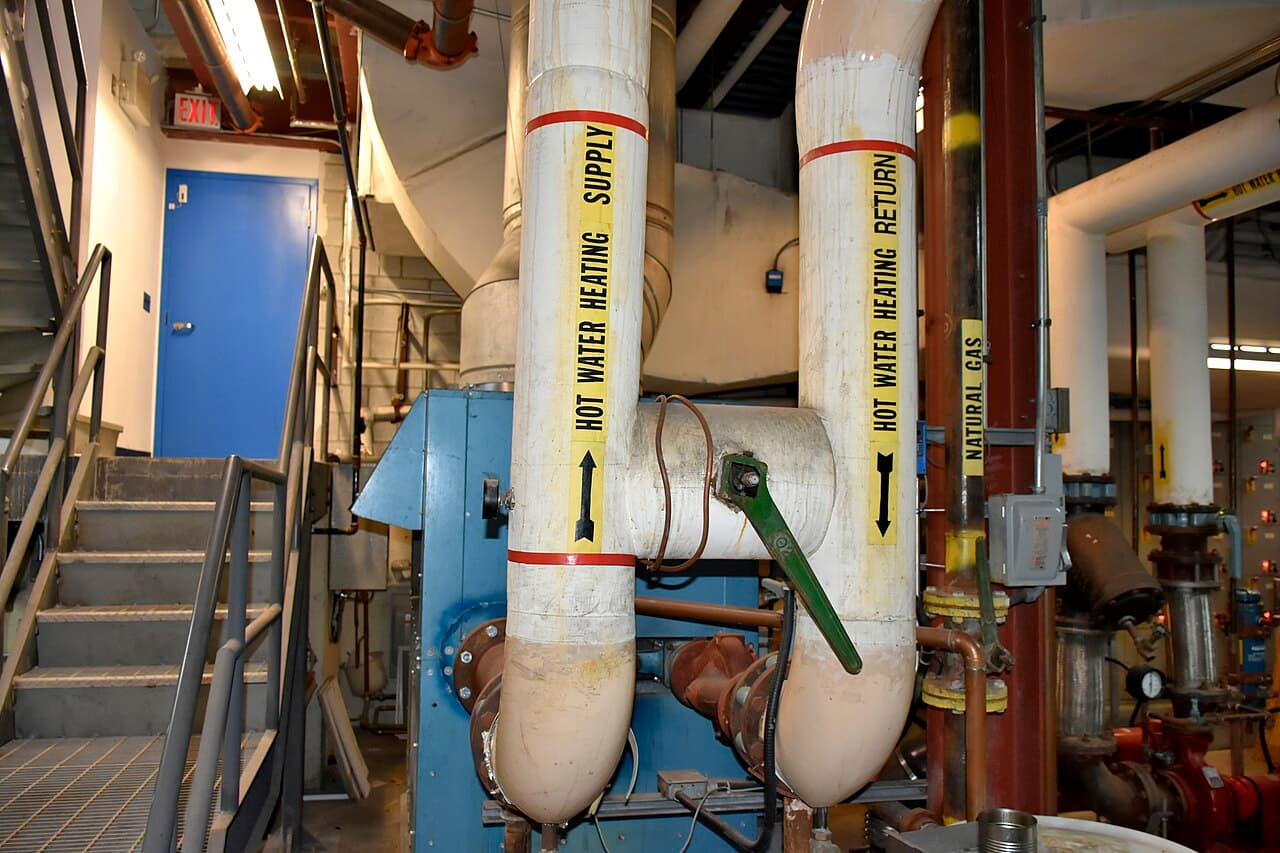
Kettling: water overheating in the boiler
Vaillant, a boiler maker, describes kettling as a noise like a kettle boiling, often described as rumbling, banging or gurgling, and typically caused by water overheating inside the boiler[1]. As the water heats, steam bubbles form, and the pressure they create makes the noise[1]. The causes Vaillant lists come down to water not flowing well enough through the heat exchanger, or a thermostat letting the water get too hot[1].
Why the water overheats
Scale in the heat exchanger
When hard water is heated, scale on the heat exchanger insulates it and obstructs the flow of water, which leads to overheating and bubbles[1]. Continual fresh make-up water shortens a boiler's life, because its minerals build up in the heat exchanger, reduce heat transfer and overheat it[2]. A sealed heating loop that holds the same water for years stays fairly clean. One that keeps topping itself up through a slow leak keeps bringing in new minerals.
That matters for Virginia homes on well or hard municipal water. Virginia Cooperative Extension explains that calcium and magnesium dissolve into groundwater as it passes through limestone and other rocks[5], and hard water leaves mineral scale inside pipes and in appliances such as water heaters[5]. Navien adds that in a hard-water area, a scale prevention system can extend a heating boiler's life by preventing lime and calcium deposits[4].
Low pressure or trapped air
If system pressure is too low, water cannot circulate well through the heat exchanger, which creates hot spots and steam[1]. Air in a boiler system can cause it to overheat or keep the pumps from circulating water[3], which is why every boiler system needs an air eliminator in the piping to remove air as water passes through[3]. If your gauge keeps dropping, our guide to why a boiler loses pressure covers the leaks and valves behind it.
A pump, valve or control problem
Blockages in the pipes or a problem with the pump restrict flow and overheat parts of the boiler[1], and a faulty thermostat or control can let the boiler heat water hotter than it should[1]. Modern boilers often catch this before you hear it. On one Navien model, the heat exchanger overheat codes tell the technician to check for proper system flow, and one of them also to clean the system filters[2].
Banging in the pipes, not the boiler
If the noise comes from the walls, floors or radiators rather than the boiler cabinet, the cause may be in the piping rather than the boiler. In hot-water systems, pipes often tick or knock as they expand and contract against joists or straps when they heat and cool. Hammering in a steam system is a different problem and needs someone who knows steam heating. Do not assume a noise from the pipes is harmless: describe where and when it happens and let a licensed technician look.
Why it is worth fixing soon
Kettling is not just noise. The high temperature and pressure of kettling strain the heat exchanger and can cause micro-cracks, corrosion and wear[1], and the boiler works harder to reach temperature, so it uses more energy[1]. Replacing a heat exchanger can be costly[1], and ignoring kettling can lead to repairs, inefficient operation and even safety risks[1]. See whether to repair or replace a boiler if yours is older.
What a technician does about it
You can help the diagnosis by noting when the noise happens (as the burner lights, mid-cycle or after it shuts off), where it comes from, and what the pressure gauge reads. Navien's manual asks owners to check the pressure and temperature gauge daily for signs of higher than normal pressure[2].
The technician then checks pressure, air removal and flow. Pressure that climbs too high as the boiler heats can come from an expansion tank that is waterlogged or undersized[2], and a relief valve that weeps may be reacting to over-pressure from a waterlogged or undersized expansion tank rather than being faulty itself[2]. If scale is the cause, Vaillant's advice is flushing the system with a descaling solution, done by an installer[1]. Navien notes that flushing the heat exchanger is a somewhat complicated procedure, done when combustion or performance shows a need[2], so it is a job for the technician. Afterwards, annual maintenance by a qualified technician can prevent kettling[1]; see how often a boiler should be serviced.
When to call a licensed pro
Call promptly if the banging is new or getting louder, the pressure gauge reads higher than usual, the relief valve is dripping or discharging, the boiler keeps locking out, or the bang comes from the burner as it lights. If you smell gas, do not try to light any appliance, do not touch electric switches or use a phone in the building, and call your gas supplier from a neighbor's phone, or the fire department if you cannot reach the supplier[2]. Worn or poorly adjusted boilers, and flues that are blocked, disconnected or leaking, are sources of carbon monoxide, an odorless and colorless gas[6]. If a CO alarm goes off, EPA's advice is to get anyone with symptoms out of the house immediately and seek medical attention; if no one has symptoms, ventilate the home with fresh air, turn off all potential sources of CO and have a qualified technician inspect your fuel-burning appliances and chimneys[7].
Virginia's tradesman rules define HVAC work to include the repair and maintenance of "steam and hot water heating systems, boilers"[8], and no one may work as a tradesman unless licensed[9]. Check any business on DPOR's License Lookup[10]. You can also browse more HVAC repair answers or find licensed heating businesses in Blacksburg.
If your boiler is banging, describe the noise once and get quotes from licensed boiler technicians.
Common questions
- Is a banging boiler dangerous?
- It should not be ignored. Vaillant warns that ignoring kettling can lead to repairs, inefficient operation and even safety risks, and that it strains the heat exchanger and can cause micro-cracks. Call a technician promptly, and sooner if the pressure gauge reads higher than normal or the relief valve is discharging. If you smell gas, leave the appliances and switches alone and call your gas supplier from a neighbor's phone.
- What is boiler kettling?
- Kettling is the rumbling, banging or gurgling a boiler makes when water overheats inside it and forms steam bubbles, like a kettle coming to the boil. The causes Vaillant lists are scale, low pressure, a faulty thermostat and circulation problems, and air in the system can do the same.
- Why does my boiler bang only when it starts up?
- Tell the technician exactly when it happens: the moment the burner lights, a few minutes into the cycle, or after it shuts off. Kettling comes from water overheating as the boiler heats, so a bang at the moment of ignition gives the technician a different starting point. Either way, call rather than wait for the next service.
- Will a power flush or descaler fix it?
- When scale is the cause, Vaillant suggests flushing the system with a descaling solution and having an installer do it. Navien describes heat exchanger flushing as a somewhat complicated procedure, so leave it to the technician, and ask what product they plan to use and whether your boiler's maker approves it.
- Can hard water in Virginia cause boiler noise?
- It can contribute. Groundwater picks up calcium and magnesium from limestone and other rocks, and that scale builds up where water is heated. A closed boiler loop stays fairly clean unless it keeps taking in fresh water through a leak, so a noisy boiler that also loses pressure deserves a leak check.
Sources
- [1] Boiler kettling: causes, effects, and solutions, Vaillant. Checked October 26, 2026.
- [5] Virginia Household Water Quality Program: Hardness in Household Water (publication 442-664), Virginia Cooperative Extension, Virginia Tech. Checked October 26, 2026.
- [6] Carbon Monoxide's Impact on Indoor Air Quality, U.S. Environmental Protection Agency. Checked October 26, 2026.
- [7] Protect Your Family and Yourself from Carbon Monoxide Poisoning, U.S. Environmental Protection Agency. Checked October 27, 2026.
- [8] 18VAC50-30-10, Definitions (Tradesman Rules and Regulations), Virginia Administrative Code, Virginia General Assembly. Checked October 26, 2026.
- [9] Va. Code § 54.1-1129, Necessity for licensure, Code of Virginia, Virginia General Assembly. Checked October 26, 2026.
- [10] License Lookup, Virginia Department of Professional and Occupational Regulation. Checked October 26, 2026.
Want a pro to handle it?
Describe the job once. Licensed local businesses send quotes, and you pay only when you book one.
Get a quote for HVAC Repair