Why is my ceiling cracking?
Most ceiling cracks are drywall movement: the board and joint compound expand and contract with humidity and temperature, and the weakest line gives, usually a taped seam or the corner where wall meets ceiling. Hairline cracks can be widened, filled, primed and repainted. A sag, a stain, or a crack that keeps widening or reopens means a pro should look.
Free to ask. Local shops send quotes, and you pay only when you book one.
By Kasra Taheri, Founder, LoclisPublished
Researched and drafted with AI, then checked claim by claim against the sources listed below before it was published. Prices and rules change; the dates beside each source say when it was last checked.
Step by step
Read when to stop and call a pro, further down this page, before you start.
Step 1: Read the crack
Note where it runs: along a seam, in the wall-ceiling corner, or out from a fixture, and check for a sag, stain or soft board.
Step 2: Rule out water
If the board is stained, soft or damp, stop and trace the leak first, because filling a crack over wet board only hides the problem.
Step 3: Test an old textured ceiling
If the ceiling is textured or the house is old, treat it as if it contains asbestos and do not sand or scrape it.[4]
Step 4: Open the crack
Widen it to remove loose material, making a groove a little deeper and wider than the crack.[2]
Step 5: Fill in layers
Press in joint compound or spackle, building deep cracks up one thin layer at a time.[2]
Step 6: Dry and sand each layer
Let each layer dry and sand it lightly before adding the next.[2]
Step 7: Prime
Prime the patch to seal the filler.[2]
Step 8: Repaint the whole ceiling
Paint wall to wall in the same sheen so the patch does not show.
Most ceiling cracks are movement, not damage
A hairline crack in a ceiling is usually the drywall following the house, not a sign that the house is failing. Seasonal swings in humidity and temperature make the board and the joint compound swell and shrink a little, and the weakest line gives. USG, the drywall maker, lists the usual cause of cracks over a joint as "structural movement and/or hygrometric and thermal expansion and contraction, or by excessively fast drying of joint compounds."[1] Hygrometric means moisture-driven, so a ceiling that cracks every winter and closes in summer is telling you about humidity.
Where the crack sits narrows down the cause:
- Straight line along a seam. The tape joint between two sheets. Often caused by structural movement and/or hygrometric and thermal expansion and contraction, or by excessively fast drying of joint compounds.[1] This is the most common crack and the easiest fix.
- In the corner where wall meets ceiling. USG describes this one as a crack that appears directly in the apex of wall-ceiling or interior angles where partitions intersect.[1] It can be caused by structural movement, improper application of joint compound in corner angle or excessive build-up of paint.[1] Layers of old paint in the corner are a real culprit.
- Radiating from a light fixture, vent or door frame. Edges of openings are weak points in the board, and cracks start there.
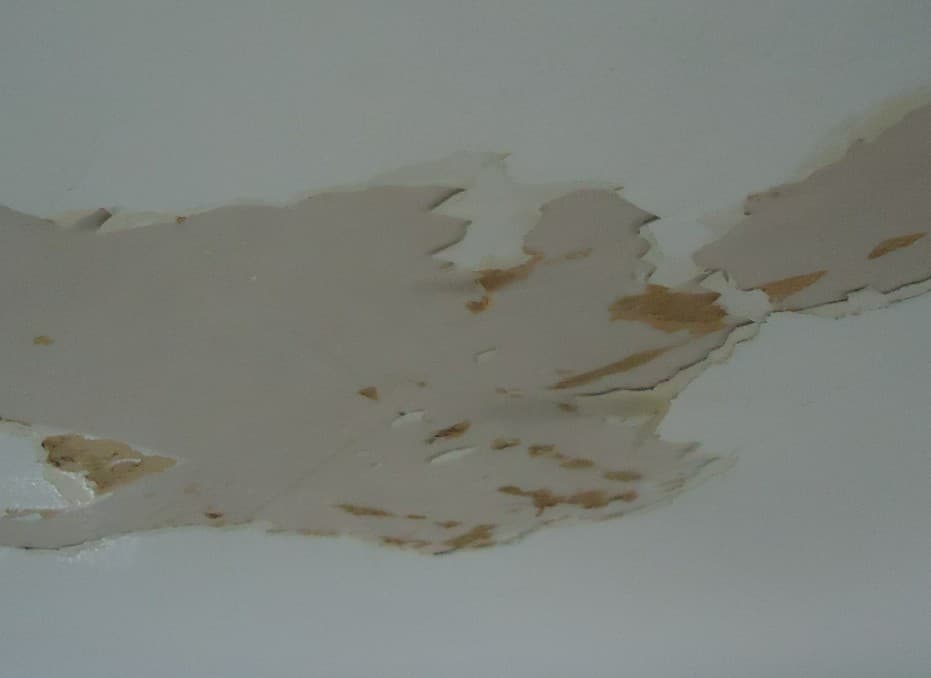
When the crack is a symptom of something else
Look at the whole ceiling, not just the line. Check whether the crack is wide, whether one side sits lower than the other, and whether the board near it is stained, soft or bowed.
A sagging ceiling is a different problem. Board sag occurs in ceilings, usually under high-humidity conditions,[1] and USG also lists too much weight from overlaid insulation[1] among the causes. Water is another: stains, paper bond failure, softness in board core or mildew growth are caused by sustained high humidity, standing water.[1] If you see brown rings, read how to fix a water stain on the ceiling before you patch anything, because filling a crack over a wet ceiling only hides the signal.
A crack that keeps reopening, grows wider, or comes with sticking doors and gaps at the wall points to movement in the framing. That is a job to have looked at, not patched.
How to repair a hairline ceiling crack
Painting over small holes and cracks can often make them more noticeable.[2] Fill first, then paint. Benjamin Moore notes that ceilings are notorious for cracks,[2] so expect to do this more than once in a house's life.
Open the crack to a solid edge: widen the crack to remove any loose material, creating a groove that is a little deeper and slightly wider than the original crack.[2] Fill it with joint compound or spackle. Deep cracks should be filled in gradually, building up the thickness of the filler material one layer at a time.[2] Make sure that each layer you are repairing is completely dry and sanded before adding another one.[2]
Priming seals the filler and helps prevent it from absorbing the new paint.[2] Then repaint the whole ceiling, wall to wall, with ceiling paint of the same sheen. A painted patch alone usually shows.
If the crack was along a taped seam and a plain fill opens again within a season or two, a taped repair is the lasting fix. That is the point to ask a drywall finisher, not to keep refilling.
Older ceilings: test before you sand
Sanding is dusty, and a ceiling in an older house may not be what it looks like. Textured paint and patching compounds used on walls and ceilings[5] are among the places EPA lists where asbestos may be found. EPA's rule: if in doubt, treat the material as if it contains asbestos and leave it alone.[4]
Old paint is a second reason for care. EPA says any renovation, repair or painting project in a pre-1978 home or building that has lead-based paint can easily create dangerous lead dust.[6] If the house predates 1978, have the paint tested before you sand or scrape it.
Stop and call a pro if
- The ceiling is sagging, bowed or soft. That means board or framing support, and sometimes water. It needs replacing or re-fixing, not filling.
- The crack is wide, uneven across its two sides, or reopens quickly. It suggests the framing or the house is moving. Have a drywall contractor or, for movement in the structure, an engineer look at it.
- There is mold or a stain. If there is mold growth in your home, you must clean up the mold and fix the water problem.[3]
- A textured ceiling needs scraping or sanding in an older house. Have it tested before it is disturbed.
- The cracks are fanning out from a light fixture or a vent. Do not open the fixture to look; wiring is an electrician's job.
Getting help in Virginia
Read what cracked or sagging ceiling repair costs in Virginia and who repairs ceilings, a drywall contractor or a painter to decide who to call. For more, browse home repair answers or drywall and ceiling repair businesses on Loclis, which lists Virginia businesses from the state's DPOR register with licence number and class.
When you are ready, describe the ceiling once and local businesses quote it.
Common questions
- Is a cracked ceiling dangerous?
- A hairline crack along a seam or in a corner usually is not; it is the drywall moving with humidity and temperature. A sag, a soft or stained spot, or a crack that is widening, uneven across its two sides or keeps reopening should be looked at by a drywall contractor, and structural movement by an engineer.
- Why does my ceiling crack every winter?
- Board and joint compound expand and contract with humidity and temperature. USG lists structural movement and hygrometric and thermal expansion and contraction among the usual causes of cracks over joints. A crack that opens and closes with the seasons points to that kind of movement.
- Why is the crack in the corner where the wall meets the ceiling?
- USG lists structural movement, improper application of joint compound in the corner angle, or excessive build-up of paint as causes. Thick old paint across the corner is a common reason it splits again after repainting.
- Can I just paint over a ceiling crack?
- Not usefully. Painting over small cracks can make them more noticeable, according to Benjamin Moore. Open, fill, sand and prime the crack first, then paint.
- Do ceiling cracks mean the house is settling?
- Sometimes, but most are cosmetic. A crack that keeps getting wider, comes with sticking doors or gaps at the wall, or runs in a diagonal across the ceiling is worth having a professional assess.
Sources
- [1] CGC Construction Handbook, Chapter 12: Problems, Remedies & Preventive Measures, United States Gypsum Company (USG). Checked October 28, 2026.
- [2] How to Fix Cracks and Holes in Walls, Benjamin Moore. Checked October 28, 2026.
- [3] A Brief Guide to Mold, Moisture and Your Home, U.S. Environmental Protection Agency. Checked October 28, 2026.
- [4] Protect Your Family from Exposures to Asbestos, U.S. Environmental Protection Agency. Checked October 28, 2026.
- [5] Learn About Asbestos, U.S. Environmental Protection Agency. Checked October 28, 2026.
- [6] Lead Renovation, Repair and Painting Program, U.S. Environmental Protection Agency. Checked October 28, 2026.
Want a pro to handle it?
Describe the job once. Licensed local businesses send quotes, and you pay only when you book one.
Get a quote for Home Repair