How do I fix a water stain on the ceiling?
Fix the leak first and let the ceiling dry for 24 to 48 hours. Scrape off loose paint, seal the stain with a stain-blocking primer, then repaint the whole ceiling. Ordinary paint alone lets the stain bleed through. Stop if the ceiling sags or feels soft, or if it has texture in an older home, which can contain asbestos.
Free to ask. Local shops send quotes, and you pay only when you book one.
By Kasra Taheri, Founder, LoclisPublished
Researched and drafted with AI, then checked claim by claim against the sources listed below before it was published. Prices and rules change; the dates beside each source say when it was last checked.
Step by step
Read when to stop and call a pro, further down this page, before you start.
Step 1: Fix the source of the leak
Have the leak repaired first; EPA says to fix plumbing leaks and other water problems as soon as possible.[1]
Step 2: Let the ceiling dry
Dry the area within 24 to 48 hours with a fan, and do not go on until it is completely dry to the touch.[1]
Step 3: Test the board
Press the stain and the board around it; if it is soft, bulging or sagging, stop and have it replaced.
Step 4: Check the texture and age
If the ceiling is textured or the house is old, treat the material as if it contains asbestos or lead paint and do not scrape or sand it.[4]
Step 5: Remove loose paint
Gently scrape off any peeling paint with a putty knife.[2]
Step 6: Seal the stain
Roll or brush a stain-blocking primer over the stain and a few inches past it, and add a second coat if it still shows through.[2]
Step 7: Repaint the ceiling
Paint the ceiling wall to wall with ceiling paint in the same sheen so the repair does not show.
Fix the leak first, let the ceiling dry completely, then scrape off loose paint, seal the stain with a stain-blocking primer and repaint the whole ceiling. Skipping the primer is the usual mistake: ordinary paint lets a brown stain bleed back through within days. EPA's guidance is plain about the order: "Fix plumbing leaks and other water problems as soon as possible."[1]
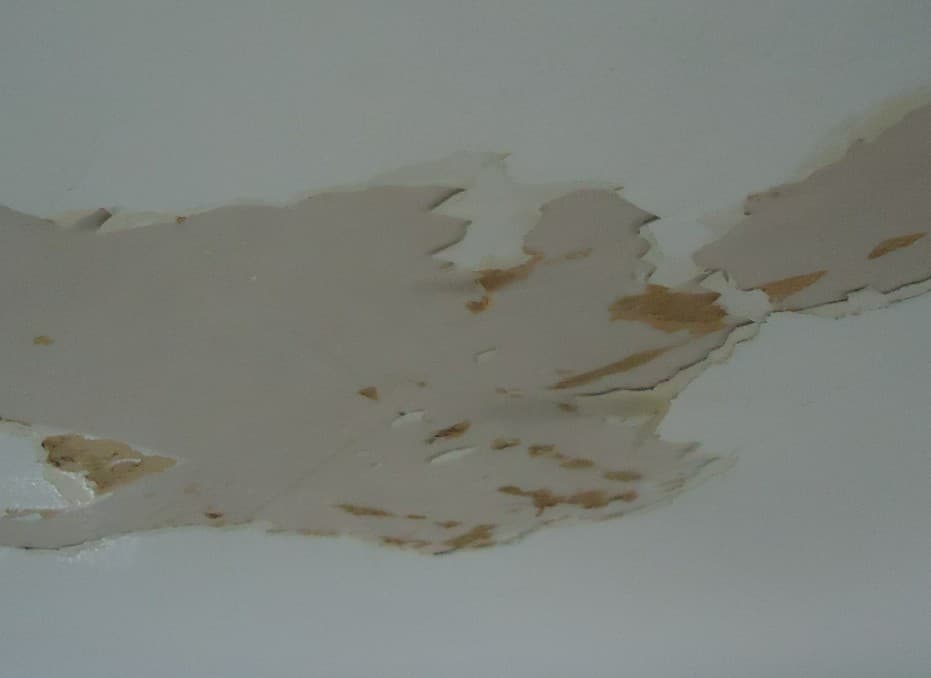
Before you touch the stain
A stain is the record of a leak, and it may not be the only one. Find and repair the source of water,[2] whether that is a roof, a pipe, a tub above or a condensation problem, before any cosmetic work. A ceiling that gets wet again will simply stain again, usually on top of your new paint.
Then give it time. It is important to dry water-damaged areas and items within 24-48 hours to prevent mold growth.[1] A small stain from a one-time drip will dry in that window with a fan moving air across it. A big or repeated one may take days, and a ceiling that is still damp to the touch is not ready for primer.
Press the stained area with a fingertip, then with a screwdriver handle. Firm, flat board is fine to repair. Board that is soft, bulging or sagging has lost its strength and has to be replaced, which is part of the cost question covered in how much it costs to fix a cracked or sagging ceiling. Sherwin-Williams puts it this way: repair any excessively damaged wood, plaster or drywall[2] before painting.
Check for mold and old materials
Look closely at the stain and, if you can, at the back of the board. Do not paint or caulk moldy surfaces.[1] If the stain has black or green growth on it, or a musty smell that returns after drying, the job has changed and the section below applies.
If your ceiling has a sprayed or popcorn texture, stop and read the next section before you sand or scrape anything. Painting over dry, intact texture is one thing; disturbing it is another.
Seal, then paint
Once the ceiling is dry and sound, remove any peeling paint[2] with a putty knife, working gently. Sand the edges smooth. Then seal the stained area with a primer designed to hold out water stains.[2] These are sold as stain-blocking primers. Brush or roll a coat over the stain and a few inches beyond it, let it dry, and look: if the brown ring still shows through, apply a second coat. A faint shadow can remain, but the primer is meant to keep it from bleeding into the topcoat.
Finish with ceiling paint. Painting only the patch usually shows as a lighter or glossier spot, so it is better to paint the whole ceiling, or at least a full section from wall to wall, using a roller and a brush at the edges. Use the same sheen as the rest of the ceiling.
If cracking or a small hole came with the stain, fill it before priming. Benjamin Moore advises that ceilings are notorious for cracks,[3] and its tip is to widen the crack to remove any loose material, creating a groove that is a little deeper and slightly wider than the original crack,[3] then fill and sand it. For a larger section of bad board, see how to repair water-damaged drywall.
Older ceilings: asbestos and lead
Textured paint and patching compounds used on walls and ceilings[5] are among the places EPA lists where asbestos may be found. EPA's rule of thumb: if in doubt, treat the material as if it contains asbestos and leave it alone.[4] Asbestos-containing materials may release fibers when they are disturbed, damaged, removed improperly, repaired, cut, torn, sanded, sawed, drilled or scraped.[4] A water-stained textured ceiling in an older house should therefore not be scraped or sanded as a first move.
Old paint raises a second issue. EPA says that any renovation, repair or painting project in a pre-1978 home or building that has lead-based paint can easily create dangerous lead dust.[7] Scraping and sanding peeling paint on an older ceiling is exactly that kind of work. Keep the area wet-cleaned and the dust contained, or hire someone trained to do it.
Stop and call a pro if
- The ceiling is sagging, soft or bulging. Wet board can fail without warning, and a sag needs the board removed and replaced, not covered over.
- The leak is not found or keeps coming back. Water from a roof, a pipe or a drain needs the right trade first; a painter cannot fix it.
- There is mold, more than a small patch, or the water was sewage or other contaminated water. EPA says that sewage or other contaminated water damage needs a professional with experience cleaning and fixing buildings damaged by contaminated water.[1]
- The ceiling is a textured one in an older home and the repair means scraping, sanding or cutting it. Get it tested by a trained and accredited asbestos professional before it is disturbed.
- Wiring or a light fixture is wet. Turn off the circuit at the panel and have an electrician look before using it.
Getting help in Virginia
A permit is not usually needed for the ceiling itself: Virginia's building code exempts replacement of Class C interior wall or ceiling finishes installed in Groups A, E, and I and replacement of all classes of interior wall or ceiling finishes in other groups.[6] The roof or plumbing repair behind the leak is separate work, so ask your locality's building department.
If you decide to hand it over, read who repairs ceilings, a drywall contractor or a painter and browse more home repair answers. Loclis lists Virginia businesses from the state's DPOR register with their licence number and class: see drywall and ceiling repair businesses.
When you are ready, describe the ceiling once and local businesses quote it.
Common questions
- Can I just paint over a water stain on the ceiling?
- Not with ordinary paint. The brown stain bleeds back through. Fix the leak, let the ceiling dry, then seal the stain with a stain-blocking primer before the topcoat, and add a second coat of primer if it still shows.
- How long should a ceiling dry before I paint it?
- EPA's target is to dry water-damaged areas within 24 to 48 hours to prevent mold growth. Paint only when the ceiling is completely dry to the touch, and wait longer if the stain was large or the room is humid.
- When does a ceiling stain mean the drywall must be replaced?
- When the board is soft, crumbling, bulging or sagging, or has mold on it. Firm, flat board with only a brown ring can usually be primed and painted. Sewage or other contaminated water is a job for a professional.
- Is a stain on a popcorn ceiling safe to scrape?
- Not until you know what is in it. EPA lists textured paint and patching compounds on ceilings as places asbestos may be found, and says to treat a material you are unsure about as if it contains asbestos and leave it alone.
- Do I need a permit to repair a ceiling after a leak?
- Usually not for the ceiling itself: Virginia's building code lists replacement of interior wall or ceiling finishes among the work exempt from a permit. The plumbing or roof repair that caused the leak is separate work, so ask your locality's building department.
Sources
- [1] A Brief Guide to Mold, Moisture and Your Home, U.S. Environmental Protection Agency. Checked October 27, 2026.
- [2] How to Fix Water, Smoke and Paint Stains, Sherwin-Williams. Checked October 27, 2026.
- [3] How to Fix Cracks and Holes in Walls, Benjamin Moore. Checked October 27, 2026.
- [4] Protect Your Family from Exposures to Asbestos, U.S. Environmental Protection Agency. Checked October 27, 2026.
- [5] Learn About Asbestos, U.S. Environmental Protection Agency. Checked October 27, 2026.
- [6] 13VAC5-63-80, Section 108 Application for permit (Virginia Uniform Statewide Building Code), Virginia Administrative Code, Virginia General Assembly. Checked October 27, 2026.
- [7] Lead Renovation, Repair and Painting Program, U.S. Environmental Protection Agency. Checked October 27, 2026.
Want a pro to handle it?
Describe the job once. Licensed local businesses send quotes, and you pay only when you book one.
Get a quote for Home Repair