Who repairs ceilings, a drywall contractor or a painter?
Hire a drywall contractor, or a licensed home-improvement contractor who does drywall, when board must be replaced, taped or textured, and a painter for a stain, peeling paint or a hairline crack on firm board. Fix any leak first. Virginia requires a license for work valued at $1,000 or more.
Free to ask. Local shops send quotes, and you pay only when you book one.
By Kasra Taheri, Founder, LoclisPublished
Researched and drafted with AI, then checked claim by claim against the sources listed below before it was published. Prices and rules change; the dates beside each source say when it was last checked.
Step by step
Read when to stop and call a pro, further down this page, before you start.
Step 1: Find out if there was a leak
Have any leak repaired first, and let the ceiling dry before you hire for the repair.
Step 2: Press the board
If the ceiling is soft, sagging or bulging, it needs a drywall contractor, not just a painter.
Step 3: Decide the trade
Board work, taping or texture is drywall; a stain, peeling paint or a hairline crack on firm board is painting.[1]
Step 4: Get three written bids
Give each business the same description and photos, and ask for at least three written bids.[4]
Step 5: Check the license
For work worth $1,000 or more, look the license up with DPOR and make sure it covers the work.[4]
Step 6: Ask about lead-safe work in older homes
In a house built before 1978, ask whether the crew is certified in lead-safe work practices.[5]
For most ceiling repairs, hire a drywall contractor, or a general handyman or home-improvement contractor who does drywall, and have a painter finish the paint. A painter alone is the right call only when the surface is sound and the job is a stain, a hairline crack or a repaint. The dividing line is simple: if board has to be replaced, taped or textured, that is drywall work; if nothing has to be rebuilt, it is painting.
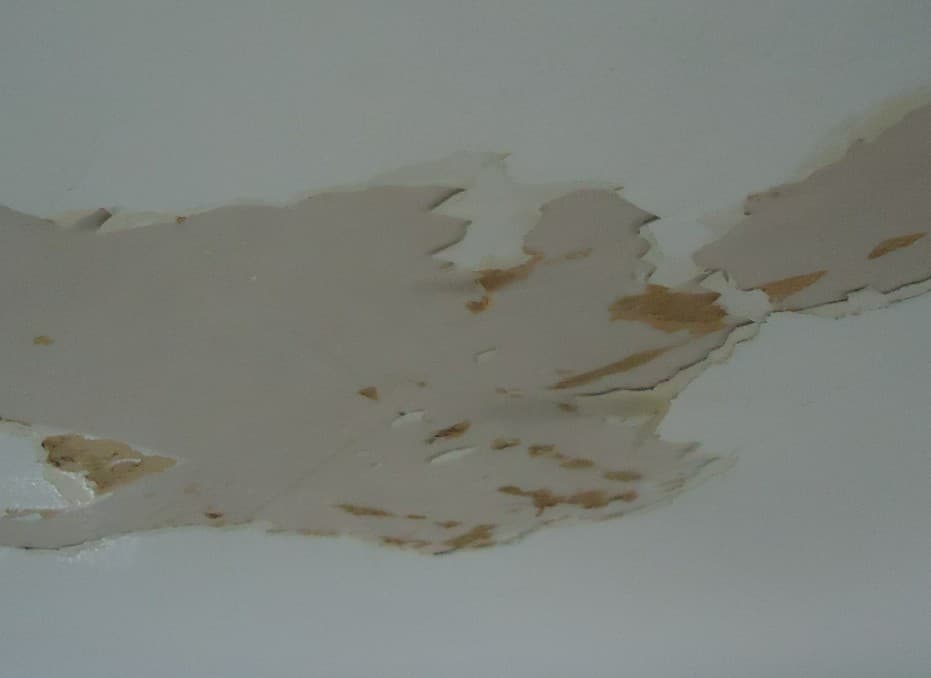
Who does what
Virginia's Board for Contractors defines the two trades separately. Drywall contracting (DRY) is the service that provides for the installation, taping and finishing of drywall,[1] which covers cutting out and replacing damaged ceiling board, taping the seams and coating them smooth. Painting and wallcovering contracting (PTC) covers surface preparation, caulking, sanding and cleaning preparatory to painting or coverings,[1] which covers priming, sealing a stain and painting.
Many one-company jobs sit in the middle. The Board's regulations add that the CBC and RBC classifications and the HIC and CIC specialties also provide for this function,[1] so a general or home-improvement contractor can legally take on both the drywall and the paint, and often does.
In practice:
- Drywall contractor: sagging, bulging or soft ceilings, water-damaged board, a large or recurring crack, a hole, or a ceiling that needs matching texture.
- Painter: a stain on firm, dry board, peeling paint, a hairline crack, or a ceiling that needs repainting after drywall work.
- Handyman or home-improvement contractor: a small combined job, such as a patch plus paint in one room.
- Roofer or plumber first: any ceiling damaged by water. The leak is the job, and the ceiling is the cleanup.
Fix the cause before you hire for the ceiling
A ceiling that sags or stains is usually telling you something is wrong above it. A drywall or paint crew will repair what they see and will not find a leak. Have the cause fixed, let the ceiling dry, then hire for the repair. See how to fix a water stain on the ceiling for the order of work, and how to repair water-damaged drywall for what a replaced section involves.
Licensing rules that decide who you can hire
DPOR's guide says that if the work is valued at $1,000 or more, a valid Virginia Contractor's License is required for the license category in which the contractor is to work.[4] No one may engage in contracting work in Virginia without a license,[2] and the Class C license covers a single job worth over $1,000 but less than $30,000.[3] Under $1,000, a painter or handyman needs no contractor license, but above it you should ask for one that fits the work, and look the number up in the DPOR license lookup before you sign.
Older homes add a second requirement. EPA says anyone paid to perform work that disturbs paint in housing and child-occupied facilities built before 1978 must be certified in lead-safe work practices.[5] That applies to a painter scraping a peeling ceiling as much as to a remodeler. Ask for the certification if your house is that old.
What to ask before you hire
DPOR's guide recommends at least three written bids using the same specifications, and not automatically accepting the lowest.[4] Give every business the same description and photos, and ask each:
- Who will do the drywall and who will do the paint, and are they one licensed business?
- Will the whole ceiling be repainted, so the repair does not show?
- Is texture being matched?
- What happens if water damage, mold or old material is found when the board is opened?
- Will the work be done with dust control and cleaned up?
DPOR advises a deposit of no more than 10% of the price or $1,000, whichever is less,[4] and get the price and scope in a written contract. For pricing, see what a cracked or sagging ceiling repair costs in Virginia.
Doing the simple part yourself
If the ceiling is dry and firm, a stain or a small crack is something you can handle: seal the stain with a stain-blocking primer, fill hairline cracks in thin layers, then paint the ceiling edge to edge. Hand the job over once board is soft, sagging or moldy, or when the ceiling is textured in an older house.
Stop and call a pro if
- The ceiling is sagging, bulging or soft. Keep clear of it and have a drywall contractor assess it.
- There has been a leak. Have the source repaired before anyone patches the ceiling.
- There is mold, or the water was sewage or other contaminated water.
- The ceiling is textured and the house is old. Have the material tested before anything is scraped or sanded.
- A bid asks for a large payment up front or the business cannot show a Virginia license for work over $1,000.
Getting help in Virginia
Browse drywall and ceiling repair businesses and more home repair answers. Loclis lists businesses from the state's DPOR register with their license number and class.
When you are ready, describe the ceiling once and local businesses quote it.
Common questions
- Can a painter fix a cracked ceiling?
- Yes, if the crack is a hairline in firm, dry board: filling, priming and painting is painting work. A wide or recurring crack, or board that is loose or sagging, is drywall work.
- Is a drywall contractor or a painter better for a water-stained ceiling?
- Neither first: fix the leak. After that, a stain on firm, dry board needs only a painter to seal and paint it. If the board is soft, bulging or sagging, a drywall contractor replaces it first.
- Does a ceiling repair in Virginia need a licensed contractor?
- DPOR's guide says a valid Virginia contractor license is required for work valued at $1,000 or more, in the license category that fits the work. Below that, no contractor license is required.
- Which license should a ceiling repair contractor hold?
- Virginia has a drywall contracting (DRY) specialty and a painting and wallcovering (PTC) specialty, and general and home-improvement classifications also provide for those functions. Look the number up in DPOR's license lookup.
- Does a painter need lead-safe certification?
- In homes built before 1978, EPA says anyone paid to perform work that disturbs paint must be certified in lead-safe work practices, including sole proprietors.
Sources
- [1] 18VAC50-22-30, Definitions of specialty services (Board for Contractors Regulations), Virginia Administrative Code, Virginia General Assembly. Checked October 27, 2026.
- [2] Va. Code § 54.1-1103, Necessity for license, Code of Virginia, Virginia General Assembly. Checked October 27, 2026.
- [3] Va. Code § 54.1-1100, Definitions (Contractors), Code of Virginia, Virginia General Assembly. Checked October 27, 2026.
- [4] What You Should Know Before You Hire a Contractor, Virginia Department of Professional and Occupational Regulation. Checked October 27, 2026.
- [5] Lead Renovation, Repair and Painting Program, U.S. Environmental Protection Agency. Checked October 27, 2026.
Want a pro to handle it?
Describe the job once. Licensed local businesses send quotes, and you pay only when you book one.
Get a quote for Home Repair