How much does it cost to fix a cracked or sagging ceiling in Virginia?
Virginia has no single price: a hairline crack is a small job, a sagging section means replacing board, and the cause, the amount of board, texture and repainting all move the quote. Get at least three written bids on the same description. Work of $1,000 or more needs a licensed contractor, and DPOR caps the deposit at 10% or $1,000.
Free to ask. Local shops send quotes, and you pay only when you book one.
By Kasra Taheri, Founder, LoclisPublished
Researched and drafted with AI, then checked claim by claim against the sources listed below before it was published. Prices and rules change; the dates beside each source say when it was last checked.
Step by step
Read when to stop and call a pro, further down this page, before you start.
Step 1: Find out why it cracked or sagged
Look for a leak, condensation, or heavy insulation above; USG lists humidity and too much weight from overlaid insulation among the causes of ceiling sag, and a sag or a wet ceiling is a job for a pro, not a patch.[1]
Step 2: Press the board gently
If it is soft, bulging or sagging, stop here and ask for quotes instead of repairing it yourself.
Step 3: Photograph the damage
Take wide and close photos and note the size of the area, so every bidder prices the same job.
Step 4: Fill a dry hairline crack
Widen the crack to remove loose material and fill it in layers, sand lightly, prime and paint.[2]
Step 5: Get three written bids
Ask for at least three bids on the same specifications.[9]
Step 6: Check the license
For work of $1,000 or more, look the contractor up with DPOR before you sign.[9]
There is no single Virginia price for a cracked or sagging ceiling, because the repair ranges from filling a hairline crack to taking down a section of board, and the cause matters more than the size. A quote is for the job, not the square foot. What moves it is the cause of the damage, how much board has to be replaced, how high and awkward the ceiling is, whether the ceiling is textured, and how much of it has to be repainted so the repair does not show. Get at least three written bids on the same description before you decide.
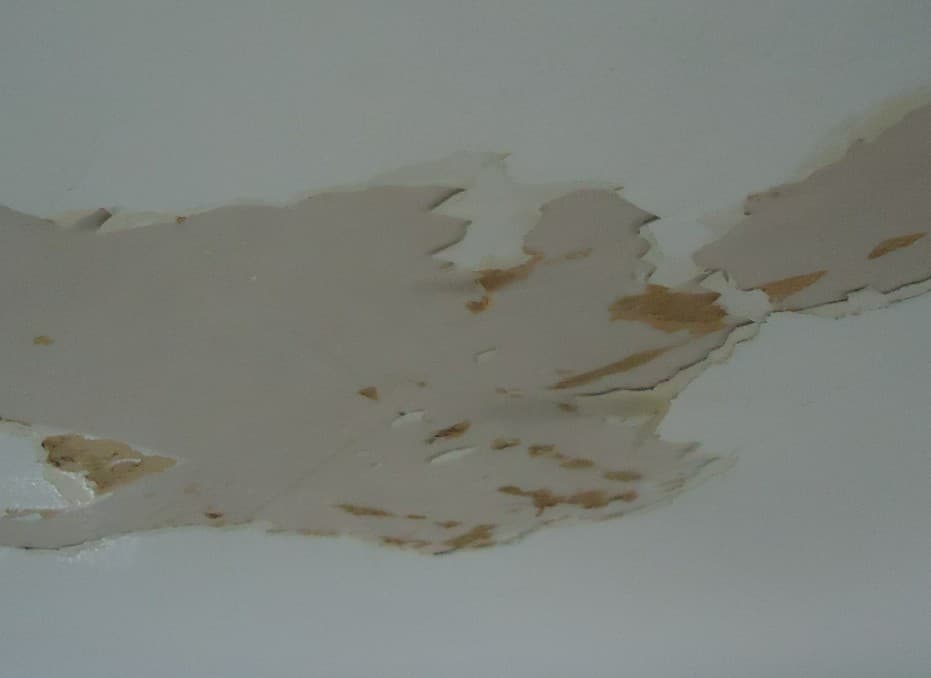
Cracked or sagging: two different jobs
A crack and a sag are priced differently because they mean different things.
A crack in a ceiling is usually cosmetic. USG's drywall handbook says joint cracking is often caused by structural movement[1] along with expansion and contraction as temperature and humidity change. A hairline crack along a taped seam is a small job: widen it, fill it, prime and paint. Benjamin Moore notes that ceilings are notorious for cracks,[2] which is why a repair bid usually includes repainting the ceiling and not just the crack.
A sag is a warning. USG's handbook says board sag occurs in ceilings, usually under high-humidity conditions,[1] and lists too much weight from overlaid insulation[1] among the causes. Sag from water is the worst case: the board has absorbed moisture and lost its strength. A sagging section has to be taken down and replaced after the cause is found, and USG's own remedy for sag is to replace or furr the board, not to level it with compound. That is a bigger job than a crack, and it is why a quote for a sagging ceiling is usually higher than one for a crack.
What drives the price
The cause. If a leak, condensation or an overloaded ceiling caused the damage, fixing the source comes first and may be a separate trade, such as a plumber or a roofer. A drywall quote that does not say how the cause was handled is incomplete.
How much board comes out. A single sagging panel is a patch. A whole room is a ceiling replacement, with more board, more taping and more waste to carry away.
Finish and texture. Taping and coating takes several coats with drying time between them, so even a small area often means more than one visit. USG says the standard Level 4 drywall finish is not recommended under non-flat or dark paints or where critical lighting is present,[3] and that skim coating the entire surface, a Level 5 finish, minimizes those imperfections.[3] Matching a textured ceiling takes skill and adds to the price.
Access. Ceilings are heavy to handle, and a high or stairwell ceiling needs scaffolding. Both add time.
Older homes. Textured paint and patching compounds used on walls and ceilings[4] are places EPA lists for possible asbestos, and a ceiling in a pre-1978 home may carry lead paint. EPA says anyone paid to perform work that disturbs paint in housing and child-occupied facilities built before 1978 must be certified in lead-safe work practices.[5] Testing, containment and certified crews appear in the quote.
What the rules require
No one may engage in contracting work in Virginia without a license,[6] and the Class C license covers a single job worth over $1,000 but less than $30,000.[7] A small crack repair can come in under $1,000, but a sagging ceiling or a room repaint often crosses it. Look the business up in the DPOR license lookup before you sign.
Virginia's building code exempts replacement of interior wall or ceiling finishes from the permit requirement,[8] but that covers the finish only, not any plumbing, wiring or framing work found above it, so ask your locality's building department. See whether replacing drywall needs a permit.
How to compare bids
DPOR's guide recommends at least three written bids using the same specifications, and not automatically accepting the lowest.[9] Give each business the same photos and description, then check that every bid names:
- the area to be repaired and whether the whole ceiling is repainted
- what is being done about the cause of the crack or sag
- the number of coats, the primer and the paint, and whether texture is matched
- what happens if the board is opened and water damage, mold or old material is found
- dust control, cleanup and haul-away
A bid far below the others usually leaves something out. DPOR advises a deposit of no more than 10% of the price or $1,000, whichever is less,[9] and get the price and scope in a written contract.
Keep the cost down on a simple crack
A dry, hairline crack is a reasonable small job. Clean out loose material, fill it in thin layers, sand lightly, prime and paint.[2] Anything wider than a hairline, any crack that keeps reopening, or any area that feels soft belongs to the next section. For a stain without a sag, see how to fix a water stain on the ceiling.
Stop and call a pro if
- The ceiling is sagging, bulging or soft. Do not push on it or stand beneath it. Have it assessed and taken down safely.
- Water caused it. Find and fix the leak before pricing the ceiling.
- The crack is wide, runs along a wall or keeps growing, which can point to movement in the framing, not to the drywall.
- The ceiling is textured and the house is old. Have the material tested before it is sanded or scraped.
- A bid is far lower than the others or asks for a large payment up front.
Getting help in Virginia
Compare the trades in who repairs ceilings, a drywall contractor or a painter, browse drywall and ceiling repair businesses and more home repair answers. Loclis lists businesses from the state's DPOR register with their license number and class.
When you are ready, describe the ceiling repair once and local businesses quote it.
Common questions
- How much does it cost to fix a cracked ceiling in Virginia?
- There is no single Virginia price. A hairline crack is a small job, while a long crack that needs the seam retaped and the ceiling repainted costs more. Get at least three written bids on the same description, and ask whether the whole ceiling is repainted.
- Why is a sagging ceiling more expensive than a crack?
- Because the board has to come down and be replaced once the cause is fixed, and filling or leveling does not correct the problem. USG says board sag usually occurs in ceilings under high-humidity conditions, and wet board has lost its strength.
- Is a sagging ceiling an emergency?
- Treat it as one. Keep people and furniture out from under it, and have it assessed. Wet board can fail without warning, and the cause, often a leak, must be found before it is repaired.
- Do I need a licensed contractor to fix a ceiling in Virginia?
- DPOR's guide says a valid Virginia contractor license is required for work valued at $1,000 or more, in the license category the work falls under. Smaller repairs do not need one, but check the license of anyone you pay for a larger job.
- Will a deposit be required?
- A deposit is normal. DPOR's rule of thumb is no more than 10% of the price or $1,000, whichever is less, with the price and scope in a written contract.
Sources
- [1] CGC Construction Handbook, Chapter 12: Problems, Remedies & Preventive Measures, United States Gypsum Company (USG). Checked October 27, 2026.
- [2] How to Fix Cracks and Holes in Walls, Benjamin Moore. Checked October 27, 2026.
- [3] Finishing & Decorating Gypsum Panels, White Paper (J2010), United States Gypsum Company. Checked October 27, 2026.
- [4] Learn About Asbestos, U.S. Environmental Protection Agency. Checked October 27, 2026.
- [5] Lead Renovation, Repair and Painting Program, U.S. Environmental Protection Agency. Checked October 27, 2026.
- [6] Va. Code § 54.1-1103, Necessity for license, Code of Virginia, Virginia General Assembly. Checked October 27, 2026.
- [7] Va. Code § 54.1-1100, Definitions (Contractors), Code of Virginia, Virginia General Assembly. Checked October 27, 2026.
- [8] 13VAC5-63-80, Section 108 Application for permit (Virginia Uniform Statewide Building Code), Virginia Administrative Code, Virginia General Assembly. Checked October 27, 2026.
- [9] What You Should Know Before You Hire a Contractor, Virginia Department of Professional and Occupational Regulation. Checked October 27, 2026.
Want a pro to handle it?
Describe the job once. Licensed local businesses send quotes, and you pay only when you book one.
Get a quote for Home Repair