Why is my exterior paint peeling?
Most often because water is getting into the wood behind the paint, from gutters, failed caulk, flashing, shrubs or moisture inside the house. Other common causes are paint put on dirty or chalky old paint, bare wood left weathering before it was primed, too many old layers, and paint applied too thin. Where and how it peels points to which one.
Free to ask. Local shops send quotes, and you pay only when you book one.
By Kasra Taheri, Founder, LoclisPublished
Researched and drafted with AI, then checked claim by claim against the sources listed below before it was published. Prices and rules change; the dates beside each source say when it was last checked.
Step by step
Read when to stop and call a pro, further down this page, before you start.
Step 1: Check the year built
If the house was built before 1978, treat the peeling paint as lead paint: keep children away from chips and do not dry scrape or sand it.[3]
Step 2: Map where it peels
Note whether peeling clusters under gutters, around windows and doors, at board ends, near bathrooms and kitchens, on the sunny side, or under eaves and porch roofs.
Step 3: Look at the back of a flake
Peel off a loose flake and see whether it carries bare wood fibers, comes off to bare wood, or separates from an older coat of paint.[1]
Step 4: Open a blister
Cut into a blister; another layer of paint underneath points to solvent blistering, while bare wood points to moisture.[2]
Step 5: Hunt for the water
Check gutters and downspouts in rain, look for gaps in caulk and flashing, and look inside the wall behind the peeling for leaks, humidifiers or an unvented bathroom.
Step 6: Probe the wood
Push a screwdriver into the wood under the peeling; soft or crumbly wood is decayed and has to be repaired before it will hold paint.[1]
Step 7: Fix the cause
Repair gutters, flashing, caulk and leaks, trim back shrubs, and add exhaust ventilation where moisture comes from inside, then let the wood dry out.[2]
Step 8: Remove loose paint
Mist the surface and scrape off loose paint back to a firm edge, catching the chips on plastic sheeting.
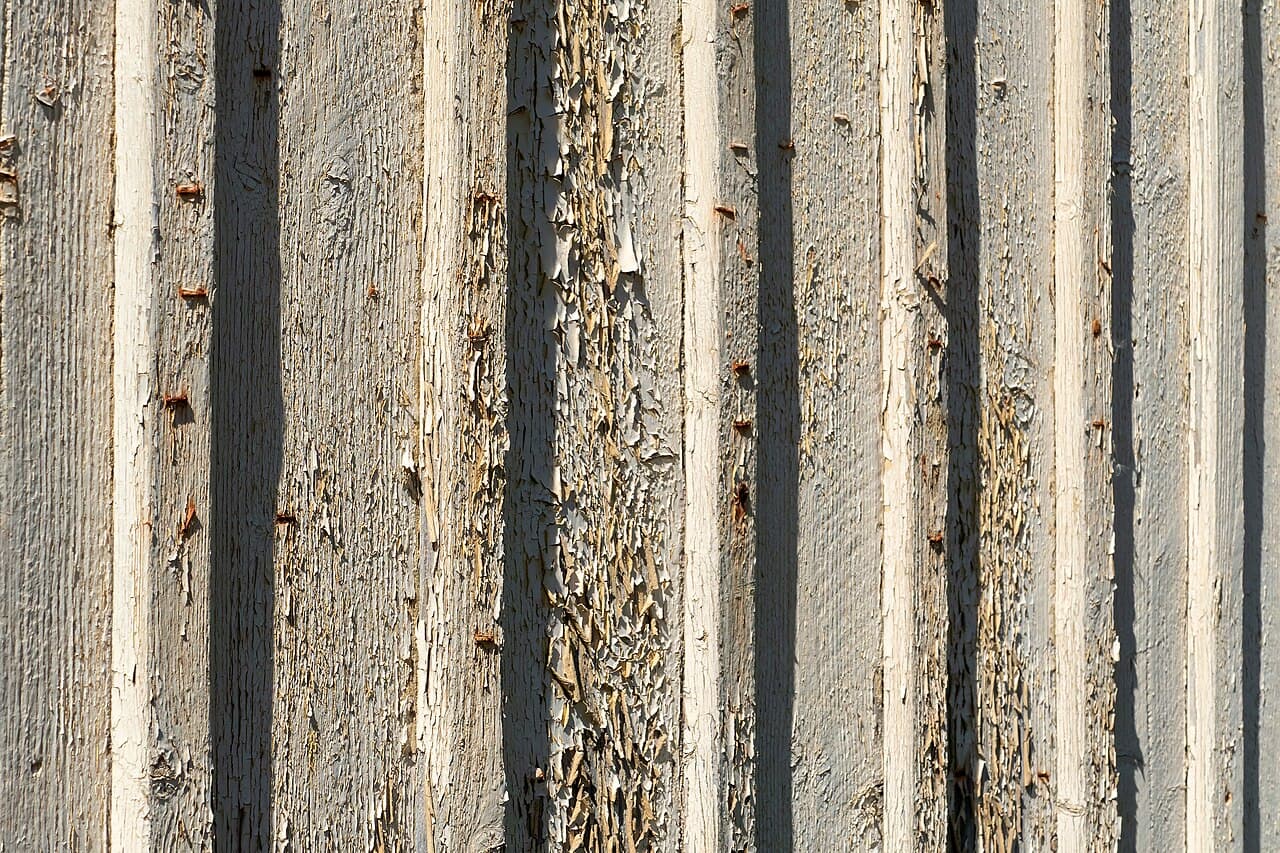
Most exterior paint peels because water gets into the wood behind it. The National Park Service puts it plainly: Peeling to bare wood is most often caused by excess interior or exterior moisture that collects behind the paint film.[2] The USDA Forest Products Laboratory agrees: Water is the main cause, but other factors can also be involved. Water speeds the failure by other causes.[1] The pattern of the peeling usually tells you which cause you have, and the fix starts with that cause, not with the paint.
If the house is older, start with lead
On a house built before 1978, peeling paint may be lead paint. The EPA says If painted surfaces are deteriorating, this may create a hazard that requires immediate attention and a certified lead professional should be hired.[3] The Virginia Department of Health points to cracked, scaly surfaces that look like alligator skin[5] as a warning sign. Keep children away from paint chips, and do not dry scrape or sand. If you hire it out, anyone who is paid to perform work that disturbs paint in housing and child-occupied facilities built before 1978 must be certified,[4] as explained in whether a painter needs to be lead-safe certified.
Peeling to bare wood: moisture from outside
When paint comes off clean down to bare wood, look for water. The Park Service's list of usual sources is faulty flashing, leaking gutters, defective roof shingles, cracks and holes in siding and trim, deteriorated caulking in joints and seams, and shrubbery growing too close to painted wood.[2]
Board ends are a giveaway. Peeling and flaking are often worst at the ends of boards[1] because end grain takes in water more easily and goes through more extreme wet-dry cycles.[1] Peeling at the bottom of corner boards, around window casings and along the lowest course of siding usually means water is sitting on or soaking into end grain.
Blisters first, then peeling
Moisture failures often start as bubbles. Water blisters form between the wood substrate and the primer.[1] The handbook lists common causes as rain entering through improperly flashed doors, windows and vents, unsealed end grain of siding and trim, ice dams and overflow from blocked gutters.[1] Oil-based paint is much more prone to blisters than latex paint,[1] and dark colors are more susceptible than light ones because they get hotter in the sun.[1]
To tell a moisture blister from a painting mistake, cut one open. If another layer of paint is visible, then solvent blistering is likely the problem whereas if bare wood is revealed, moisture is probably to blame.[2] Solvent blisters happen when solvent-rich paint applied in direct sunlight dries on top too quickly and traps solvent underneath.[2]
Moisture from inside the house
Peeling on the outside of a bathroom, kitchen or laundry wall can be water vapor moving out through the wall. The handbook notes: Plumbing leaks, humidifiers, and shower spray are sources of inside water.[1] The Park Service's remedy: "Excess interior moisture should be removed from the building through installation of exhaust fans and vents."[2]
New paint peeling off old paint
If the top coat lifts off an older coat that is still stuck to the wood, it is intercoat peeling. Intercoat peeling usually occurs within a year of repainting[1] and most often occurs in protected areas such as eaves and covered porches because these surfaces do not receive a regular rinsing from rainfall.[2] Dirt and salts left on the old paint stop the new coat from bonding. Chalk does the same: if latex paint is applied over old, chalking oil paint, peeling can also occur because the latex paint is unable to penetrate the chalky surface and adhere.[2]
Weathered wood, wet wood and thin paint
Bare wood left too long. Wood left unpainted in the sun loses its grip on paint within weeks. In Forest Products Laboratory tests, For boards exposed 16 weeks, the paint peeled and needed refinishing within 3 years; for boards exposed only 1 week, the paint started peeling after 13 years.[1] A telltale sign: Paint applied to weathered wood often fails over large areas and sometimes wood fibers are attached to the back of the film, clearly showing the grain of the wood.[1]
Wet wood. Painting wet wood increases the risk of blistering and peeling,[1] which is why paint put on right after washing or rain can fail.
Too much paint. The Park Service warns that When paint builds up to a thickness of approximately 1/16 inch, roughly 16 to 30 layers, one or more extra coats may be enough to trigger cracking and peeling.[2] "Thick paint invariably fails at the weakest point of adhesion-the oldest layers next to the wood."[2]
Too little paint. At the other end, Flaking often occurs with cracking parallel to grain and usually occurs with thin films.[1]
Knots. Knots are more prone to paint peeling and staining than most wood,[1] so isolated peeling over knots is a wood problem more than a paint problem.
How to fix it
Fix the water first, then the wood, then the paint. Decayed wood does not hold paint,[1] so soft wood has to be repaired or replaced. Let wet wood dry out before you prime.
Before you strip a whole wall, test how well the old paint is holding. Prime a small area, let it dry overnight, press an adhesive bandage on and snap it off. If both the new paint and the old paint coat adhere to the tape, the old paint is not well bonded to the wood and must be removed before repainting.[1] If only the new coat comes off, the surface needs more cleaning or priming.
Scrape off loose paint, sand bare wood if the paint is lead-free, and prime. Bare wood should be primed within 48 hours[2] so it does not weather again. How to prep a house for exterior painting covers the full sequence, and cracking paint on window trim covers the related problem of cracking.
Stop and call a pro if
- The house was built before 1978 and paint is peeling over large areas, especially where children live or play.
- The peeling traces back to a roof leak, failed flashing or ice dams. Roof work belongs to a roofer.
- Probing finds soft wood in sills, fascia, corner boards or framing, or moisture is coming through the wall from a leak you cannot find.
- The peeling is high on a two-storey wall or under a roof edge you would need a tall ladder to reach.
For what a repaint costs, see exterior painting costs in Virginia. Browse exterior painters, look up painting businesses around Blacksburg, or read more exterior answers. To have someone find the cause and repaint, describe your exterior painting job once and licensed local businesses can quote it.
Common questions
- Why is paint peeling on only one side of my house?
- Look at what that side has that the others do not. A wall below a bathroom or kitchen may be getting moisture from inside; a wall under an overflowing gutter or beside dense shrubs stays wet; and the sunny south and west sides weather fastest. Peeling under eaves and porch ceilings is often new paint that did not stick to dirty old paint.
- My house was painted a year ago and it is already peeling. Why?
- Peeling within a year of repainting is usually intercoat peeling: the new paint did not bond to old paint that was dirty, chalky or glossy. It can also mean the wood was wet when it was painted or bare wood was not primed. Check whether the flakes come off down to older paint or to bare wood, and raise it with the painter under your written contract.
- Can I just paint over peeling paint?
- No. New paint over loose paint fails with it. Scrape off everything that is not firmly bonded, find and fix the source of moisture, prime any bare wood, then repaint. If the house was built before 1978, use lead-safe methods or hire a lead-safe certified painter.
- Is peeling paint dangerous?
- On a house built before 1978 it can be. Old paint may contain lead, and deteriorating lead paint produces chips and dust that are harmful, especially to young children. The EPA says peeling paint on such a house may need immediate attention from a certified lead professional.
- Why is paint peeling under my eaves and porch ceiling but not on the walls?
- Those surfaces never get rinsed by rain, so dirt and airborne salts build up on them. If they were not washed before the last repaint, the new coat could not bond to the old one and lifts off it. Wash them well, scrape the loose paint, sand the edges, and repaint. They also collect dew, which feeds mildew.
Sources
- [1] Chapter 16: Finishing Wood, Wood Handbook (FPL-GTR-282), USDA Forest Service, Forest Products Laboratory. Checked October 27, 2026.
- [2] Preservation Brief 10: Exterior Paint Problems on Historic Woodwork, National Park Service. Checked October 27, 2026.
- [3] Lead Abatement, Inspection, and Risk Assessment, U.S. Environmental Protection Agency. Checked October 27, 2026.
- [4] Lead Renovation, Repair and Painting Program: Contractors, U.S. Environmental Protection Agency. Checked October 27, 2026.
- [5] Lead-Safe Virginia, Virginia Department of Health. Checked October 27, 2026.
Want a pro to handle it?
Describe the job once. Licensed local businesses send quotes, and you pay only when you book one.
Get a quote for Roofing