Why is my floor buckling?
Floors buckle because the boards or planks swell or expand with nowhere to go. The usual causes are water from a leak or spill, humidity that stays too high, and a floating floor pressed against a wall, cabinet or heavy object with no expansion gap. Find and stop any moisture first, then check the gap at the edges.
Free to ask. Local shops send quotes, and you pay only when you book one.
By Kasra Taheri, Founder, LoclisPublished
Researched and drafted with AI, then checked claim by claim against the sources listed below before it was published. Prices and rules change; the dates beside each source say when it was last checked.
Step by step
Read when to stop and call a pro, further down this page, before you start.
Step 1: Name the floor and map the lift
Note whether the floor is hardwood, laminate or floating vinyl plank, and where the raised area is: along one wall, across the middle, or near a sink, appliance or door.
Step 2: Look for a water source
Check for a leak or spill near the buckle, such as under a dishwasher, sink or refrigerator ice line, at an exterior door, or from a wet slab or crawl space below. If you find water, stop it and dry the area.[5]
Step 6: Check the sun
See whether the lifted area sits where strong direct sun hits the floor for hours each day.[1]
Step 7: Remove the cause, then let the floor settle
Dry the area, bring humidity into range, and free the pinned edge, then give the floor time to relax before deciding whether any planks need replacing.
Why floors buckle
A buckled floor is a floor that has grown and has nowhere to go, so it pushes up into a ridge or a hump. Almost every case traces back to one of three causes: water, humidity, or a floating floor that is pinned at its edges. Sun and bad installation make each of those worse.
The cause decides the fix, so work through it in order: moisture first, because it can damage what is under the floor, then the edges, then the room's conditions.
Water is the first suspect
Look at where the lift is. A buckle beside a dishwasher, sink, refrigerator or exterior door points to a leak or a repeated spill. A lift across a large area, especially over a slab or a crawl space, points to moisture rising from below.
Dry anything wet quickly. The EPA says that if wet or damp materials or areas are dried 24-48 hours after a leak or spill happens, in most cases mold will not grow.[5] Laminate makers add a related rule for routine cleaning: Shaw says "Do not wash or wet mop the floor with soap, water, oil-soap detergent or any other liquid cleaning product."[3] Water pushed through the seams of a fibreboard-core floor is a common cause of swollen edges.
If the floor is over a wood subfloor, one manufacturer's guide says wood subfloors should be dry, and that the moisture in wood subfloors should not exceed 12%.[1] A pin-type moisture meter, which a flooring installer will have, is how to find out.
Humidity and the season
Wood and wood-fibre floors take up moisture from the air and swell, then shrink again when the air dries. Virginia summers push indoor humidity up, and a floor that has no room to swell buckles at the worst of it.
Shaw tells laminate owners to monitor humidity levels and maintain between 35% and 65% humidity year round to minimize expansion and contraction of your laminate flooring.[3] For hardwood, its advice is to maintain consistent humidity levels (35-55%) to prevent warping.[4] A dehumidifier or air conditioner in summer, and not letting a closed-up house sit damp, usually keeps a room in range.
A floating floor with no room to move
Laminate and floating vinyl plank are not fastened to the subfloor. They expand and contract as a single sheet, and they need a gap around the edge to do it. One floating vinyl guide says to maintain a 5/16” (8mm) gap consistently around the perimeter of the vinyl floor at all vertical surfaces.[2] Another says that for areas less than 2500 sq. ft – minimum expansion space is ¼”.[1] The exact figure depends on the product, so use the guide for yours.
Things that quietly remove that gap:
- Baseboard or quarter round nailed down through the flooring. The guide is plain that baseboard and quarter round, must not be fastened through the vinyl flooring.[2]
- Cabinets, islands or heavy built-ins set on the floor. The guide says to "Do not install cabinets directly on the floor as this is a floating installation method."[1]
- A door frame, pipe or threshold that the planks run tight against.
- A floor that was laid before it had adjusted to the room. One guide warns that improper acclimation of floating Luxury vinyl flooring may result in gapping, buckling or joints that are hard to lock.[2]
Sun and heat
A floor under a big south-facing window or glass door can get hot enough to expand. One vinyl plank guide warns that high direct temperature from sunlight may result in thermal expansion causing the material to buckle or expand, and says this is not a defect of the material.[1] Blinds or curtains in the afternoon help.
What to do about it
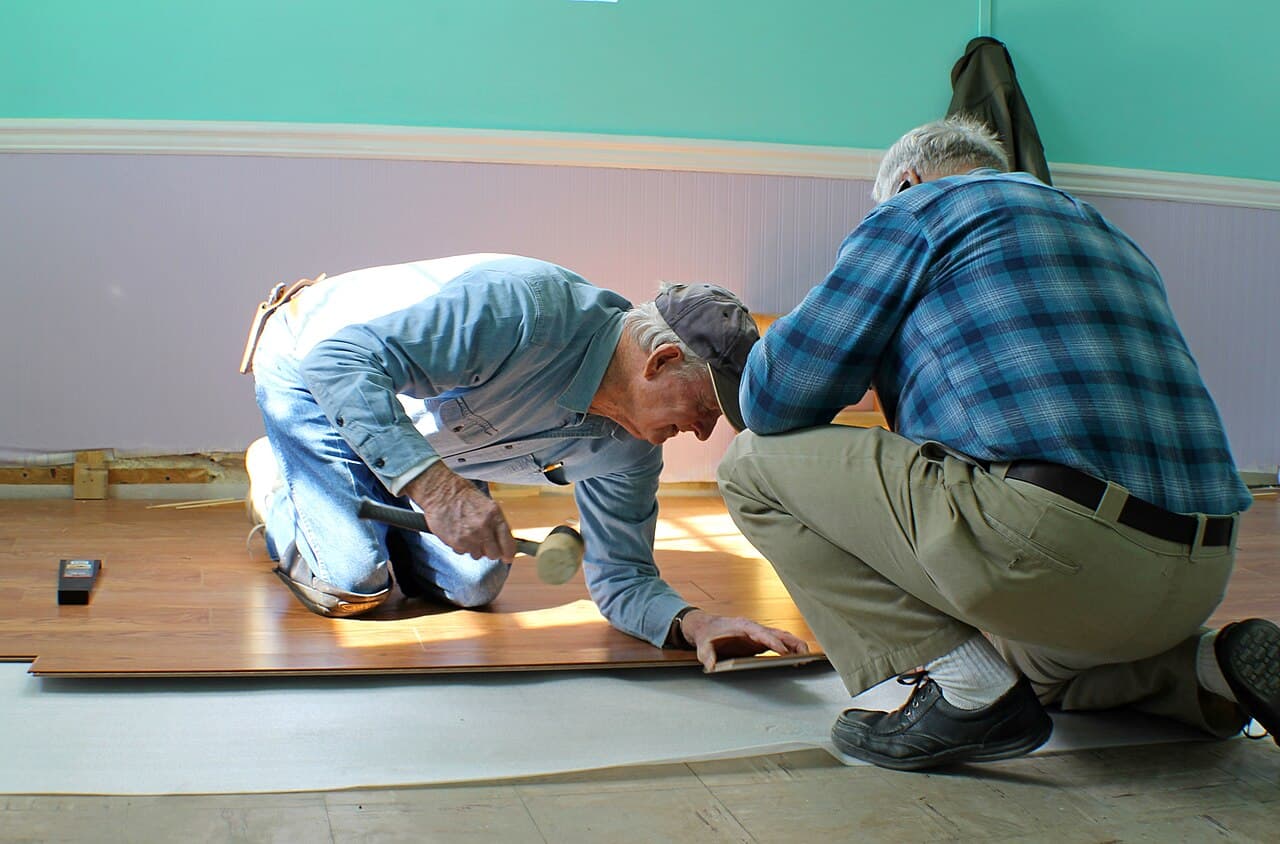
Fix the cause first. If the planks are floating, pull the trim, find where the floor is tight and free it. Often that means trimming a few millimetres off the edge boards or removing a fixture that is pinning the floor. Once dry and relaxed, a floor that stays raised may need its damaged planks replaced; how to replace a damaged laminate plank covers that for click-lock floors.
Stop and call a pro if
- The floor is nailed or glued hardwood that has cupped or lifted across a room. That usually means a moisture source or subfloor problem, and sanding or pulling boards too early can make it worse.
- You cannot find where the water comes from, or the floor is wet over a slab or crawl space.
- The subfloor feels soft or damp, or there is a musty smell, which suggests it needs repair, not just new planks.
- You see mold or the floor stayed wet longer than a couple of days.
- The buckle covers most of a room, or the floor was installed recently and may still be under warranty. Contact the installer or maker before touching it.
Getting help in Virginia
If you are deciding who should do the work, read should I hire a flooring installer to replace a few damaged boards. For the wider picture, browse home repair answers and flooring pros in Virginia.
When you are ready, describe the buckled floor once and local pros can quote it.
Common questions
- Will a buckled floor go back down on its own?
- Sometimes, if the cause was a short-lived spike in humidity or a floating floor that was pressed against a wall and you free it. A floor that swelled from water often stays swollen, because wood fibre and fibreboard cores do not shrink back to their original shape. Fix the cause, wait, and then judge whether the damaged planks need to be replaced.
- What humidity should I keep the room at?
- Shaw Floors tells laminate owners to keep humidity between 35% and 65% year round to minimize expansion and contraction, and tells hardwood owners to keep it consistent at 35 to 55% to prevent warping. A hygrometer costs little and shows whether the room is in range.
- How big should the gap at the wall be on a floating floor?
- It depends on the product, so read its installation guide. One floating vinyl guide calls for 5/16 inch around the perimeter, and another sets a minimum of 1/4 inch for rooms under 2,500 square feet. Baseboard and quarter round should not be fastened through the flooring.
- Can I just cut out the buckled planks?
- Only once the cause is gone. Replacing planks on a floor that is still wet or still pinned at the edges just repeats the problem. When the cause is fixed, see how to replace a damaged laminate plank for floating floors.
- Does a buckled floor mean mold?
- It can, when water is the cause. The EPA says that if wet or damp materials are dried 24 to 48 hours after a leak or spill, in most cases mold will not grow, so the longer a wet floor sits, the more likely you have a bigger job than replacing planks.
Sources
- [1] Malibu Wide Plank Installation Guidelines for Rigid Core Luxury Vinyl Plank Floors (041922), Malibu Wide Plank, installation guide. Checked October 28, 2026.
- [2] Residential D.I.Y. Floating Floor Installation Instructions (May 2015), Floating vinyl floor manufacturer's installation instructions, Lowe's product documents. Checked October 28, 2026.
- [3] Laminate Floor Care & Maintenance, Shaw Floors. Checked October 28, 2026.
- [4] Hardwood Care, Shaw Floors. Checked October 28, 2026.
- [5] A Brief Guide to Mold, Moisture and Your Home, U.S. Environmental Protection Agency. Checked October 28, 2026.
Want a pro to handle it?
Describe the job once. Licensed local businesses send quotes, and you pay only when you book one.
Get a quote for Home Repair