Why does my heat pump blow cool air in winter?
Often it is working normally: heat pump air runs around 85–100°F, cooler than a furnace's, and the system blows cooler air for a few minutes while it defrosts the outdoor coil. Check that the thermostat is on Heat with the fan on Auto. Cold air that lasts, heavy ice, or aux heat that never shuts off points to a fault a licensed technician should find.
Free to ask. Local shops send quotes, and you pay only when you book one.
By Kasra Taheri, Founder, LoclisUpdated
Researched and drafted with AI, then checked claim by claim against the sources listed below before it was published. Prices and rules change; the dates beside each source say when it was last checked.
This is a job for a licensed pro in Virginia
This page explains what the work involves, the permits, what a licensed pro does and what drives the cost. It does not give step-by-step instructions, because this work needs a licence, a permit or both, and doing it wrong can injure someone. Before you hire, check the licence on Virginia's DPOR record.
Most of the time, nothing is wrong. Heat pump air is cooler than furnace air, and for a few minutes at a time in winter the system blows cooler still while it defrosts its outdoor coil. A thermostat set to the wrong mode, a fan left on, a clogged filter or a blocked outdoor unit cause the rest of the easy cases. Cold air that lasts, ice that will not clear or aux heat that never shuts off is a fault for a licensed technician.
First: is the air actually cold?
A heat pump does not make the hot blast a gas furnace does. "Heat pump supply air can typically be around 85–100°F during heating, compared with roughly 120–140°F from a gas furnace."[2] That is below body temperature at the low end, so it can feel cool on your hand at the register while it is still warming the house. Carrier says that if the air coming out feels lukewarm (90-100°F), this is normal for heat pumps.[2]
The better test is the room. If the house is holding the temperature you set, the system is doing its job.
Defrost: short bursts of cool air
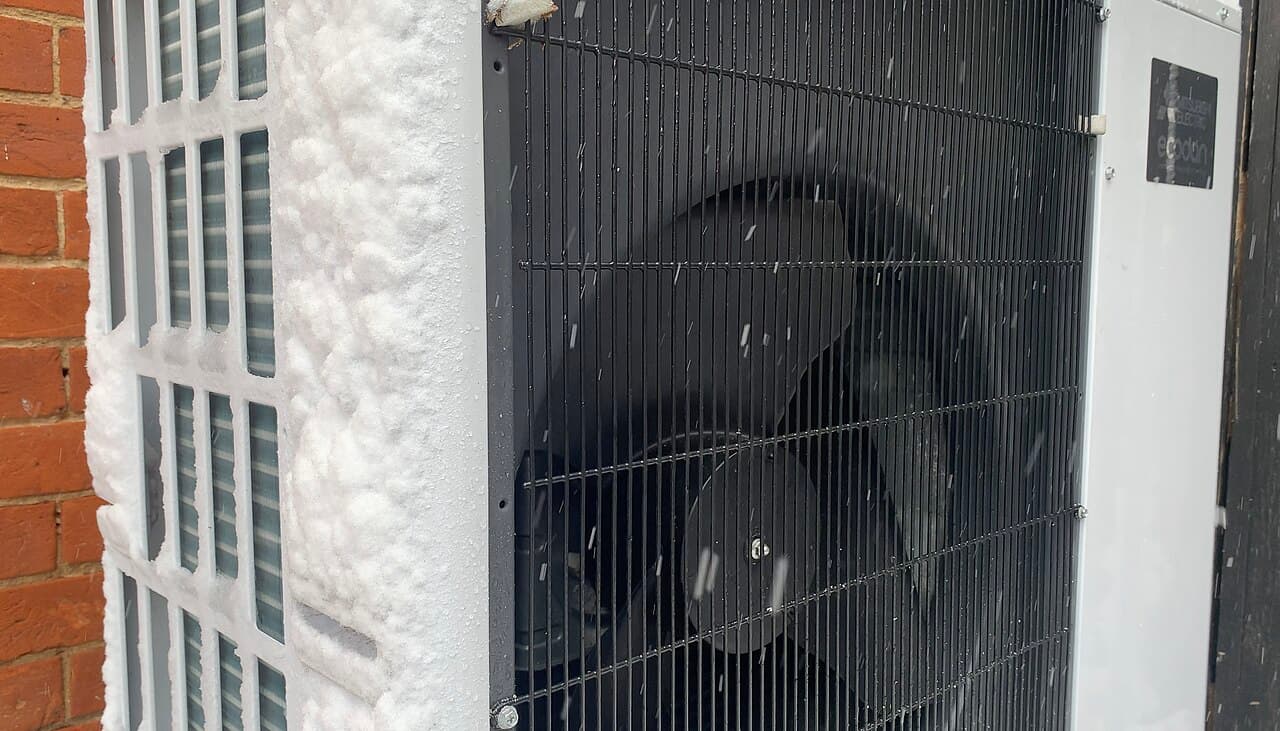
In cold, damp weather frost forms on the outdoor coil, and the heat pump clears it with a defrost cycle. Carrier says: "A brief period of cooler air during a defrost cycle can be normal; persistent cold air may indicate a problem that requires a qualified HVAC technician."[1] A typical defrost cycle lasts about 5–10 minutes,[1] and the thermostat normally brings on auxiliary heat while the heat pump is in defrost mode,[3] which softens the dip. In frosty weather, Lennox says a heat pump should automatically defrost itself every 30 to 90 minutes.[6]
You may also hear a gentle whooshing sound from the reversing valve, which Carrier says is typically normal,[1] as the system switches between modes. For more on why this happens, see how a heat pump works in cold weather.
Check the thermostat
Carrier's first check is to verify the thermostat is set to "Heat" and the fan is set to "Auto" rather than "On."[1] A fan left on is the classic cause: "If you like to run your fan continuously for air circulation and filtering, you may be feeling room temperature or cool air because the system isn't actively heating."[1] Also confirm that a programmable or smart thermostat's schedule or settings have not been changed,[1] for example after a power cut.
Check the filter and the outdoor unit
Filter. "A clogged filter restricts airflow, potentially causing the system to shut down or blow lukewarm air."[2] Carrier recommends checking the filter every 60-90 days and replacing or cleaning it according to the manufacturer's recommendations.[2] See how often to change a furnace filter, which applies to heat pump air handlers too.
Outdoor unit. Look at it from a safe spot. Snow drifts, leaves and shrubs choke the airflow, and Carrier's general guideline is to keep at least 24 inches of clear space around the heat pump, while following the clearance requirements for your specific model.[1] Some frost is fine: "A light, thin layer of frost—generally less than 1/4 inch—is normal during winter operation and should clear during the unit's automatic defrost cycle."[1] Heavy ice is not: "Ice buildup thicker than 1/4 inch, a solid coating of ice, or ice that does not clear during defrost is not normal and requires attention."[1]
Power. The outdoor unit and the indoor unit have separate breakers,[2] so one half can lose power while the other keeps running. A tripped breaker or a dead outdoor unit is a reason to call a technician, not to open the panel. When a heat pump will not turn on or off, Trane's first step is to have the power source checked by an HVAC professional, and it explains why: "This task must be performed by a professional, because it's possible it could blow a fuse in your home."[4]
Watch the aux heat light
In real cold, the backup heat coming on is normal. In mild weather it is a clue. Trane: "If it's above 40 degrees and your thermostat shows AUX HEAT for more than an hour or two, you might want to investigate."[3] Lennox adds that an aux heat light that comes on frequently or stays on more than about 30 minutes at a time is an indicator that your heat pump can't handle the workload it's being handed.[5]
Causes that need a technician
When settings, filter and clearance check out, the cool air usually comes from inside the system. Common causes include:
- low refrigerant, which is generally the result of a leak[5]
- a stuck reversing valve, the part that switches the direction of refrigerant flow, especially when the system heats poorly but cools perfectly[2]
- a faulty defrost board, which can let the outdoor coil freeze or make the system think it is defrosting when it is not[5]
- a faulty outdoor fan motor, which leaves too little air moving across the coil[5][1]
- a failing compressor[5]
If the air is warm but the house still will not reach the setting, Carrier also lists an undersized system, or poor insulation and drafty windows and doors.[1] Ducts can be part of it: "In a typical home, about 20–30% of the air moving through the duct system can be lost through leaks, holes and poorly connected ducts."[2]
What not to do
- Do not attack the ice. "Never try to chip ice from the coil."[1] Lennox also says to never pour hot water on the unit, as the sudden temperature change can crack components.[6]
- Do not open it up. "Don't attempt to remove panels or work on internal components."[1]
- Do not work in the electrical panel. Leave a tripped breaker to the technician.[4]
Emergency heat as a stopgap
If the heat pump has clearly failed and the house is getting cold, emergency heat keeps you warm until help arrives. Turning on emergency heat shuts down the heat pump and makes the auxiliary system the main heat source.[3] If that backup is electric heat, Carrier warns that relying solely on electric resistance heat can significantly increase your electric bill.[2] Trane's advice: "If you engage the emergency setting, call for HVAC service right away."[3]
When to call a licensed pro
Call when the cool air outlasts a defrost cycle, ice stays on the coil, a breaker has tripped, the aux light stays on in mild weather or the unit makes new noises; Trane counts banging, screeching, rattling, buzzing, grinding or gurgling as noises that call for a professional.[4] Refrigerant leaks, reversing valves, defrost boards, fan motors and compressors are licensed work. Under EPA's Section 608 rules, technicians who maintain, service, repair, or dispose of equipment that could release refrigerants into the atmosphere must be certified,[7] and under Virginia law no individual may work as a tradesman without a licence, and the Code defines a tradesman as someone who does electrical, plumbing or heating, ventilation and air conditioning work for the general public for compensation.[8][9] Check a business on DPOR's License Lookup.[10]
To keep it from happening again, read how to keep a heat pump running well in winter. Loclis lists DPOR-licensed HVAC businesses with their licence number and class: find HVAC businesses in Blacksburg, browse heat pump services, or read more heating and cooling answers.
Describe what your heat pump is doing and licensed local HVAC businesses quote the repair.
Common questions
- Is it normal for a heat pump to blow cool air for a few minutes?
- Yes, during defrost. Carrier says a brief period of cooler air during a defrost cycle can be normal and that a typical cycle lasts about 5–10 minutes. Lennox says a heat pump should automatically defrost itself every 30 to 90 minutes in frosty weather. Cold air that lasts much longer is not normal.
- Why does heat pump air feel colder than furnace air?
- Because it is cooler. Carrier puts typical heat pump supply air at around 85–100°F during heating, compared with roughly 120–140°F from a gas furnace. The house still warms, just more gently. Lukewarm air in that range is normal.
- Should I switch to emergency heat if the air is cold?
- Only if the heat pump has actually failed. Emergency heat shuts the heat pump off and runs only the backup, and if that backup is electric resistance heat, Carrier warns it can significantly increase your electric bill. Trane says to use it only in a true emergency and to call for HVAC service right away when you do.
- Can I chip the ice off my heat pump?
- No. Carrier says never to chip ice from the coil, and Lennox warns against both chipping ice and pouring hot water on the unit, which can damage the coil, fins and fan. Keep the area around the unit clear and let the defrost cycle work; call a technician if the ice stays.
- Why is my aux heat light always on?
- In very cold weather some aux heat is normal. Trane says it is worth investigating if it is above 40 degrees and the thermostat shows AUX HEAT for more than an hour or two, and Lennox treats aux heat that stays on more than about 30 minutes at a time as a sign the heat pump cannot keep up. Common causes include low refrigerant, a faulty defrost board or a reversing valve problem.
Sources
- [1] Heat Pump Troubleshooting Guide, Carrier. Checked October 26, 2026.
- [2] Heat Pump Not Heating? Here's How to Troubleshoot, Carrier. Checked October 26, 2026.
- [3] What Is Auxiliary Heat in a Heat Pump System?, Trane. Checked October 26, 2026.
- [4] Heat Pump Troubleshooting: Diagnosing Common Issues, Trane. Checked October 26, 2026.
- [5] What Does Aux Heat Mean on My Thermostat?, Lennox. Checked October 26, 2026.
- [6] What to Do If Your Heat Pump Is Frozen?, Lennox. Checked October 26, 2026.
- [7] Section 608 Technician Certification Requirements, U.S. Environmental Protection Agency. Checked October 27, 2026.
- [8] Va. Code § 54.1-1129, Necessity for licensure, Code of Virginia, Virginia General Assembly. Checked October 26, 2026.
- [9] Va. Code § 54.1-1128, Definitions, Code of Virginia, Virginia General Assembly. Checked October 26, 2026.
- [10] License Lookup, Virginia Department of Professional and Occupational Regulation. Checked October 26, 2026.
Want a pro to handle it?
Describe the job once. Licensed local businesses send quotes, and you pay only when you book one.
Get a quote for HVAC Repair