Does a wood stove need to be EPA certified in Virginia?
A new wood heating stove sold in Virginia must be EPA-certified, because the federal wood heater standards apply nationwide: stoves made or sold since May 15, 2020 must meet a 2.0 grams-per-hour particle limit, or 2.5 under the cord wood test. The rule does not affect stoves already in use in homes, but your locality may still require a permit to install one.
Free to ask. Local shops send quotes, and you pay only when you book one.
By Kasra Taheri, Founder, LoclisPublished
Researched and drafted with AI, then checked claim by claim against the sources listed below before it was published. Prices and rules change; the dates beside each source say when it was last checked.
This is a job for a licensed pro in Virginia
This page explains what the work involves, the permits, what a licensed pro does and what drives the cost. It does not give step-by-step instructions, because this work needs a licence, a permit or both, and doing it wrong can injure someone. Before you hire, check the licence on Virginia's DPOR record.
Yes for a new stove, no for one that is already heating your house. The certification requirement is federal, so it applies in Virginia the same way it applies in every other state: a new wood heating stove has to be EPA-certified to be sold, while a stove already in use in your home is not affected. What Virginia and its localities add is the permit and inspection for installing one.
What the federal rule requires
The rule is EPA's New Source Performance Standards for residential wood heaters, in Title 40 of the Code of Federal Regulations, Part 60, Subpart AAA. It tightened in two steps. First, stoves manufactured, imported or sold at retail on or after May 15, 2015 had to be certified to a weighted average of no more than 4.5 grams of particulate matter per hour.[2] Since then, a stove manufactured or sold at retail for use in the United States on or after May 15, 2020 may not exceed a weighted average of 2.0 g/hr, or 2.5 g/hr for a stove certified under the cord wood alternative test.[2]
The rule reaches anyone who manufactures, sells, offers for sale, imports, distributes, or installs or operates a covered wood heater.[1] EPA's list of appliances that must meet its requirements includes "Wood and pellet stoves (including fireplace inserts)",[5] and the 2015 update added a previously unregulated type known as a "single burn rate" stove.[4]
For buyers, three parts matter most:
- Dealers sell certified stoves only. A dealer may not advertise or sell a covered stove unless it has been certified to the 2015 or 2020 standards, and must give the buyer an owner's manual and a copy of the warranty.[3]
- The label stays on. No one may advertise for sale, sell or operate a covered stove that does not have its permanent label, and no one may alter, deface or remove that label.[3]
- Installation follows the manual. No one may install or operate a covered stove except in a manner consistent with the instructions on its permanent label and in the owner's manual, including only using fuels for which the unit is certified.[3]
What the rule does not cover
EPA states it plainly: "The rule does not affect existing woodstoves and other wood-burning heaters currently in use in people’s homes."[4] It also does not apply to heaters fueled solely by oil, gas or coal, or to outdoor fireplaces, fire pits, pizza ovens or chimineas.[4]
Residential masonry heaters and site-built masonry fireplaces are not covered,[1] and cook stoves and camp stoves are exempt from the emission limits.[1] Wood-fired hydronic heaters and forced-air furnaces are regulated under a separate subpart.[1] Gas stoves (and gas fireplace inserts) do not require EPA certification.[5]
Rules that come with a certified stove
Owning a certified stove brings a few operating rules. Operating a stove that was originally equipped with a catalytic combustor is prohibited if the catalytic element is deactivated or removed.[3] The owner's manual must say that operating the stove in a manner inconsistent with the manual would void the warranty.[2]
The rule also lists fuels you may not burn in a covered stove, including residential or commercial garbage, lawn clippings or yard waste, anything containing plastic or rubber, paints and paint thinners, construction or demolition debris, cardboard, plywood or particleboard, railroad ties, pressure-treated wood or pallets, and unseasoned wood.[2] Paper, cardboard, sawdust and wax fire starters are still allowed for starting a fire.[2]
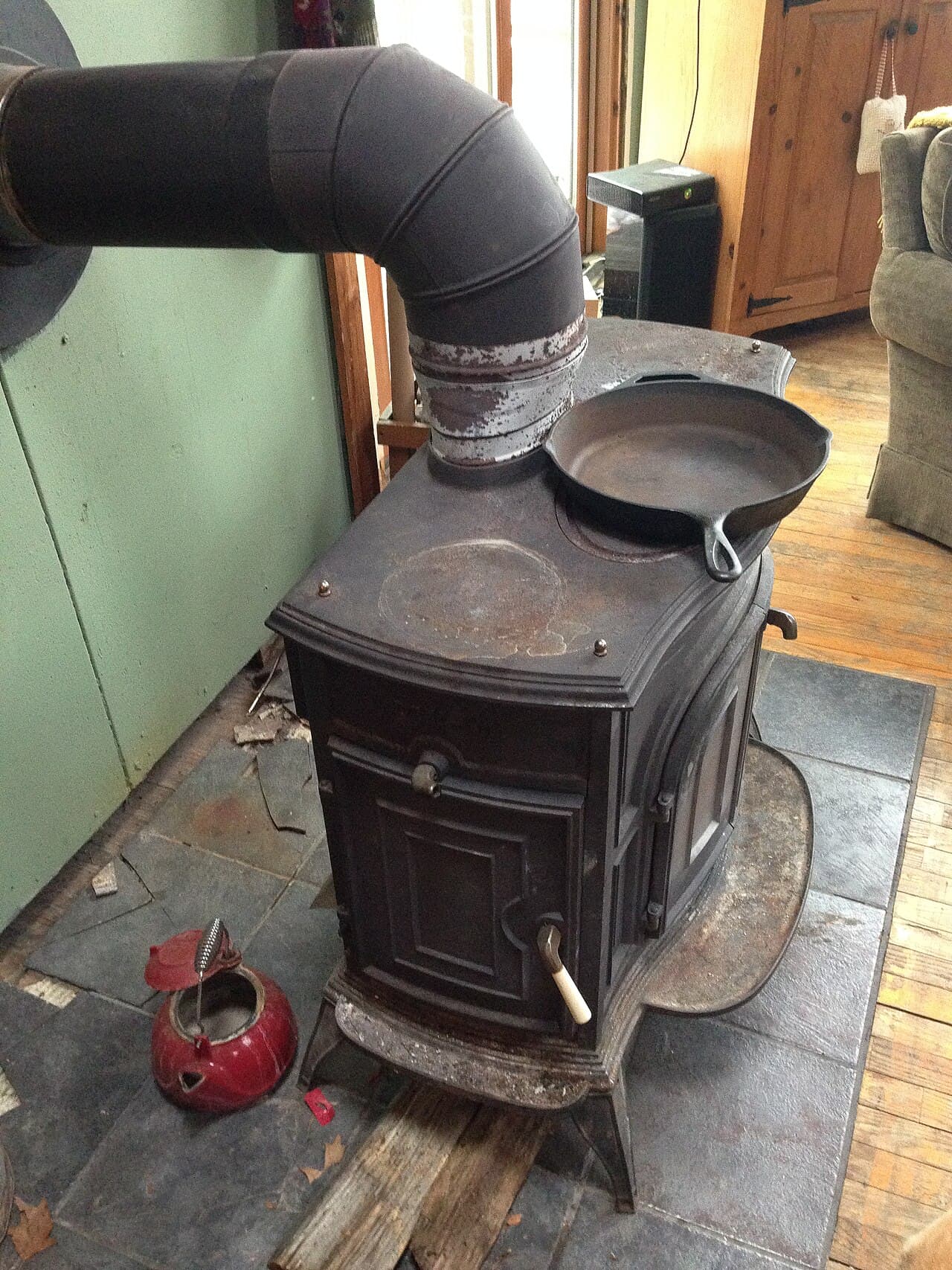
Checking whether your stove is certified
"Most stoves in homes are not EPA-certified."[7] To check yours, EPA says an EPA-certified stove has a label on the back of it indicating EPA certification.[5] You can also look on the back for a metal tag, check the owner's manual, or search EPA's list of certified appliances.[6] As a rough guide, wood stoves without glass doors are generally older models, and wood heaters manufactured before 1990 burn wood less efficiently.[6]
Buying or getting rid of a used stove
The federal sale requirement on commercial owners does not apply to stoves previously owned and operated by a noncommercial owner.[3] EPA's view is that replacing an older stove with a cleaner-burning stove will not improve air quality if the older stove is reused somewhere else,[5] which is why changeout programs usually require older stoves to be destroyed and recycled as scrap metal, or rendered inoperable.[5] If you are retiring an uncertified stove, EPA suggests you make sure your old stove cannot be used to burn wood, for example by removing its doors.[5]
If you buy used, look for the label and ask for the manual, since the manual is where the stove's clearances and installation instructions are written down.
Virginia's part: permits and inspections
Certification covers the stove; the building code covers the installation. Prince William County's fire department notes that under the Virginia Uniform Statewide Building Code, a permit is required when installing a prefabricated fireplace, insert, or wood stove.[8] EPA's own advice is to check with your local city or county building department for permit requirements,[5] and to check with your state or local air quality agency to determine the types of wood-burning appliances that are approved for use in your area.[5]
Certification is worth having even where the law does not force it. EPA says a certified stove lets you use 1/3 less wood fuel for the same heat and reduce creosote build-up and the risk of chimney fires.[6] How a wood stove heats a house explains why, and what an installed stove costs in Virginia covers the budget.
When to call a licensed pro
Installing a stove, relining a chimney for one or changing its venting is pro-only work on Loclis. EPA puts it this way: "It's important not only to purchase an EPA-certified stove, but also to have it properly installed by a certified technician".[5] Virginia's Board for Contractors says that if the work is valued at $1,000 or more, a valid Virginia Contractor’s License is required for the license category in which the contractor is to work.[10] Ask the installer to show you the stove's label and manual, to pull the permit, and to give you the inspection result. How to check a contractor's licence shows how to look one up.
After that, Fairfax County Fire and Rescue's advice is to have a licensed chimney sweep clean and inspect your chimney at least once a year.[9] What a chimney sweep does explains the visit.
Loclis lists DPOR-licensed businesses with their licence number and class. Browse wood stove services, look up chimney businesses in Blacksburg, or see all chimney and fireplace answers.
Describe your stove project once and local businesses quote it.
Common questions
- Do I have to replace my old uncertified stove?
- Not under the federal rule. EPA says the standards do not affect existing woodstoves and other wood-burning heaters already in use in people's homes. An older stove still needs to be in safe condition, installed with proper clearances and inspected every year, and replacing it with a certified model usually cuts wood use and smoke.
- Can a store sell me an uncertified new stove if I sign a waiver?
- No. Federal rules bar a commercial seller from advertising or selling a covered stove unless it is certified to the 2015 or 2020 standards, and the seller must hand over the owner's manual and warranty. A waiver does not change that.
- Does a fireplace insert need to be EPA-certified?
- A wood-burning insert does. EPA lists wood and pellet stoves, including fireplace inserts, among the appliances that must meet its emission requirements. Gas inserts do not need EPA certification, and an open fireplace is not certified at all.
- Is a pellet stove covered by the same rule?
- Yes. The federal standards set particle limits for new pellet stoves as well as wood stoves, and a pellet stove certified to burn pellets may burn only the pellets its owner's manual specifies, graded by an approved third party.
- Does Virginia have its own wood stove emission standard?
- The certification standard that applies to new stoves sold here is the federal one. What Virginia and its localities add is the building code: counties and cities issue permits and inspect installations. EPA also suggests checking with your state or local air quality agency about which appliances are approved for use in your area.
Sources
- [1] 40 CFR 60.530: Am I subject to this subpart?, Electronic Code of Federal Regulations (eCFR). Checked October 27, 2026.
- [2] 40 CFR 60.532: What standards and associated requirements must I meet and by when?, Electronic Code of Federal Regulations (eCFR). Checked October 27, 2026.
- [3] 40 CFR 60.538: What activities are prohibited under this subpart?, Electronic Code of Federal Regulations (eCFR). Checked October 27, 2026.
- [4] New Source Performance Standards for Residential Wood Heaters, U.S. Environmental Protection Agency. Checked October 27, 2026.
- [5] Frequent Questions about Wood-Burning Appliances, U.S. Environmental Protection Agency, Burn Wise. Checked October 27, 2026.
- [6] Energy Efficiency and Your Wood-Burning Appliance, U.S. Environmental Protection Agency, Burn Wise. Checked October 27, 2026.
- [7] Choosing Wood-Burning Appliances, U.S. Environmental Protection Agency, Burn Wise. Checked October 27, 2026.
- [8] When Using Alternative Home Heating Systems - Use Wisely & Safely, Prince William County Department of Fire and Rescue. Checked October 27, 2026.
- [9] Heating Systems Safety, Fairfax County Fire and Rescue Department. Checked October 27, 2026.
- [10] What You Should Know Before You Hire a Contractor, Virginia Board for Contractors, DPOR. Checked October 27, 2026.
Want a pro to handle it?
Describe the job once. Licensed local businesses send quotes, and you pay only when you book one.
Get a quote from a local pro