How much does a wood stove cost installed in Virginia?
There is no single Virginia price. Installed cost depends most on the venting, whether an existing chimney can be lined or a new insulated chimney is needed, then on the stove, hearth protection, permit and labour. For scale, Woodstock Soapstone listed its Ideal Steel Hybrid stove at $3,590 when we checked on October 27, 2026, before any installation.
Free to ask. Local shops send quotes, and you pay only when you book one.
By Kasra Taheri, Founder, LoclisPublished
Researched and drafted with AI, then checked claim by claim against the sources listed below before it was published. Prices and rules change; the dates beside each source say when it was last checked.
This is a job for a licensed pro in Virginia
This page explains what the work involves, the permits, what a licensed pro does and what drives the cost. It does not give step-by-step instructions, because this work needs a licence, a permit or both, and doing it wrong can injure someone. Before you hire, check the licence on Virginia's DPOR record.
A wood stove installation is really two purchases: the stove, and everything that gets its smoke safely out of the house. The second part changes far more from house to house, so two Virginia homeowners buying the same stove can get very different quotes. The useful way to budget is to understand each part, then compare written, itemised quotes.
The stove itself
Stove prices depend on size, materials and combustion type. As a dated example from one manufacturer that sells direct, when we checked on October 27, 2026, Woodstock Soapstone listed its Ideal Steel Hybrid at $3,590[1] and its Progress Hybrid at $4,850.[2] Both are listed as EPA 2020 certified.[1][2] Those are list prices for the stove alone, before pipe, chimney work, delivery or installation, and other brands and dealers price differently.
Combustion type affects long-term cost as well as the sticker price. EPA notes that catalytic stoves are typically more expensive long term than non-catalytic models because the catalyst honeycomb eventually breaks down and needs to be replaced, though modern catalysts can last up to 10 years with proper maintenance and use.[3] Non-catalytic stoves tend to be less expensive and don't require catalyst maintenance or cleaning.[3]
A new stove from a dealer has to be EPA-certified; whether a wood stove must be EPA certified in Virginia explains the rule.
The chimney or vent: the biggest variable
EPA says the cost of installation can vary depending on the condition of the existing chimney, because you may need a new chimney flue.[3] Most quotes fall into one of three situations:
- A sound masonry chimney of the right size. This usually needs a stainless liner sized to the stove and a connector pipe. Woodstock Soapstone says the insulating blanket for its liner kit is required for chimneys with no liner or a liner in poor condition,[4] so ask whether insulation is in the liner price.
- A chimney that is oversized, short or damaged. A flue that is too large lets smoke slow down and condense, resulting in creosote, condensation and sluggish draft,[5] and masonry repairs are a separate line item.
- No usable chimney. This means a new prefabricated metal chimney through the ceiling and roof or up an outside wall. Woodstock Soapstone recommends a minimum chimney height of fourteen feet for its stoves, and its guidance says every chimney must rise at least three feet above the roof on the uphill side and at least two feet higher than any part of the roof within 10 feet.[5] It also says an exterior chimney should be insulated, with insulated chimney pipe or an insulated chase,[5] which adds material and labour.
Roof work, a tall run on a two-storey house and a steep roof all add time and cost.
Hearth, clearances and floor protection
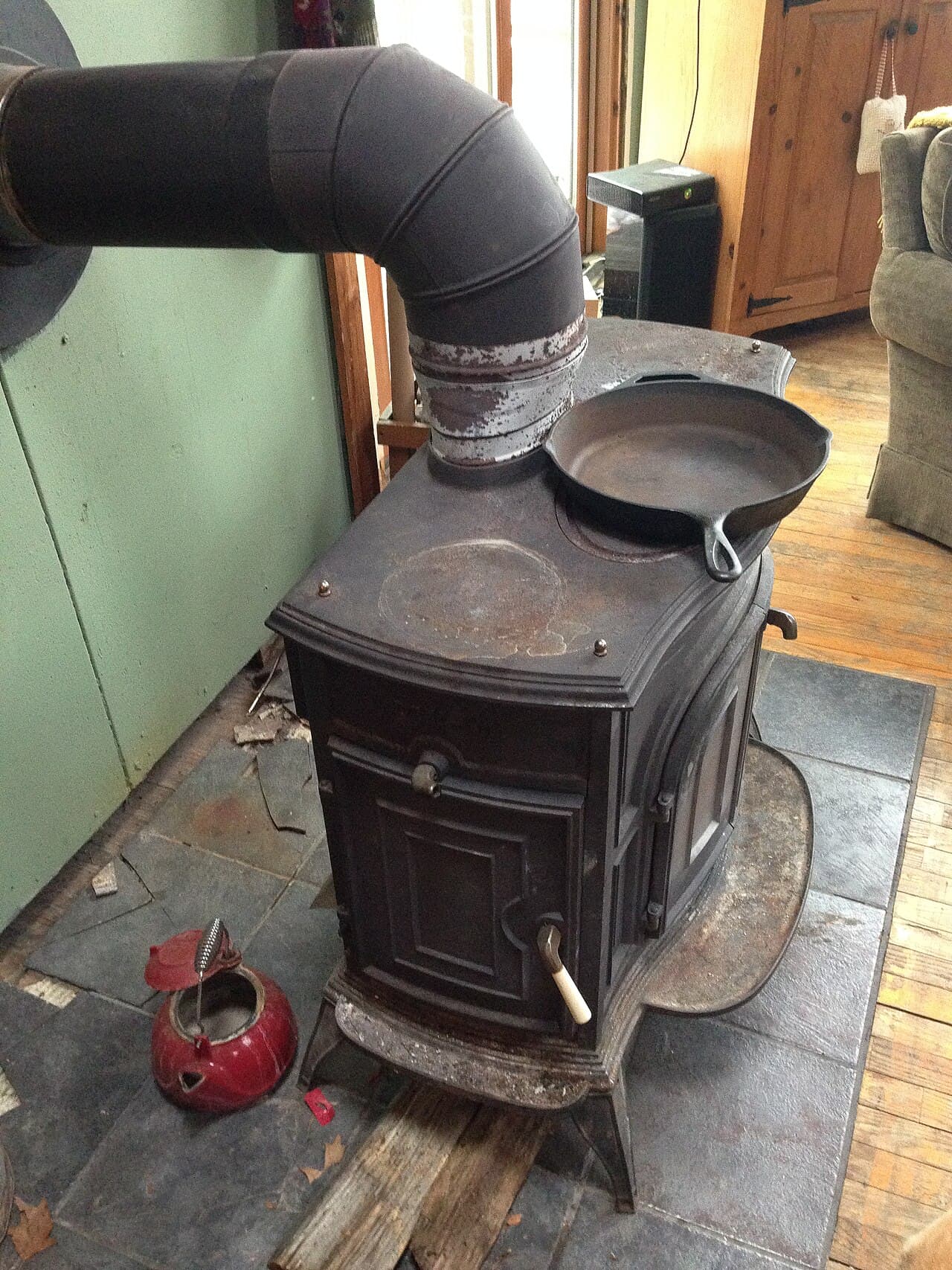
Federal rules say no one may install or operate a covered stove except in a manner consistent with the instructions on its permanent label and in the owner's manual,[6] so the manual's clearances and floor-protection requirements decide what the hearth has to be. Fairfax County Fire and Rescue's fireplace guidance says free-standing fireplaces should be at least three feet from unprotected walls, drapes, or other flammable materials, with wall protection for walls closer than that, and a pad of brick or insulated fireproof material on the floor beneath.[7] It also says pipes connecting free-standing stoves and fireplaces to a chimney should be at least No. 24 gauge steel, UL listed and installed in accordance with the listing.[7] A custom stone or tile hearth costs more than a ready-made pad.
Permit and inspection
Prince William County's fire department notes that under the Virginia Uniform Statewide Building Code, a permit is required when installing a prefabricated fireplace, insert, or wood stove.[8] The USBC requires a permit before work on mechanical systems or "any equipment regulated by the USBC," while its list of permit exemptions includes the "replacement of mechanical appliances provided such equipment is not fueled by gas or oil" in the residential groups it names.[9] Whether a straight stove swap fits that exemption is a question for your local building department, so ask it, and ask its fee, before you budget. Virginia's Board for Contractors says the contractor should apply for and obtain any necessary building permits, and that this should be spelled out in your contract.[10]
Tax credits and rebates
Under the federal Energy Efficient Home Improvement Credit, biomass stoves with a thermal efficiency rating of at least 75% qualified for a credit of up to $2,000 per year, and installation labour could count. But the IRS says you can claim the credit for improvements made through December 31, 2025.[11] For a stove going in now, check the current IRS guidance or ask a tax professional before counting on a credit.
EPA does not provide individual rebates or discounts for cleaner-burning stoves, though some state, local and tribal agencies run changeout programs,[3] and those programs usually require the old stove to be destroyed and recycled as scrap metal, or rendered inoperable.[3]
Running costs to plan for
- Firewood. With an EPA-certified stove, you can expect to use up to one-third less firewood than in an older, less efficient stove.[3]
- Yearly service. Plan to have heating equipment and chimneys cleaned and inspected each year by a professional.[12] What chimney sweeping costs in Virginia covers that bill.
- Parts. A catalytic stove eventually needs a new catalyst, as above, so ask what one costs for the model you are quoted.
What a written quote should list
Virginia law requires all licensed contractors to provide a written contract for residential work.[10] Ask for each of these as a separate line:
- the stove make and model, with its EPA certification;
- the venting: liner or new chimney, its diameter, insulation, total height, cap and roof flashing;
- hearth pad or floor protection and any wall shielding;
- who pulls the permit and books the inspection;
- removal and disposal of an old stove or insert;
- delivery, start date, finish date and the payment schedule.
On deposits, the Board for Contractors suggests an initial deposit of no more than 10% of the total price or $1,000, whichever is less, and says that for custom-made or special-order items a reasonable deposit could be as high as 30% of the total contract value.[10]
When to call a licensed pro
Wood stove installation is pro-only work on Loclis because of the fire and carbon monoxide risk, the roof work and the permit. EPA strongly recommends that a certified technician install a wood stove or fireplace insert.[3] Virginia's Board for Contractors says that if the work is valued at $1,000 or more, a valid Virginia Contractor’s License is required for the license category in which the contractor is to work,[10] so check the licence before you sign. How to check a contractor's licence shows how to look one up, and how a wood stove heats a house helps you size what you are buying.
Loclis lists DPOR-licensed businesses with their licence number and class. Browse wood stove services, look up chimney businesses in Blacksburg, or see all chimney and fireplace answers.
Describe your stove project once and local businesses send written quotes.
Common questions
- Is it cheaper to put a stove into an existing chimney?
- Often, but not always. A sound masonry chimney of the right size may only need an insulated liner and a connector. A chimney that is oversized, too short, cracked or shared with another appliance can need enough work that a new prefabricated chimney is the simpler quote. Ask for the inspection findings in writing.
- Does the stove price include installation?
- Usually not. Manufacturer and dealer list prices are typically for the stove alone. Pipe, liner or chimney, hearth protection, delivery, permit and labour are separate, so ask for a quote that lists each one.
- Can I still get the federal tax credit for a wood stove?
- The IRS page for the Energy Efficient Home Improvement Credit says you can claim it for improvements made through December 31, 2025. For a stove installed after that date, check the current IRS guidance or ask a tax professional before counting on any credit.
- Should I pay a large deposit to reserve a stove?
- Virginia's Board for Contractors suggests a deposit of no more than 10% of the price or $1,000, whichever is less, and says up to 30% can be reasonable for special orders or custom-made items. Do not let payments get ahead of the work.
- Do I need a permit to replace an old stove with a new one?
- It depends on your locality and the job. The building code exempts the replacement of mechanical appliances not fueled by gas or oil in the residential groups it lists, but a new chimney, new liner or a stove in a new location is new work. Ask your county or city building department before the job starts.
Sources
- [1] Ideal Steel Hybrid Wood Stove, Woodstock Soapstone Company (stove manufacturer). Checked October 27, 2026.
- [2] The Progress Hybrid Wood Stove, Woodstock Soapstone Company (stove manufacturer). Checked October 27, 2026.
- [3] Frequent Questions about Wood-Burning Appliances, U.S. Environmental Protection Agency, Burn Wise. Checked October 27, 2026.
- [4] Masonry Chimneys, Woodstock Soapstone Company (stove manufacturer). Checked October 27, 2026.
- [5] What Makes a Good Chimney, Woodstock Soapstone Company (stove manufacturer). Checked October 27, 2026.
- [6] 40 CFR 60.538: What activities are prohibited under this subpart?, Electronic Code of Federal Regulations (eCFR). Checked October 27, 2026.
- [7] Fireplace Safety Tips and Can Your Ashes, Fairfax County Fire and Rescue Department. Checked October 27, 2026.
- [8] When Using Alternative Home Heating Systems - Use Wisely & Safely, Prince William County Department of Fire and Rescue. Checked October 27, 2026.
- [9] 13VAC5-63-80. Section 108 Application for permit (Virginia Uniform Statewide Building Code), Virginia Administrative Code (law.lis.virginia.gov). Checked October 27, 2026.
- [10] What You Should Know Before You Hire a Contractor, Virginia Board for Contractors, DPOR. Checked October 27, 2026.
- [11] Energy Efficient Home Improvement Credit, Internal Revenue Service. Checked October 27, 2026.
- [12] Heating fire safety, U.S. Fire Administration, FEMA. Checked October 27, 2026.
Want a pro to handle it?
Describe the job once. Licensed local businesses send quotes, and you pay only when you book one.
Get a quote from a local pro