How does a wood stove heat a house?
A wood stove burns wood in a closed firebox and heats its metal or stone body, which radiates heat into the room. Warm air then drifts into nearby rooms and up stairways. The chimney's draft pulls combustion air in and carries smoke out, and modern EPA-certified stoves also burn much of the smoke, turning more of each log into heat.
Free to ask. Local shops send quotes, and you pay only when you book one.
By Kasra Taheri, Founder, LoclisPublished
Researched and drafted with AI, then checked claim by claim against the sources listed below before it was published. Prices and rules change; the dates beside each source say when it was last checked.
This is a job for a licensed pro in Virginia
This page explains what the work involves, the permits, what a licensed pro does and what drives the cost. It does not give step-by-step instructions, because this work needs a licence, a permit or both, and doing it wrong can injure someone. Before you hire, check the licence on Virginia's DPOR record.
A wood stove heats a house in two ways at once. The fire heats the stove's metal or stone body, which radiates heat to everything in the room, and the warmed room air rises and spreads into nearby rooms and up the stairs. The chimney keeps the whole process running by pulling combustion air into the firebox and carrying the smoke outside.
The details decide whether one stove warms a whole floor or only roasts the room it sits in.
What happens inside the firebox
Burning a log happens in three stages. First the water in the wood is driven off as steam, then the wood releases gases that are burned or escape as smoke, and finally the carbon in the wood burns as coals.[4] Those gases need temperatures in excess of 1100-1200 degrees Fahrenheit to burn,[4] and most wood burning stoves cannot consistently reach that range, so many of the gases never get hot enough to burn and leave as smoke.[4] Smoke going up the chimney is heat you paid for and did not get.
Modern stoves are built to burn that smoke inside the stove. Certified appliances typically use a catalyst, secondary combustion, or a combination of the two technologies (hybrid).[1]
- A catalytic stove sends the smoky exhaust through a coated honeycomb, where the byproducts generally burn at around 500 degrees, much lower than a non-catalytic stove, which needs a temperature of 1100 degrees.[1] EPA puts their average efficiency at around 78%.[1]
- A non-catalytic stove, also called secondary combustion, relies on firebox insulation, a large baffle that gives the gases a longer, hotter path, and pre-heated combustion air fed through small holes above the fuel.[1] These make up about 80% of the market and average 71% efficiency.[1]
- A hybrid has both, so emissions are reduced from both low and high burns.[1]
The air controls on the stove set how fast the fire burns. Turning the air down usually gives a longer, cooler burn and opening it gives a hotter, faster one. The owner's manual says where each control belongs at each stage of a fire.
The chimney is the engine
A stove cannot heat anything without draft. Hot gases rise, and the greater the temperature difference between the gases in the chimney and the outside air, the faster they rise.[5] As exhaust leaves, fresh air for combustion is drawn into the stove at the same rate that exhaust flows out.[5] EPA calls the venting system the "engine" that drives the burning process, and says that if it does not provide adequate draft, the stove will perform poorly or fail.[1]
That is why chimney location matters. A chimney inside the house stays warm and draws well, while a cold exterior chimney will not draw as well and is subject to heavier creosote buildup than an interior one.[5]
How the heat reaches the rest of the house
"Wood stoves are radiant heaters. The closer you get to them, the warmer you are."[6] Radiant heat warms the floor, walls and furniture around the stove, and those surfaces warm the air. From there the heat travels on air currents: it flows easily to adjacent rooms and up stairways, but will not easily find its way down narrow hallways and into back rooms.[6] It also tends to dam up behind door headers until enough has collected at the ceiling to spill down through the doorway.[6]
So placement shapes comfort. If the goal is to heat the whole house, the best location for the stove is the central part of the house.[6] Cathedral ceilings are a special case because heat can collect above the living area, where it is of little use.[6] A stove in a room that is largely closed off can overheat it, while the same stove in an open plan spreads its heat over a larger area.[6] Opening or closing interior doors changes where the heat goes.
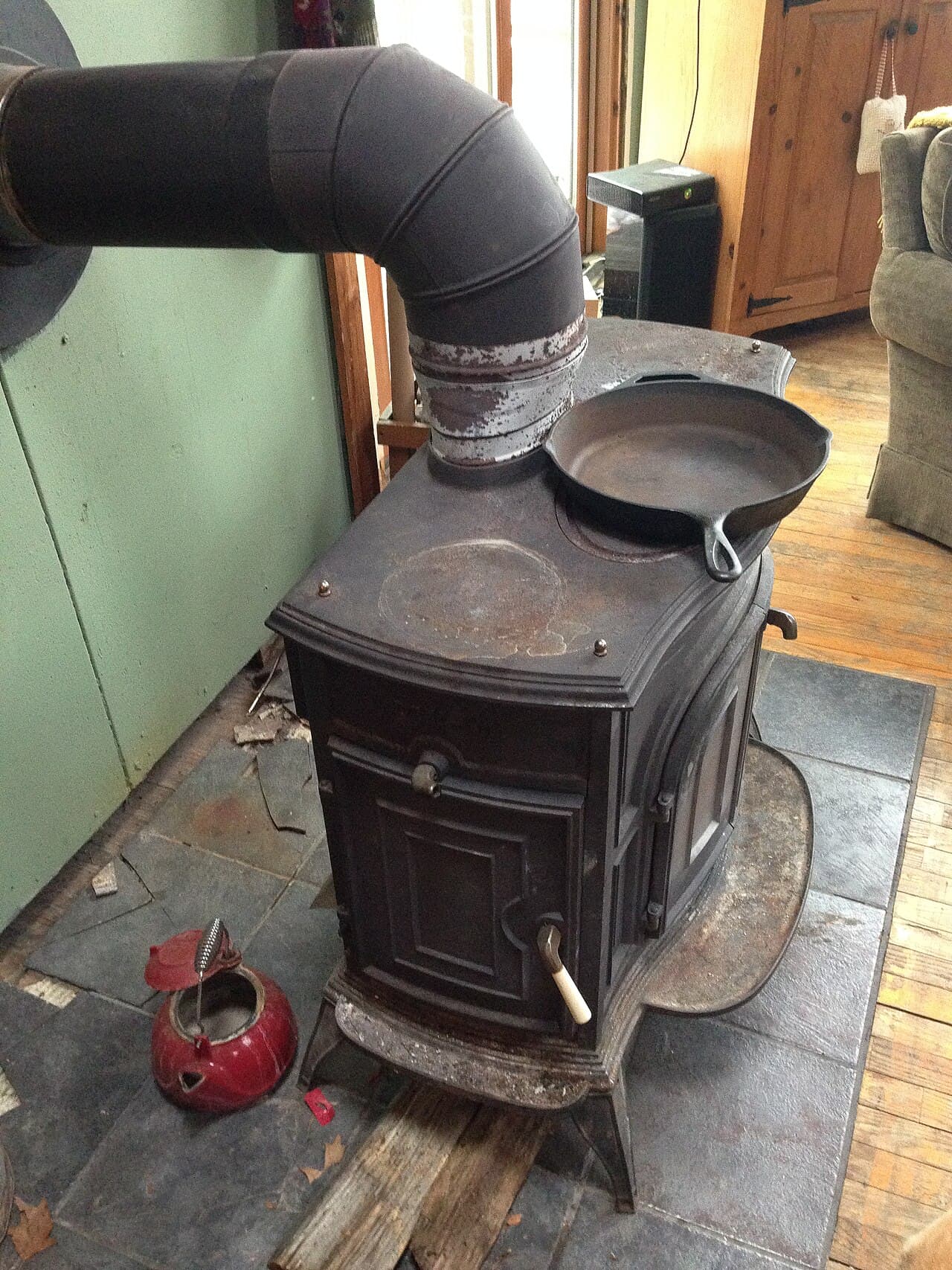
Heat output rises and falls with each load
A wood fire is not a thermostat. Woodstock Soapstone, a stove maker, notes that a stove rated at 50,000 BTU/hr may drop to one-tenth of that amount toward the end of a burn cycle, and will probably average about 25,000 BTU per hour over one burn cycle.[6] When you compare stoves, look at the whole heat-output range, not only the peak.
Efficiency figures are easy to misread too. Advertisements often quote combustion efficiency, and overall efficiency, the share of heat that actually reaches the space being heated, may be 10% to 20% lower.[2] Beyond the label, sizing comes down to the space you are heating, how much heat the house loses, and the wood you burn,[6] which is why EPA suggests bringing a floor plan of your home when you visit hearth retailers.[1]
Dry wood is part of the heating system
When wood is first cut, up to 50% of its weight is water,[4] and the fire has to boil that off before the wood gives you any heat. EPA says wood burns best at a moisture content of less than 20 percent.[3] A certified stove also stretches the woodpile: you can expect to use up to one-third less firewood than in an older, less efficient stove.[1] For drying times, see how long firewood needs to season.
Why a stove heats better than an open fireplace
With an open fireplace, most of the heat from a fireplace goes out the chimney,[1] and fireplace drafts can pull warm air up the chimney and leave other rooms cooler.[2] EPA adds that fireplaces do not burn as cleanly as EPA-certified wood heaters, creating 20 times the amount of air pollution.[2] A stove or fireplace insert closes the fire in and controls its air, and that control is what turns wood into usable heat.
When to call a licensed pro
Installing, moving or venting a wood stove is pro-only work on Loclis. It involves clearances to combustible walls and floors, a chimney that has to draft correctly, and the risk of a house fire or carbon monoxide. EPA strongly recommends that a certified technician install a wood stove or fireplace insert, and warns that errors in installation by a non-professional may not be visible and some could result in a home fire.[1] Federal rules say no one may install or operate a covered stove except in a manner consistent with the instructions on its permanent label and in the owner's manual.[7]
Permits are handled locally. Prince William County's fire department notes that under the Virginia Uniform Statewide Building Code, a permit is required when installing a prefabricated fireplace, insert, or wood stove.[8] Ask your own county or city building department what it needs. Virginia's Board for Contractors says that if the work is valued at $1,000 or more, a valid Virginia Contractor’s License is required for the license category in which the contractor is to work.[9] How to check a contractor's licence walks through the DPOR search.
Once the stove is in, have heating equipment and chimneys cleaned and inspected each year by a professional.[10] What a chimney sweep does explains that visit, and what an installed stove costs in Virginia covers the budget.
Loclis lists DPOR-licensed businesses with their licence number and class. Browse wood stove services, look up chimney businesses in Blacksburg, or see all chimney and fireplace answers.
Describe your wood stove job once and local businesses quote it.
Common questions
- Can one wood stove heat a whole house?
- Sometimes. It depends on the stove's size, how much heat the house loses, and the layout. Heat spreads easily to adjacent rooms and up open stairways but not down narrow hallways or into closed-off back rooms, so a centrally placed stove in an open floor plan does far better than one at the end of a long house.
- Do I need a fan to move the heat?
- Not always, but it can help. Warm air tends to pool at the ceiling and behind door headers, so a ceiling fan in a room with a high ceiling, or a small fan near a doorway, can help push heat into the next room. Check the stove's manual before adding any blower kit to the stove itself.
- Is a catalytic or non-catalytic stove better at heating?
- Both heat well when sized and installed properly. EPA says catalytic stoves average around 78% efficiency and burn cleanly at low burn rates, which suits long, steady burns. Non-catalytic stoves average around 71%, cost less, need no catalyst replacement and show more visible flame. Hybrids combine the two.
- Why does my stove burn hot but the house stays cold?
- Usually the heat is not reaching the rest of the house, or the stove is too small for the space and heat loss. Wet wood also wastes heat boiling off water. If the stove smokes, drafts poorly or the room smells of smoke, have a chimney professional check the venting before burning harder.
- Does a wood stove work in a power outage?
- A wood stove that runs on natural chimney draft keeps heating without power, though any blower fan on it stops. Pellet stoves are different: EPA notes that most pellet stoves need electricity to operate, because the automatic pellet feed requires electric power.
Sources
- [1] Frequent Questions about Wood-Burning Appliances, U.S. Environmental Protection Agency, Burn Wise. Checked October 27, 2026.
- [2] Energy Efficiency and Your Wood-Burning Appliance, U.S. Environmental Protection Agency, Burn Wise. Checked October 27, 2026.
- [3] Best Wood-Burning Practices, U.S. Environmental Protection Agency, Burn Wise. Checked October 27, 2026.
- [4] Wood Burning Basics, Woodstock Soapstone Company (stove manufacturer). Checked October 27, 2026.
- [5] What Makes a Good Chimney, Woodstock Soapstone Company (stove manufacturer). Checked October 27, 2026.
- [6] What Size Woodstove?, Woodstock Soapstone Company (stove manufacturer). Checked October 27, 2026.
- [7] 40 CFR 60.538: What activities are prohibited under this subpart?, Electronic Code of Federal Regulations (eCFR). Checked October 27, 2026.
- [8] When Using Alternative Home Heating Systems - Use Wisely & Safely, Prince William County Department of Fire and Rescue. Checked October 27, 2026.
- [9] What You Should Know Before You Hire a Contractor, Virginia Board for Contractors, DPOR. Checked October 27, 2026.
- [10] Heating fire safety, U.S. Fire Administration, FEMA. Checked October 27, 2026.
Want a pro to handle it?
Describe the job once. Licensed local businesses send quotes, and you pay only when you book one.
Get a quote from a local pro