How does a geothermal heat pump work?
A geothermal heat pump trades heat with the ground instead of the outdoor air. Fluid in a buried pipe loop picks up the earth's steady warmth in winter, and an indoor heat pump concentrates that heat with a compressor and blows it through your ducts. In summer the cycle reverses and the loop carries heat from the house back into the cooler ground.
Free to ask. Local shops send quotes, and you pay only when you book one.
By Kasra Taheri, Founder, LoclisPublished
Researched and drafted with AI, then checked claim by claim against the sources listed below before it was published. Prices and rules change; the dates beside each source say when it was last checked.
This is a job for a licensed pro in Virginia
This page explains what the work involves, the permits, what a licensed pro does and what drives the cost. It does not give step-by-step instructions, because this work needs a licence, a permit or both, and doing it wrong can injure someone. Before you hire, check the licence on Virginia's DPOR record.
A geothermal heat pump heats and cools a house by trading heat with the ground instead of the outdoor air. A loop of buried pipe carries fluid that picks up the earth's steady warmth in winter and hands heat back to the earth in summer. An indoor heat pump concentrates that heat with a compressor and sends it through your ducts.
The ground is the heat source
Air temperature swings with the seasons, but the ground holds a much steadier temperature. The U.S. Department of Energy says temperatures about 30 feet below the surface stay relatively constant year-round, between about 50°F and 59°F,[1] so for most of the country soil temperatures are usually warmer than the air in winter and cooler than the air in summer.[1]
That steady temperature is the whole difference from an ordinary heat pump. Both move heat with electricity and refrigerant, but GHP systems exchange heat from the earth, while air-source heat pumps exchange heat from the air,[1] so a geothermal unit does not depend on the temperature of the outside air.[1] On a cold winter night an air-source unit has to pull heat out of very cold air, while a geothermal unit pulls it out of ground that is much warmer. For the air-source side of the comparison, see how a heat pump works in cold weather.
The three parts of a system
Every geothermal system has the same three pieces.
- The ground loop. A series of connected pipes buried near the house, either vertically or horizontally, circulating a fluid that absorbs heat from or deposits heat into the surrounding soil.[1] Closed loops should be installed using only high-density polyethylene pipe,[4] and the sealed loop circulates an antifreeze-and-water solution.[4]
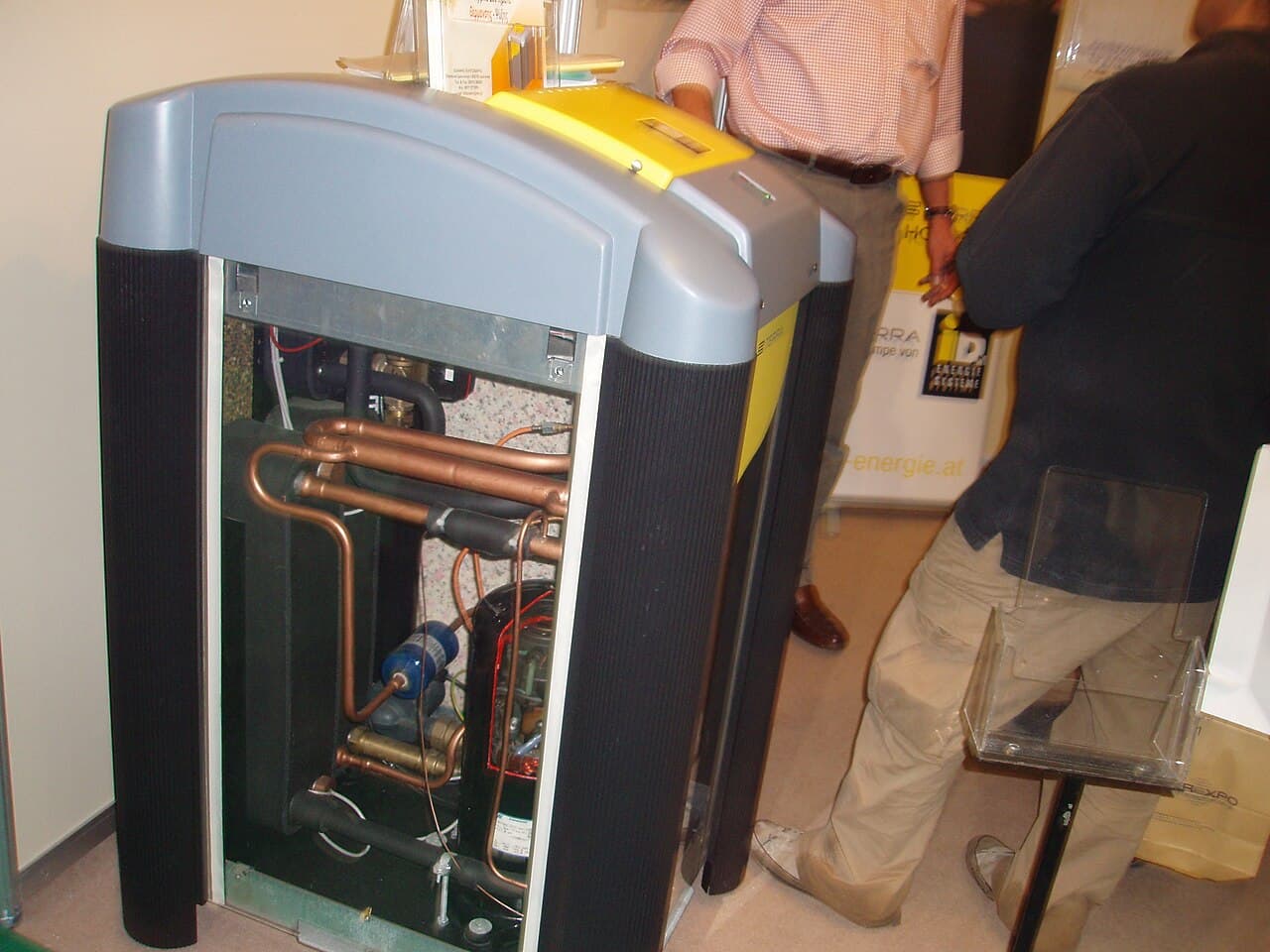
- The heat pump. The indoor unit usually sits inside the house, often in a basement or utility room. In winter it removes heat from the loop fluid, concentrates it and transfers it to the house; in summer it removes heat from the house and deposits it underground.[1]
- The distribution system. Conventional ductwork is generally used to distribute the heated or cooled air,[1] while water-to-water models condition the house or heat domestic water through refrigerant-to-water heat exchangers instead of an air coil.[6]
What happens inside the unit in winter
The heating cycle is a loop of its own. First, fluid from the loop flows through a water-to-refrigerant heat exchanger, and its heat turns cold liquid refrigerant into a gas.[3] The compressor squeezes that gas until it is very hot, approximately 165°F,[3] and sends it to the air coil, a radiator-like coil in the unit's air section. House air blown across the coil picks up that heat, and the result is warm air, typically 95° to 105°F, delivered through the duct system.[3] The refrigerant, cooled again, passes through an expansion valve and returns to pick up more heat from the loop fluid.[3]
Air at 95° to 105°F feels milder at the register than a gas furnace's blast, so the system makes up for it with longer, steadier cycles. WaterFurnace notes that geothermal systems will typically have a longer run time than a natural gas or propane furnace,[3] and that this is by design, not a sign of trouble.
In summer it runs in reverse
A reversing valve sends the refrigerant the opposite way.[3] The air coil becomes the cold side, cooling and dehumidifying the house air, and the heat goes into the loop fluid, which carries it into the cooler earth.[3][4] The same loop works for both heating and cooling.[4]
The kinds of ground loop
The loop is the expensive, permanent part of the system, and its type depends on the lot.
- Horizontal closed loops run in trenches that are normally four to six feet deep.[4] They need open yard but no drilling.
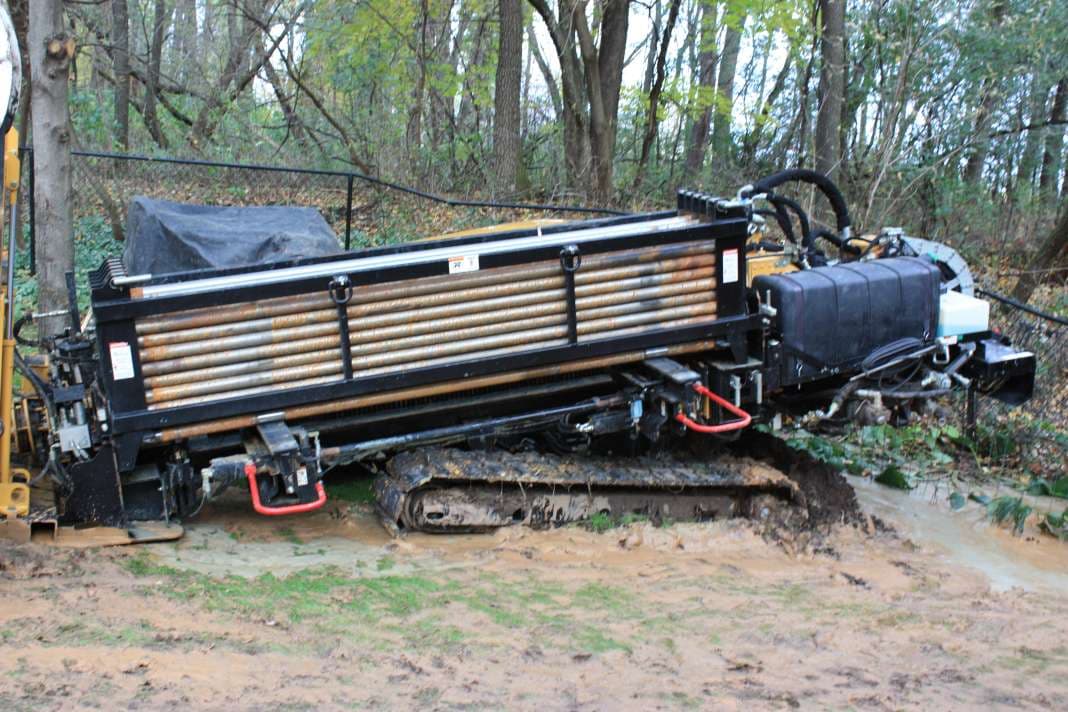
- Vertical closed loops are used where space is limited or where the soil does not suit horizontal loops. A drilling rig bores several holes, a U-shaped double pipe goes into each, and each hole is filled with grout.[3]
- Pond loops rest coils on the bottom of a pond. For a typical home, the pond should be at least 1/2 acre in surface area and at least 8 ft. deep, even during a dry spell.[3]
- Open loops use water from a well, which runs through the unit and is then discharged.[3] They depend on good well yield and water quality, because minerals in the water can gradually clog the unit's heat exchanger.[3]
Backup heat and hot water
A system may also include an auxiliary heater, which provides back-up heat during cold outdoor temperatures and emergency heat if the compressor fails.[3] Supplemental heat may be in the form of fossil fuel or electric resistance, and dual-fuel systems use a fossil fuel furnace as a supplement in extremely cold weather.[4] Sizing the unit below the coldest night is deliberate. Dealers generally size the geothermal unit to provide the majority of the heating requirements down to a certain outdoor air temperature,[3] because a unit and loop big enough for the coldest night of the year would be oversized every other night and cost more to install.
Many units also have a hot water assist that preheats water by as much as 2°-10° F[3] before it reaches your water heater. It trims the water heater's work rather than replacing it.
How efficient it is
Heating efficiency for heat pumps is measured as a coefficient of performance, or COP: units of heat delivered per unit of electricity used. For comparison, electric resistance heaters have a coefficient of performance (COP) of 1, which Virginia Cooperative Extension calls generally the most expensive method of heating.[7] By contrast, most geothermal heat pump systems have COPs of 3-4.5,[4] so they deliver three to four and a half units of heat for each unit of electricity.
To earn the ENERGY STAR label, a single-stage closed-loop water-to-air unit needs at least an EER of 17.1 and a COP of 3.6,[6] and ENERGY STAR says certified models use 61% less energy than a standard model.[5] Ask for the ENERGY STAR rating of any unit you are quoted.
What an installation involves in Virginia
A geothermal job usually brings in more than one trade and more than one permit.
- Drilling. The Board for Contractors' water well/pump specialty covers the installation of a water well system, including geothermal wells, and no other classification or specialty provides for construction of water wells.[8]
- The well permit. The Virginia Department of Health issues an express geothermal permit that applies to the construction of wells used solely for a closed-loop geothermal heating system, contingent upon proper registration and payment of application fees.[9] The registration lists, among other things, the contractor license number of the water well systems provider and a scaled site plan.[9]
- The heat pump. Virginia requires a master tradesman licence as a condition of licensure for HVAC contractors.[10] See whether an HVAC technician needs a licence in Virginia.
- The local permit. Rules vary by locality. Fairfax County lists geothermal system installation among the projects that need a residential mechanical permit, and lists a House Location Plat or Grading Plan Submission ID Number among the items that may be required, applicable for geothermal installations.[11]
- Utility marking. Virginia law says no one may begin an excavation without first submitting a locate request to the notification center.[12] Your contractor should have the request in before any trenching or drilling for the loop starts.
When to call a licensed pro
From the first conversation. The Department of Energy suggests that, to judge whether your house and lot suit geothermal, you start with a geothermal designer (instead of an installer) or a local professional engineer.[2] A vertical loop needs a drilling rig[3] and a well permit,[9] and WaterFurnace does not recommend that homeowners install an earth loop themselves.[4] The indoor unit holds a sealed refrigerant circuit and high-voltage controls, which are licensed HVAC work.
Before you sign, check every contractor's licence, including the driller's water well specialty. For costs, see how much a geothermal system costs in Virginia, and for whether it pays off, is geothermal heating worth it in Virginia.
Loclis lists DPOR-licensed HVAC businesses with their licence number and class. Browse geothermal services, find HVAC businesses in Blacksburg, or read more heating and cooling answers.
If you already have a geothermal system that needs work, describe the job once and licensed local HVAC businesses quote it.
Common questions
- Is a geothermal heat pump the same as an air-source heat pump?
- No. Both move heat with refrigerant and a compressor, but a geothermal unit trades heat with the ground through a buried loop, while an air-source unit trades heat with the outdoor air. Because the ground stays at a steadier temperature, a geothermal system does not depend on the outdoor air temperature.
- Does a geothermal system burn anything?
- The heat pump itself does not. It runs on electricity and moves heat rather than making it by combustion. Many systems include an auxiliary heater for back-up and emergency heat, and that supplemental heat may be electric resistance or a fossil fuel furnace in a dual-fuel set-up, which does burn fuel.
- Why does the air from my vents feel cooler than a gas furnace?
- A geothermal unit typically delivers air at about 95° to 105°F, cooler than the blast from a gas furnace, and runs longer cycles to keep the house at temperature. Longer run times are normal for these systems.
- Can a geothermal heat pump heat my water too?
- Many can preheat it. An optional hot water assist, often called a desuperheater, moves spare heat from the refrigerant into your water heater tank, raising the water temperature by as much as 2° to 10°F. Your water heater still finishes the job.
- Do I need a permit for a geothermal system in Virginia?
- Often more than one. The Virginia Department of Health issues an express geothermal permit for wells used solely for a closed-loop geothermal heating system, and the registration includes the water well systems provider's contractor license number. Localities such as Fairfax County also list geothermal system installation among projects that need a mechanical permit. Your contractors normally pull them.
Sources
- [1] Geothermal Heat Pumps, U.S. Department of Energy, Office of Geothermal. Checked October 26, 2026.
- [2] Tax Credits, Incentives, and Technical Assistance for Geothermal Heat Pumps, U.S. Department of Energy, Office of Geothermal. Checked October 26, 2026.
- [3] Owner's Manual, Residential Products (OM1500MW), WaterFurnace International. Checked October 26, 2026.
- [4] Geothermal FAQ & Glossary, WaterFurnace International. Checked October 26, 2026.
- [5] Geothermal Heat Pumps, ENERGY STAR, U.S. Environmental Protection Agency. Checked October 26, 2026.
- [6] Geothermal Heat Pumps Key Product Criteria, ENERGY STAR, U.S. Environmental Protection Agency. Checked October 26, 2026.
- [7] ENERGY SERIES: What about the Heating System?, Virginia Cooperative Extension, Virginia Tech. Checked October 26, 2026.
- [8] 18VAC50-22-30, Definitions of specialty services, Virginia Administrative Code, Board for Contractors. Checked October 26, 2026.
- [9] 12VAC5-630-271, Express geothermal well permits, Virginia Administrative Code, Virginia Department of Health. Checked October 26, 2026.
- [10] Va. Code § 54.1-1100, Definitions, Code of Virginia, Virginia General Assembly. Checked October 26, 2026.
- [11] Mechanical (MECHR) - Residential, Fairfax County, Virginia. Checked October 26, 2026.
- [12] Va. Code § 56-265.17, Notification required prior to excavation or demolition, Code of Virginia, Virginia General Assembly. Checked October 26, 2026.
Want a pro to handle it?
Describe the job once. Licensed local businesses send quotes, and you pay only when you book one.
Get a quote for HVAC Repair