How long does a geothermal system last?
A geothermal system has two lifespans. The buried loop of high-density polyethylene pipe lasts for decades, and WaterFurnace, citing the Department of Energy, gives it a rated material life of more than 100 years. The indoor heat pump wears out sooner, about 25 years on average by the same estimate, and regular service, clean filters and a protected loop help it get there.
Free to ask. Local shops send quotes, and you pay only when you book one.
By Kasra Taheri, Founder, LoclisUpdated
Researched and drafted with AI, then checked claim by claim against the sources listed below before it was published. Prices and rules change; the dates beside each source say when it was last checked.
This is a job for a licensed pro in Virginia
This page explains what the work involves, the permits, what a licensed pro does and what drives the cost. It does not give step-by-step instructions, because this work needs a licence, a permit or both, and doing it wrong can injure someone. Before you hire, check the licence on Virginia's DPOR record.
A geothermal system has two lifespans, and they are very different. The buried loop is close to permanent: WaterFurnace, citing the U.S. Department of Energy, says geothermal units have an average equipment life of 25 years while the underground loop system has a rated material life of more than 100 years.[1] Estimates vary. ENERGY STAR's savings estimate for certified geothermal heat pumps assumes a 15-year life of the product.[5] How long yours lasts depends mostly on installation quality and maintenance.
Why it tends to outlast ordinary systems
Compared with air-source systems, the Department of Energy says geothermal systems have been shown to be quieter, last longer, and require less maintenance.[4] One reason is that the unit's fan, compressor and pump are housed indoors, protected from the weather,[2] so they avoid the sun, rain, ice and debris an outdoor condenser lives with.
The loop: decades, if it was installed right
Closed loop systems should be installed using only high-density polyethylene pipe. Properly installed, these pipes will last for many decades.[2] WaterFurnace adds that PVC pipe should never be used.[2] If you are buying a house with geothermal, ask the seller or the original installer what pipe was used and who installed it.
Day to day, closed loops require no regular maintenance,[3] but if you notice air noise within the piping or if your loop is ever damaged by excavation, contact your dealer.[3]
Protect the loop from digging
The main outside threat to a loop is a shovel, an auger or an excavator. Three habits help:
- Keep the loop map. The installer should give you a layout of the loop field with measurements and locations of each circuit based on fixed points such as the corners of the house.[3] Some loop contractors install metallic tape or tracer wire in the trench[3] to help find it later.
- Know where the boreholes are. Under Virginia Department of Health rules, closed-loop ground-source heat pump wells are exempt from the rule that well casings stick up at least 12 inches above ground, but their location shall be permanently marked for easy location in the future.[7]
- Call before anyone digs. Virginia law says no one may begin an excavation without first submitting a locate request to the notification center,[8] and a fence, deck, pool or drainage contractor should also see your loop map before starting.
The indoor unit: what keeps it running
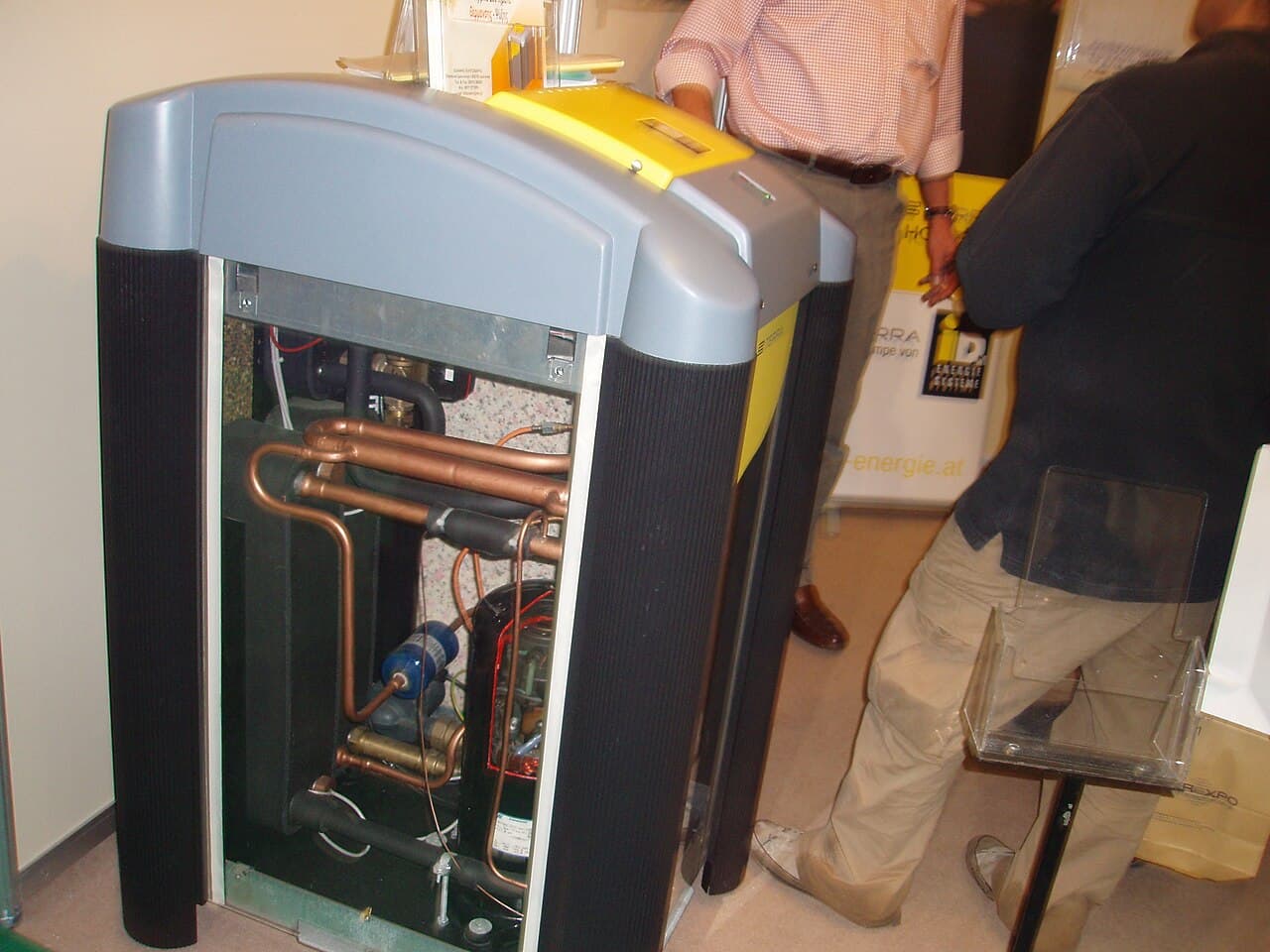
The heat pump itself has a compressor, blower, pumps, controls and a sealed refrigerant circuit, and those are what eventually wear out. WaterFurnace recommends that you have your system thoroughly checked by your dealer twice per year (usually Spring and Fall)[3] and take a maintenance agreement if your dealer offers one.
A professional check-up typically covers the items on ENERGY STAR's list. The technician will tighten all electrical connections and measure voltage and current on motors,[6] because faulty electrical connections can cause unsafe operation of your system and reduce the life of major components.[6] Moving parts get lubricated, since parts that lack lubrication cause friction in motors.[6] Blower components get cleaned and adjusted, because airflow problems can reduce your system's efficiency by up to 15 percent.[6] Controls and the condensate drain are checked too. For more on what a visit includes, see how often a heat pump should be serviced.
What you can do between visits
These are owner's checks, not repairs:
- Filters. WaterFurnace's schedule is standard disposable filters every 2 to 4 months, 1-inch pleated filters every 2 to 4 months, and 2-inch and 4-inch pleated filters every 4 to 6 months.[3] ENERGY STAR warns that a dirty filter can increase energy costs and damage your equipment, leading to early failure.[6] See how often to change a furnace filter.
- Thermostat. Check your thermostat once a month for fault signals and to make sure Emergency Heat is not engaged.[3] A unit stuck on emergency heat is losing its efficiency and needs service.
- The unit. Check the unit twice a year for lights that are on, moisture around its base or the flow center, and anything that looks or sounds unusual.[3]
- The drain. In summer, watch for water around the unit; the drain hole or hose may occasionally become clogged, most likely during the cooling season.[3]
Open loops need more care
Systems that run on well water wear faster without upkeep, because minerals and other particles in the water may eventually begin to clog the heat exchanger in the unit.[3] Your dealer sets a cleaning schedule based on your water: Some homeowners find that they can go a few years between cleanings while others may need to have the heat exchanger cleaned yearly.[3] The job needs special equipment and chemicals, so do not attempt to clean the heat exchanger yourself.[3]
What shortens a system's life
- Bypassed safety controls. The unit has safety controls that protect it in case of improper airflow, water flow or refrigerant charge, and these controls should not be bypassed.[3] Doing so may void the warranty.[3]
- Repeated lockout resets. A lockout is a warning; resetting it again and again without a repair runs a faulty unit. See why a geothermal system is not keeping the house warm.
- An addition or big remodel. A significant change or addition to the home may result in the system being inadequately sized,[3] and a unit that runs flat out all winter wears faster.
When to call a licensed pro
For the yearly or twice-yearly service, for any lockout that comes back, and for anything involving the refrigerant circuit, pumps or controls. Federal rules say technicians who maintain, service, repair, or dispose of equipment that could release refrigerants into the atmosphere must be certified,[9] and in Virginia the Board for Contractors requires a master tradesman licence as a condition of licensure for HVAC contractors.[10] Ask whether the company services geothermal equipment and can test loop flow and pressure.
When the indoor unit nears the end of its life, ask for a loop check and a fresh load calculation before you replace it. For a wider comparison, see how long an HVAC system lasts, and for replacement costs, how much a geothermal system costs in Virginia.
Browse geothermal services, find HVAC businesses in Blacksburg, or read more heating and cooling answers.
For service or a repair, describe the job once and licensed local HVAC businesses quote it.
Common questions
- Does the ground loop ever need replacing?
- Rarely, if it was installed properly with high-density polyethylene pipe. WaterFurnace says such pipe will last for many decades, and gives the loop a rated material life of more than 100 years, citing the Department of Energy. Damage from digging is the main threat, so keep the loop map.
- Why does a geothermal unit outlast an air conditioner?
- Its fan, compressor and pump are indoors, out of the weather, and the Department of Energy says geothermal systems have been shown to last longer and need less maintenance than air-source systems. They still wear, so regular service matters.
- How often should a geothermal system be serviced?
- WaterFurnace recommends a thorough dealer check twice a year, usually spring and fall, and a dealer maintenance agreement if one is offered. Between visits, change or clean the air filter on schedule and watch the thermostat for fault signals.
- Do open-loop systems wear out faster?
- They need more care. Minerals in well water can gradually clog the heat exchanger and cut capacity until the unit fails, so a dealer sets a cleaning schedule based on your water. Some homes go a few years between cleanings; others need it yearly.
- When the indoor unit wears out, do I need a new loop?
- Not usually, if the loop is sound. Ask the contractor to check the loop's condition and flow before quoting, and to confirm the new unit is sized for the house as it is now, especially after an addition or remodel.
Sources
- [1] About Geothermal, WaterFurnace International. Checked October 26, 2026.
- [2] Geothermal FAQ & Glossary, WaterFurnace International. Checked October 26, 2026.
- [3] Owner's Manual, Residential Products (OM1500MW), WaterFurnace International. Checked October 26, 2026.
- [4] Geothermal Heat Pumps, U.S. Department of Energy, Office of Geothermal. Checked October 26, 2026.
- [5] Geothermal Heat Pumps, ENERGY STAR, U.S. Environmental Protection Agency. Checked October 26, 2026.
- [6] Maintenance Checklist, ENERGY STAR, U.S. Environmental Protection Agency. Checked October 26, 2026.
- [7] 12VAC5-630-410, Construction; general, Virginia Administrative Code, Virginia Department of Health. Checked October 26, 2026.
- [8] Va. Code § 56-265.17, Notification required prior to excavation or demolition, Code of Virginia, Virginia General Assembly. Checked October 26, 2026.
- [9] Section 608 Technician Certification Requirements, U.S. Environmental Protection Agency. Checked October 27, 2026.
- [10] Va. Code § 54.1-1100, Definitions, Code of Virginia, Virginia General Assembly. Checked October 26, 2026.
Want a pro to handle it?
Describe the job once. Licensed local businesses send quotes, and you pay only when you book one.
Get a quote for HVAC Repair