How much does a geothermal system cost in Virginia?
No reliable Virginia price is published, because the ground loop, the lot and the house set most of the cost. Expect geothermal to cost more up front than an air-source heat pump, plus a state well-permit fee for a closed-loop geothermal well system and local permits. The 30% federal tax credit is not available for systems placed in service after December 31, 2025.
Free to ask. Local shops send quotes, and you pay only when you book one.
By Kasra Taheri, Founder, LoclisPublished
Researched and drafted with AI, then checked claim by claim against the sources listed below before it was published. Prices and rules change; the dates beside each source say when it was last checked.
This is a job for a licensed pro in Virginia
This page explains what the work involves, the permits, what a licensed pro does and what drives the cost. It does not give step-by-step instructions, because this work needs a licence, a permit or both, and doing it wrong can injure someone. Before you hire, check the licence on Virginia's DPOR record.
No one publishes a reliable Virginia price for a geothermal system, and an honest quote is not possible without seeing your lot. The ground loop, which can mean trenching, drilling or a pond, sets most of the cost, and the house sets the rest. What is certain: it costs more up front than an air-source system, a few fees are fixed by law, and the big federal tax credit has ended.
Why it costs more than an ordinary heat pump
Geothermal heat pumps are cost-effective in the long run, but the costs of ground heat-exchanger loops make them more expensive up front, according to the Department of Energy.[1] The buried loop, its permits and the site work are what an air-source quote does not have.
For a sense of what an air-source system runs, with dated manufacturer prices, see how much a heat pump costs in Virginia.
What drives the price
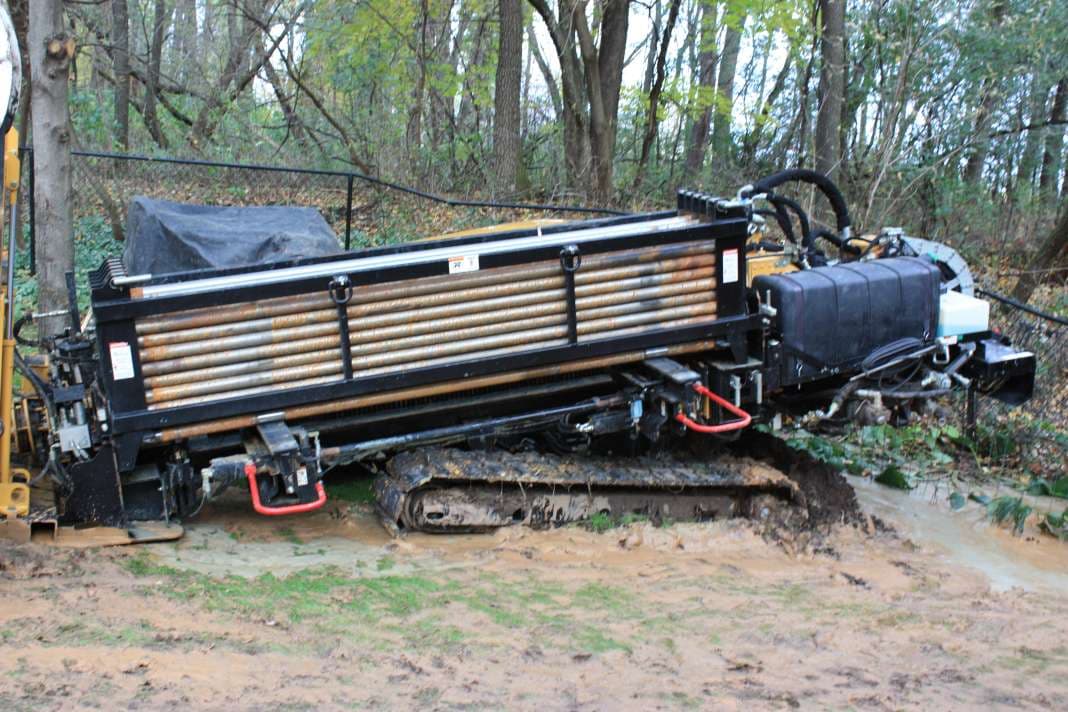
The loop type. For horizontal loops, the type of horizontal loop should be chosen by system size, space available, soil conditions and the excavating equipment used.[3] Vertical loops are used where space is limited or the soil does not suit horizontal loops, and they require a drilling rig,[3] so the depth and number of boreholes, and how hard the rock is, weigh heavily on the price. Pond loops can be a cost-effective option because trenching is limited to the supply and return piping,[3] but the pond should ideally be less than 200 feet from the house, and farther away the benefit is reduced by added trenching, materials and pumping costs.[3] An open loop uses an existing or new well, and well water should be tested for hardness, acidity and iron content before a heat pump is installed.[4]
Site restoration. Horizontal trenches are usually about 24 inches wide and leave temporary bare areas[4] that need regrading and seed or sod. Ask whether the quote includes it.
Size. Geothermal heat pumps typically are sized to meet your cooling requirements,[4] and depending on the house they supply 80-100 percent of your design heating load.[4] Bigger is not automatically better: sizing the unit to cover the entire heating load may lower heating costs slightly, but the savings may not offset the added cost of the larger unit and larger loop.[4] A good quote is based on a room-by-room load calculation, not the size of your old system.
Ductwork. Ductwork must be installed in homes that don't have an existing air distribution system,[4] and old ducts may need sealing or resizing. A house heated by baseboard or a boiler costs more to convert than one with sound ducts.
Equipment options. Ask how each quoted unit is staged and what that adds to the price. Optional extras include a hot water assist, which can preheat water by as much as 2°-10° F,[3] and the auxiliary heat package.
Electrical work. A geothermal unit plus backup heat may need new circuits or a larger electrical panel, which is a separate licensed trade.
Fees set by law and by your locality
The Virginia Department of Health issues an express geothermal permit for the construction of wells used solely for a closed-loop geothermal heating system, contingent upon proper registration and payment of application fees.[6] When we checked on October 26, 2026, the Virginia Department of Health's fee schedule listed $300 for a closed-loop geothermal well system, one fee per well system.[5] A single application fee is required for any geothermal well system, regardless of the number of wells included in the system.[6]
Local permits are on top of that. Fairfax County requires a residential mechanical permit for geothermal system installation and lists a House Location Plat or Grading Plan Submission ID Number among the items that may be required, applicable for geothermal installations.[7] Other counties and cities set their own fees, and your contractor normally pulls the permits and includes the fees in the quote. See do you need a permit to replace an HVAC system in Virginia.
Tax credits and rebates in 2026
Many older articles quote a 30% federal credit. That has ended for homes. The IRS says the Residential Clean Energy Credit equaled 30% of the cost of qualified property, including geothermal heat pumps, installed from 2022 through December 31, 2025, and is not available for any property placed in service after December 31, 2025.[8] On the business side, the Department of Energy says commercial building owners interested in installing GHPs are eligible for tax credits under the Investment Tax Credit (ITC, Section 48).[2] It also notes that the One Big Beautiful Bill Act (P.L. 119-21), enacted on July 4, 2025, revised dates and provisions affecting these credits, and refers readers to Treasury.gov or IRS.gov for the current rules.[2]
Virginia's federally funded rebates are not open either. In its rebate FAQ, last updated October 13, 2026, Virginia Energy says the Home Energy Rebates are not available now and that it cannot provide an estimated date for when they will be.[9] The planned HOMES program would provide up to $8,000 per household for retrofit projects with at least 20% modeled savings,[9] and the HEAR program lists up to $8,000 for an ENERGY STAR-certified heat pump for space heating and cooling.[9] Virginia Energy also warns that projects must be completed by a Verified Contractor, that Virginia's list of Verified Contractors has not yet been established, and that households that start before launch may assume full risk of project ineligibility.[9]
For help available now, Virginia Energy points residents to Virginia Energy Connect, its central hub for energy incentive information.[9] Households with low incomes can ask about DOE's Weatherization Assistance Program[2] through the state.
What it costs to run
Running cost is where geothermal earns its price back. Most geothermal heat pump systems have COPs of 3-4.5,[4] meaning three to four and a half units of heat for every unit of electricity, while electric resistance heaters have a COP of 1, which Virginia Cooperative Extension calls generally the most expensive method of heating.[10] If you heat with oil or propane today, Extension's advice is to compare fuels by the cost per amount of heat produced, not by the price per gallon, therm or kilowatt hour,[10] and to check with your local utility before replacing an existing system.[10] For whether the numbers work for your house, read is geothermal heating worth it in Virginia.
Getting quotes you can compare
ENERGY STAR advises that you get written, itemized estimates and compare cost, energy efficiency and warranties,[11] and that you sign a written proposal that specifies project costs, model numbers, the job schedule and warranty information.[11] For a geothermal job, ask each bidder for:
- the load calculation the unit size is based on
- the loop design: type, total pipe or borehole length, depth and who drills or trenches it
- the unit's model number, staging and ENERGY STAR rating, and the size of the backup heat
- what is included: ductwork, electrical changes, thermostat, the water heater connection, permits, inspections and yard restoration
- separate warranty terms for the indoor unit, the loop and the labour
When to call a licensed pro
For the whole project, and for the design before you price it. A contractor's licence class limits the size of a single job: Class C covers a single contract over $1,000 but less than $30,000, Class B covers $30,000 or more but less than $150,000, and Class A covers $150,000 or more.[12] Make sure the class matches the contract amount. On top of the class, the Board for Contractors requires a master tradesman licence as a condition of licensure for HVAC contractors.[12] Check the licence of the HVAC company and the loop driller before you pay a deposit.
Loclis lists DPOR-licensed HVAC businesses with their licence number and class. Browse geothermal services, find HVAC businesses in Blacksburg, or read more heating and cooling answers. See pricing for how Loclis charges.
If you have a geothermal system that needs repair, describe the job once and licensed local HVAC businesses quote it.
Common questions
- Why is geothermal so much more expensive than a regular heat pump?
- Mostly because of the ground loop, which needs trenching, drilling or a pond, plus permits and site restoration. The Department of Energy says the cost of ground heat-exchanger loops is what makes geothermal more expensive up front.
- Can I still get the 30% federal tax credit for geothermal?
- Not for a new home system. The IRS says the Residential Clean Energy Credit covered qualified property installed from 2022 through December 31, 2025, and is not available for property placed in service after that date. The Department of Energy says commercial building owners are eligible for the Investment Tax Credit (Section 48) for geothermal heat pumps, but notes that the One Big Beautiful Bill Act revised dates and provisions affecting these credits, so check Treasury.gov or IRS.gov for the current rules.
- What does the Virginia geothermal well permit cost?
- When we checked on October 26, 2026, the Virginia Department of Health's fee schedule listed $300 for a closed-loop geothermal well system, one fee per system no matter how many wells it includes. Local mechanical or building permits are separate and set by your county or city.
- Are there Virginia rebates for geothermal?
- Not through the federally funded Home Energy Rebates yet. Virginia Energy's FAQ, last updated October 13, 2026, says they are not available and gives no launch date. Ask your electric utility and check Virginia Energy Connect for programs open now, and ask whether a geothermal unit would qualify once the rebates launch.
- Does a bigger geothermal unit save more money?
- Not usually. Units are typically sized to the cooling load and cover 80 to 100 percent of the design heating load, with backup heat for the coldest days. A larger unit and loop cost more to install, and the extra heating savings may not cover the difference.
Sources
- [1] Geothermal FAQs, U.S. Department of Energy, Office of Geothermal. Checked October 26, 2026.
- [2] Tax Credits, Incentives, and Technical Assistance for Geothermal Heat Pumps, U.S. Department of Energy, Office of Geothermal. Checked October 26, 2026.
- [3] Owner's Manual, Residential Products (OM1500MW), WaterFurnace International. Checked October 26, 2026.
- [4] Geothermal FAQ & Glossary, WaterFurnace International. Checked October 26, 2026.
- [5] 12VAC5-620-70, Establishing fees, Virginia Administrative Code, Virginia Department of Health. Checked October 26, 2026.
- [6] 12VAC5-630-271, Express geothermal well permits, Virginia Administrative Code, Virginia Department of Health. Checked October 26, 2026.
- [7] Mechanical (MECHR) - Residential, Fairfax County, Virginia. Checked October 26, 2026.
- [8] Residential Clean Energy Credit, Internal Revenue Service. Checked October 26, 2026.
- [9] Home Energy Rebates Frequently Asked Questions, Virginia Department of Energy. Checked October 26, 2026.
- [10] ENERGY SERIES: What about the Heating System?, Virginia Cooperative Extension, Virginia Tech. Checked October 26, 2026.
- [11] 10 Tips for Hiring a Heating and Cooling Contractor, ENERGY STAR, U.S. Environmental Protection Agency. Checked October 26, 2026.
- [12] Va. Code § 54.1-1100, Definitions, Code of Virginia, Virginia General Assembly. Checked October 26, 2026.
Want a pro to handle it?
Describe the job once. Licensed local businesses send quotes, and you pay only when you book one.
Get a quote for HVAC Repair