How much does drywall repair cost in Virginia?
There is no official or standard price for drywall repair in Virginia, so the real number is a written quote. What moves it: how many holes and how big, ceilings and texture, whether the wall is repainted, how many return visits drying time forces, and lead or asbestos precautions in an older home. DPOR says work valued at $1,000 or more needs a licensed contractor.
Free to ask. Local shops send quotes, and you pay only when you book one.
By Kasra Taheri, Founder, LoclisPublished
Researched and drafted with AI, then checked claim by claim against the sources listed below before it was published. Prices and rules change; the dates beside each source say when it was last checked.
Step by step
Read when to stop and call a pro, further down this page, before you start.
Step 1: Photograph and measure each repair
Take a photo of every hole or crack with a tape measure in the shot, and note which room and wall it is on, so every business prices the same work.
Step 2: Say how far the painting goes
State whether you want the patches primed and spot painted or each wall repainted corner to corner, and give the paint color and sheen if you have them.
Step 3: Mention ceilings, texture and water
Flag any ceiling repair, textured wall or stained, soft drywall, since each changes the method and the time.
Step 4: Give the age of the house
Say whether the house was built before 1978, because anyone paid to disturb its paint must be certified in lead-safe work practices.[11]
Step 5: Flag a fire-rated wall
Say if a repair is on a wall or ceiling you know or suspect is a fire-rated assembly, since repairing a required component of one needs a permit in Virginia.[4]
Step 6: Ask how they charge
Ask whether the price is per hour with a minimum, per repair or for the whole job, how many visits it includes, and how materials are billed.
Step 7: Get written quotes
Get at least three written quotes for the same list, and ask about any quote far below the others.[5]
Step 9: Keep the deposit small
Limit any deposit to 10% of the price or $1,000, whichever is less, and do not pay in full until the work is finished.[5]
There is no official price list for drywall repair in Virginia, and no state agency publishes one, so any single number you read is a guess. What a business charges depends on what it finds on the wall and how it bills: by the hour with a minimum, by the repair, or for the whole job. The way to a real number is a written quote for a clear list. This page explains what moves that number and what to put in the request so the quotes you get are comparable.
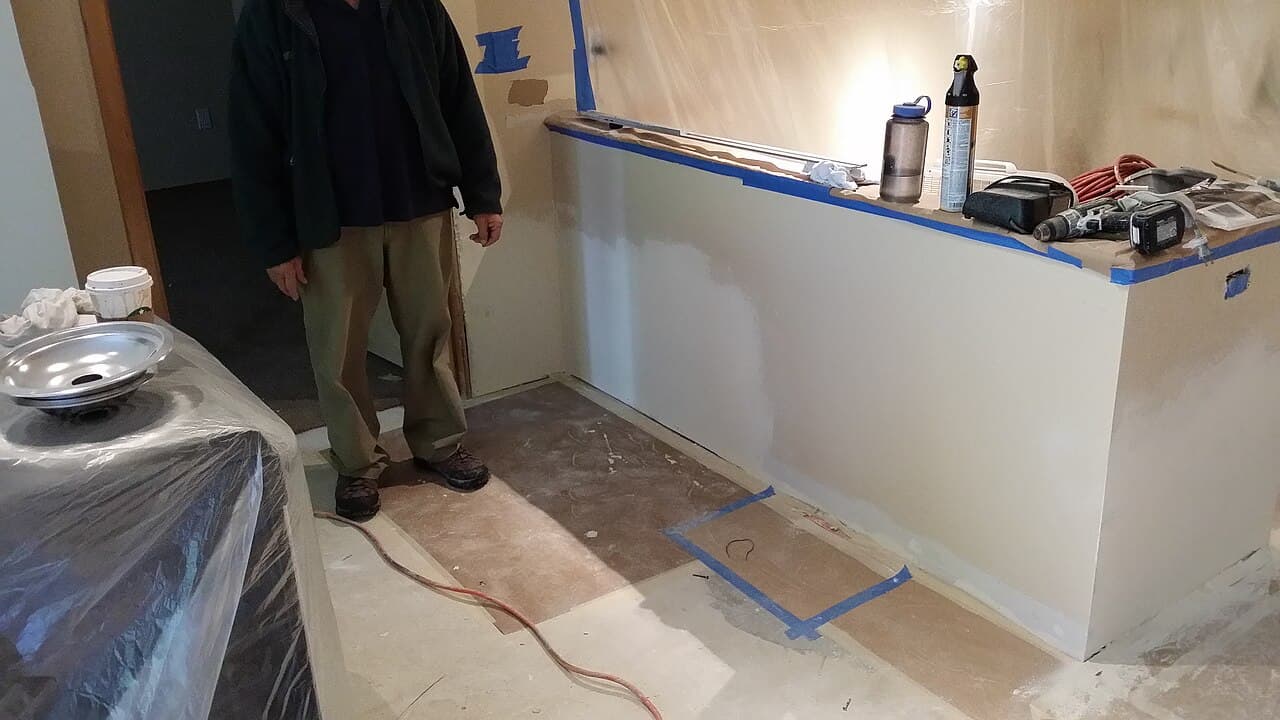
What drives the price
The size and number of repairs. A handful of nail holes is a short visit. A doorknob hole needs a patch or tape bridged over it. A hole bigger than a fist, or a section ruined by a leak, is cut out and replaced with a new piece of drywall; USG sells repair panels 23-5/8 inches square, designed to accommodate normal stud spacing,[8] which shows how big a typical cut-in repair gets. Grouping every repair in the house into one visit usually costs less than calling several times.
Drying time and return trips. This is the cost driver most people do not expect. USG allows about 24 hours between coats of its patching compound at 75°F and 50% humidity.[6] DAP's directions for its lightweight joint compound call for three coats, each dried about 24 hours and sanded, then another 24 hours before the surface is painted.[7] A taped or cut-in repair can therefore mean three or four trips, and each trip costs the business time and travel. Ask how many visits the quote includes.
How far the painting goes. A patch has to be primed and painted to disappear. Benjamin Moore's touch-up guidance is that flat and matte finishes touch up more easily than glossier ones,[10] so on an eggshell, satin or faded wall, the honest quote may be to repaint the whole wall. That costs more than a spot touch-up and usually looks far better. Having the original paint can, or at least the color name and sheen, saves time.
The finish you expect. In a room with big windows or a long hallway lit from the side, every ridge shows. USG says the surface should be skim coated with joint compound where it will be subjected to severe artificial or natural side lighting, or be decorated with gloss paint (eggshell, semigloss or gloss).[9] Skimming a wall is a different, larger job than patching a hole, so say up front if you want the repair invisible under raking light.
Ceilings, texture and water. Ceiling repairs take longer because of ladder work and gravity. Matching an existing texture, such as orange peel or knockdown, takes skill and test patches. A stained or soft area is a leak to find and fix first, and the drywall work only comes after it is dry.
The age of the house. In a home built before 1978, anyone paid to do work that disturbs painted surfaces in a pre-1978 home must be certified in lead-safe work practices, sole proprietors included.[11] Lead-safe setup and cleanup add time. Old texture or patching compound may also need an asbestos test before it is sanded or cut, and the EPA advises that sampling suspected asbestos be done by a trained and accredited asbestos professional rather than by the homeowner.[12] That is a separate cost, usually from a separate firm.
Permits and licences
Most drywall jobs need no permit. Virginia's building code lists the replacement of interior wall and ceiling finishes, and the application of paint or wallpaper, as ordinary repairs that need no permit application,[4] but it does require a permit for the repair or replacement of any required component of a fire or smoke rated assembly,[4] A business that knows this will say so in the quote.
No one may engage in contracting work in Virginia without a licence,[2] and the Class C licence covers a single job worth over $1,000 but less than $30,000.[1] The Board for Contractors' drywall (DRY) and painting and wallcovering (PTC) specialties cover this work, and so does the broader home improvement (HIC) specialty.[3] DPOR's consumer guide says that if the work is valued at $1,000 or more, a valid Virginia contractor's license is required for the license category in which the contractor is to work,[5] so a whole-house repair and repaint can pass that line quickly.
Getting quotes you can compare
DPOR's consumer guide tells homeowners to get at least three written bids for the same work and to be wary of any bid far lower than the others,[5] and recommends a deposit of no more than 10% of the price or $1,000, whichever is less.[5] A good quote names each repair, the method (spackle, tape, patch or new drywall), primer and paint, how many visits, cleanup, and what happens if the business finds water damage behind the wall.
Stop and call a pro if
- The drywall is wet, soft, stained or smells musty. Find and fix the leak before anyone prices the patch.
- The damage is on a wall or ceiling you know or suspect is part of a fire-rated assembly, since that repair needs a permit.
- Cracks keep coming back in the same places, or run from the corners of doors and windows, which points to movement in the house rather than a patching problem.
- The house was built before 1978 and the job means sanding or cutting old paint, texture or patching compound.
Related reading
See how to patch a small hole yourself, whether to hire a handyman or a drywall contractor, what a handyman costs in Virginia and whether it is illegal to hire an unlicensed contractor. Browse drywall repair, find handyman businesses around Blacksburg, or read the other handyman answers.
When you are ready, describe the drywall repair once and local businesses quote it.
Common questions
- Is there a standard price for drywall repair in Virginia?
- No. No state agency publishes drywall repair prices, and handymen and drywall contractors set their own. Some charge by the hour with a minimum, some by the repair and some by the job. The way to know the price is to send the same detailed list to several businesses and compare written quotes.
- Why does a small patch job sometimes take several visits?
- Compound has to dry between coats. USG allows about 24 hours between coats of its patching compound in normal room conditions, and a taped repair usually needs two or three coats plus primer and paint. Fast-drying spackling can shorten a nail-hole job to one visit, but a larger patch rarely can.
- Does drywall repair need a permit in Virginia?
- Usually not. The building code lists replacing interior wall and ceiling finishes and applying paint among the work that needs no permit application. The exception that catches people is a fire-rated assembly, where repairing a required component does need a permit.
- Does the person fixing my drywall need a licence?
- DPOR says that work valued at $1,000 or more needs a valid Virginia contractor's license. Virginia's Class C licence covers a single job over $1,000 and under $30,000, and drywall, painting or home improvement specialties cover this work. If the house was built before 1978, paid work that disturbs paint still needs EPA lead-safe certification.
- Is it cheaper to repaint the whole wall or just the patch?
- A spot touch-up uses less paint and time, but it often shows, especially on eggshell or satin walls or paint that has aged. Repainting the wall corner to corner costs more and usually hides the repair completely. Ask for both prices in the quote so you can choose.
Sources
- [1] Va. Code § 54.1-1100, Definitions (Contractors), Code of Virginia, Virginia General Assembly. Checked October 27, 2026.
- [2] Va. Code § 54.1-1103, Necessity for license, Code of Virginia, Virginia General Assembly. Checked October 27, 2026.
- [3] 18VAC50-22-30, Definitions of specialty services (Board for Contractors Regulations), Virginia Administrative Code, Virginia General Assembly. Checked October 27, 2026.
- [4] 13VAC5-63-80, Section 108 Application for permit (Virginia Uniform Statewide Building Code), Virginia Administrative Code, Virginia General Assembly. Checked October 27, 2026.
- [5] What You Should Know Before You Hire a Contractor, Virginia Department of Professional and Occupational Regulation. Checked October 27, 2026.
- [6] Sheetrock Brand Patch and Repair Pack Plus 3 Application Tips (J1805), United States Gypsum Company. Checked October 27, 2026.
- [7] Lightweight Wallboard Joint Compound, Ready to Use: Technical Data Sheet, DAP Products. Checked October 27, 2026.
- [8] Sheetrock Brand Patch & Repair Panels, USG. Checked October 27, 2026.
- [9] Wallboard Finished Appearance, Managing Expectations and Best Practices (WB2625), United States Gypsum Company. Checked October 27, 2026.
- [10] How to Touch Up Paint, Benjamin Moore. Checked October 27, 2026.
- [11] Lead Renovation, Repair and Painting Program, U.S. Environmental Protection Agency. Checked October 27, 2026.
- [12] Protect Your Family from Exposures to Asbestos, U.S. Environmental Protection Agency. Checked October 27, 2026.
Want a pro to handle it?
Describe the job once. Licensed local businesses send quotes, and you pay only when you book one.
Get a quote from a local pro