Should I hire a handyman or a drywall contractor?
For a few holes, cracks or one patch, a handyman is usually the practical choice. Hire a drywall or painting contractor for whole rooms, ceilings, new sections of drywall, texture matching or a smooth finish under strong light. In Virginia, DPOR says work valued at $1,000 or more needs a licensed contractor, and paid work that disturbs paint in a pre-1978 home needs lead-safe certification.
Free to ask. Local shops send quotes, and you pay only when you book one.
By Kasra Taheri, Founder, LoclisPublished
Researched and drafted with AI, then checked claim by claim against the sources listed below before it was published. Prices and rules change; the dates beside each source say when it was last checked.
Step by step
Read when to stop and call a pro, further down this page, before you start.
Step 1: List the damage
Walk the house and list every hole, crack and stain with a photo and a rough size, so you know whether it is a small patch job or a room-sized one.
Step 2: Rule out a leak
If any drywall is stained, soft or damp, have the leak found and fixed first; the patching comes after the wall is dry.
Step 3: Decide the finish you want
Say whether a spot touch-up is fine or the repair must disappear under strong side light, since the second may mean skim coating and repainting whole walls.[7]
Step 4: Estimate the total
If the work is likely to reach $1,000, you need a licensed contractor, according to DPOR.[5]
Step 6: Ask about lead-safe certification
For a house built before 1978, ask for the firm's EPA lead-safe certification before any paint is sanded or cut.[6]
Step 7: Ask about fire-rated walls
If a repair is on a wall or ceiling that is part of a fire-rated assembly, ask who will get the permit Virginia requires.[4]
Step 8: Get written quotes
Get at least three written bids for the same list and do not automatically take the lowest.[5]
Step 9: Put it in a written contract
Have the scope, number of coats, primer, paint, cleanup and price written down, and keep the deposit to 10% or $1,000, whichever is less.[5]
For a few nail holes, a doorknob hole, a hairline crack or one water-stained patch, a handyman is usually the practical hire: the work is small, mixed with other jobs, and priced by the visit. Call a drywall or painting contractor when the job is a whole room, a ceiling, a new section of drywall, a textured surface to match, or a wall that has to look flawless in strong light. In Virginia the size of the job also decides who may legally take it on.
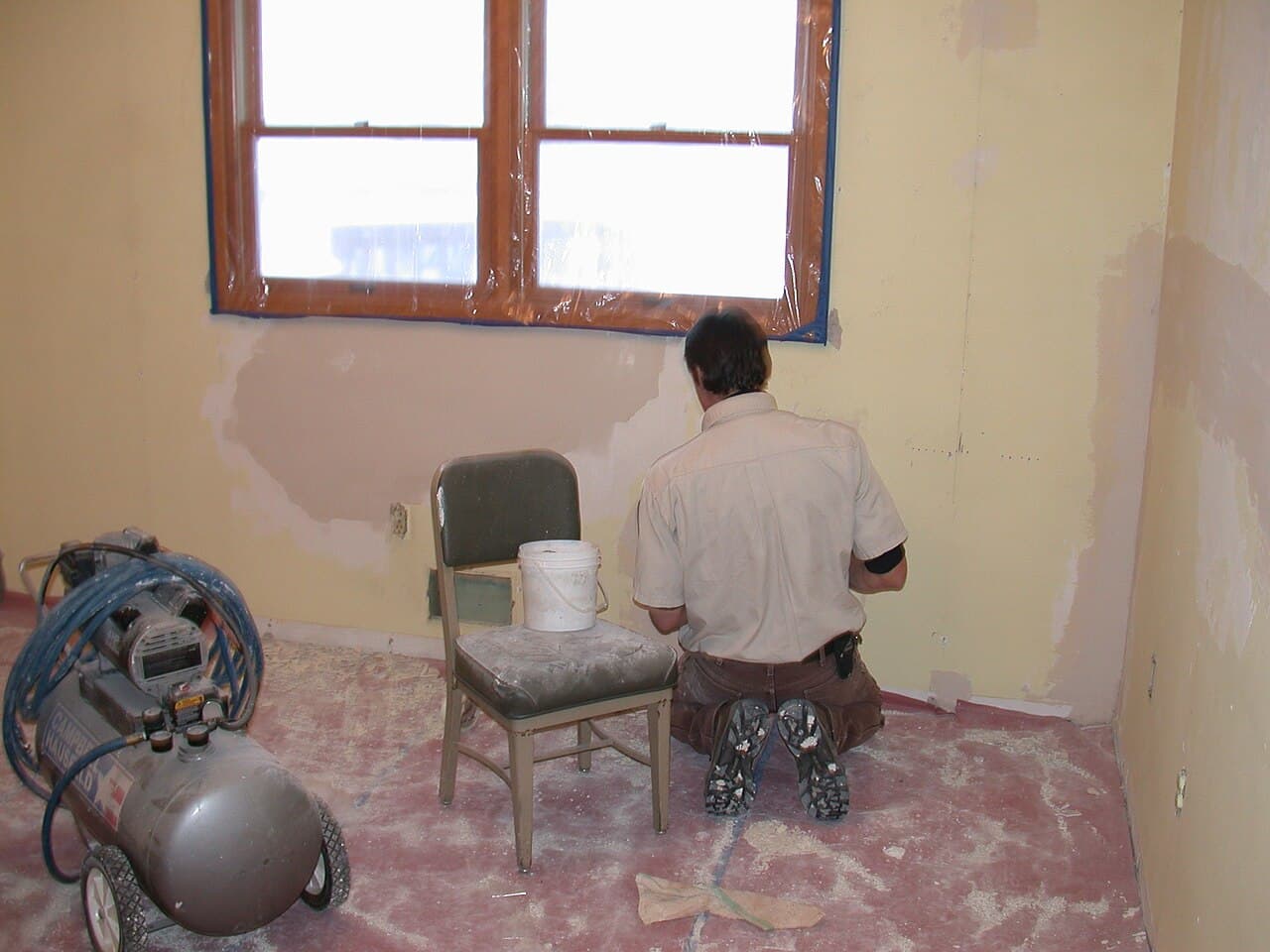
When a handyman is the right call
A handyman fits the small, mixed list: three holes in the hallway, a towel bar that pulled out, a cracked corner bead, and the sticking closet door, all in one visit. The repairs are short, the drying time between coats can be fitted around other tasks, and you avoid paying a specialist's minimum for each small item. If you want to try the simplest repairs yourself, see how to patch a small hole in drywall.
When a drywall or painting contractor fits better
Specialists earn their price on large and visible work: hanging and finishing new board, replacing a ceiling section, matching orange-peel or knockdown texture, or making a long wall look uniform. Finish quality has limits even for experts. USG's own guidance says that, depending on the finisher's skill, the light and the paint, distinct shadows at the joints may be visible even when completed by the most highly skilled professionals available in the industry.[7]
Light and sheen raise the bar. USG says the standard Level 4 drywall finish is not recommended under non-flat or dark paints or where critical lighting is present,[8] and that skim coating the entire surface, a Level 5 finish, will minimize these imperfections.[8] If your living room has a wall of west-facing windows and you want satin paint, that is a finisher's job, and it is worth saying so in the request.
What Virginia requires
No one may engage in contracting work in Virginia without a licence,[2] and the Class C licence covers a single job worth over $1,000 but less than $30,000.[1] DPOR's consumer guide says that if the work is valued at $1,000 or more, a valid Virginia contractor's license is required,[5] and a whole-house repair and repaint can pass that line quickly.
The licence also has to fit the work. The Board for Contractors has a drywall contracting (DRY) specialty for installing, taping and finishing drywall, and a painting and wallcovering (PTC) specialty that includes the surface preparation, caulking and sanding before paint.[3] The broader home improvement (HIC) specialty also covers both kinds of work on a house,[3] which is why many licensed handyman businesses hold it. But the HIC specialty does not cover electrical, plumbing, HVAC or gas fitting,[3] so moving an outlet or a pipe inside the opened wall is a job for a licensed tradesman.
DPOR's consumer guide warns: "A license number in an advertisement or on a business card does not necessarily mean the contractor’s license is valid."[5] Look the business up. Hiring licensed has practical benefits too: Virginia law requires licensed contractors to give a written contract for residential work,[5] and the state's Contractor Transaction Recovery Fund can pay claims up to $20,000 to consumers who win a court judgment against a licensed contractor for improper or dishonest conduct.[5] For more, see whether it is illegal to hire an unlicensed contractor.
Older homes and fire-rated walls
In a home built before 1978, anyone paid to do work that disturbs painted surfaces in a pre-1978 home must be certified in lead-safe work practices, and that includes sole proprietors.[6] That applies to a handyman and a drywall contractor alike, so ask for the certification before work starts.
A wall or ceiling that is part of a fire-rated assembly is a special case. Virginia's building code requires a permit for the repair or replacement of any required component of a fire or smoke rated assembly,[4] and USG notes that a fire-rated repair must use like materials to restore the assembly to its original condition.[9] A business that does that kind of repair will know the permit and the board type; one that shrugs at the question is the wrong hire for that wall.
Comparing quotes
DPOR's guide recommends at least three written bids using the same specifications, and not automatically accepting the lowest,[5] and a deposit of no more than 10% of the price or $1,000, whichever is less.[5] Ask each business the same questions: how many coats and visits, which primer, whether they repaint the whole wall or touch up, how they control dust, and what happens if they open the wall and find water damage. See what drywall repair costs in Virginia for what moves the price.
Stop and call a pro if
- The drywall is wet, sagging or stained from above. Stop the water first, then hire for the repair.
- Cracks keep reopening, run diagonally from door and window corners, or doors have started to stick at the same time. That is a question about the structure, not the patch.
- The repair is on a wall or ceiling that is part of a fire-rated assembly, or would mean moving wiring, plumbing or ductwork inside the wall.
- The house was built before 1978 and the job means sanding or cutting old paint or texture.
Find someone
Browse drywall and paint services and drywall patching, find handyman businesses or painting businesses around Blacksburg, or read the other handyman answers.
When you know what you need, describe the drywall repair once and local businesses quote it.
Common questions
- Can a handyman legally do drywall work in Virginia?
- Yes, for small jobs. DPOR says a Virginia contractor's license is required for work valued at $1,000 or more, so patching a few holes will usually fall below that line. Once the job reaches it, the handyman needs a Class C or higher licence with a specialty that covers the work, such as home improvement, drywall or painting.
- What is the difference between a drywall contractor and a painter for repairs?
- A drywall contractor hangs, tapes and finishes the board; a painting contractor prepares and paints it, including filling and sanding small defects. Many repairs need both skills. Virginia's home improvement specialty covers both kinds of work on a house, so one licensed business can often do the whole job.
- Do I need a permit to have drywall repaired?
- Usually not. The building code lists replacing interior wall and ceiling finishes and applying paint among the work that needs no permit application. A repair to a required component of a fire-rated assembly does need a permit.
- Who fixes drywall after a leak?
- Start with whoever stops the water: a plumber for a pipe, a roofer for a roof leak. Once the cause is fixed and the framing is dry, a handyman can patch a small area, while a drywall contractor or a water damage repair firm is the usual choice for a large wet section or a sagging ceiling.
- How do I check a drywall contractor's licence?
- Use DPOR's online licence lookup or call the Board for Contractors at (804) 367-8511. Check that the licence is current, that its class covers the size of your job, and that it carries a specialty such as drywall, painting or home improvement. A number printed on a card or a truck is not proof on its own.
Sources
- [1] Va. Code § 54.1-1100, Definitions (Contractors), Code of Virginia, Virginia General Assembly. Checked October 27, 2026.
- [2] Va. Code § 54.1-1103, Necessity for license, Code of Virginia, Virginia General Assembly. Checked October 27, 2026.
- [3] 18VAC50-22-30, Definitions of specialty services (Board for Contractors Regulations), Virginia Administrative Code, Virginia General Assembly. Checked October 27, 2026.
- [4] 13VAC5-63-80, Section 108 Application for permit (Virginia Uniform Statewide Building Code), Virginia Administrative Code, Virginia General Assembly. Checked October 27, 2026.
- [5] What You Should Know Before You Hire a Contractor, Virginia Department of Professional and Occupational Regulation. Checked October 27, 2026.
- [6] Lead Renovation, Repair and Painting Program, U.S. Environmental Protection Agency. Checked October 27, 2026.
- [7] Wallboard Finished Appearance, Managing Expectations and Best Practices (WB2625), United States Gypsum Company. Checked October 27, 2026.
- [8] Finishing & Decorating Gypsum Panels, White Paper (J2010), United States Gypsum Company. Checked October 27, 2026.
- [9] Repair Drywall: USG Interior Panel & Finishing Solutions, USG. Checked October 27, 2026.
Want a pro to handle it?
Describe the job once. Licensed local businesses send quotes, and you pay only when you book one.
Get a quote from a local pro