Why is my drywall patch showing through the paint?
Usually because the patch was not primed: bare joint compound absorbs paint differently from the painted wall around it, so it dries duller or shinier, which painters call flashing. A smooth patch on a textured wall, a ridge or dip, scuffed paper, a glossy sheen and side lighting make it worse. Prime the patch, match the texture, then repaint the wall.
Free to ask. Local shops send quotes, and you pay only when you book one.
By Kasra Taheri, Founder, LoclisPublished
Researched and drafted with AI, then checked claim by claim against the sources listed below before it was published. Prices and rules change; the dates beside each source say when it was last checked.
Step by step
Read when to stop and call a pro, further down this page, before you start.
Step 1: Look at it in raking light
Hold a flashlight flat against the wall beside the patch to see whether the problem is a sheen spot, a ridge or dip, fuzzy paper or a texture difference.
Step 2: Level a ridge or fill a dip
Lightly sand a ridge, or spread a thin coat of compound wider than the old patch so it tapers out in a gentle arc instead of a hard edge.[3]
Step 3: Fix roughened paper
Where sanding raised fuzzy fibers on the drywall paper, skim a little joint compound over them with a broad knife.[2]
Step 4: Let every coat dry
Wait until each coat is fully dry before the next so it finishes shrinking before you sand or paint.[3]
Step 5: Sand with a damp sponge
Wet sand with a wrung-out sponge where you can, since wet-sanded areas are easier to hide under paint than dry-sanded ones.[2]
Step 6: Match the texture
On a textured or roller-stippled wall, recreate the texture over the patch and use the same type of roller or brush as the original paint.[6]
Step 9: Check it in your own light
Look at the wall again in daylight and with the room's lamps on, from where you normally sit or stand, before deciding it needs more work.
A drywall patch that shows through paint is almost always one of a few problems: the patch was not primed, its surface is a different texture from the wall, it is not quite flat, or the paint's sheen and the light in the room are exaggerating a small difference. Most of the time you can fix it without starting over. Work out which problem you have first, because the cure is different for each.
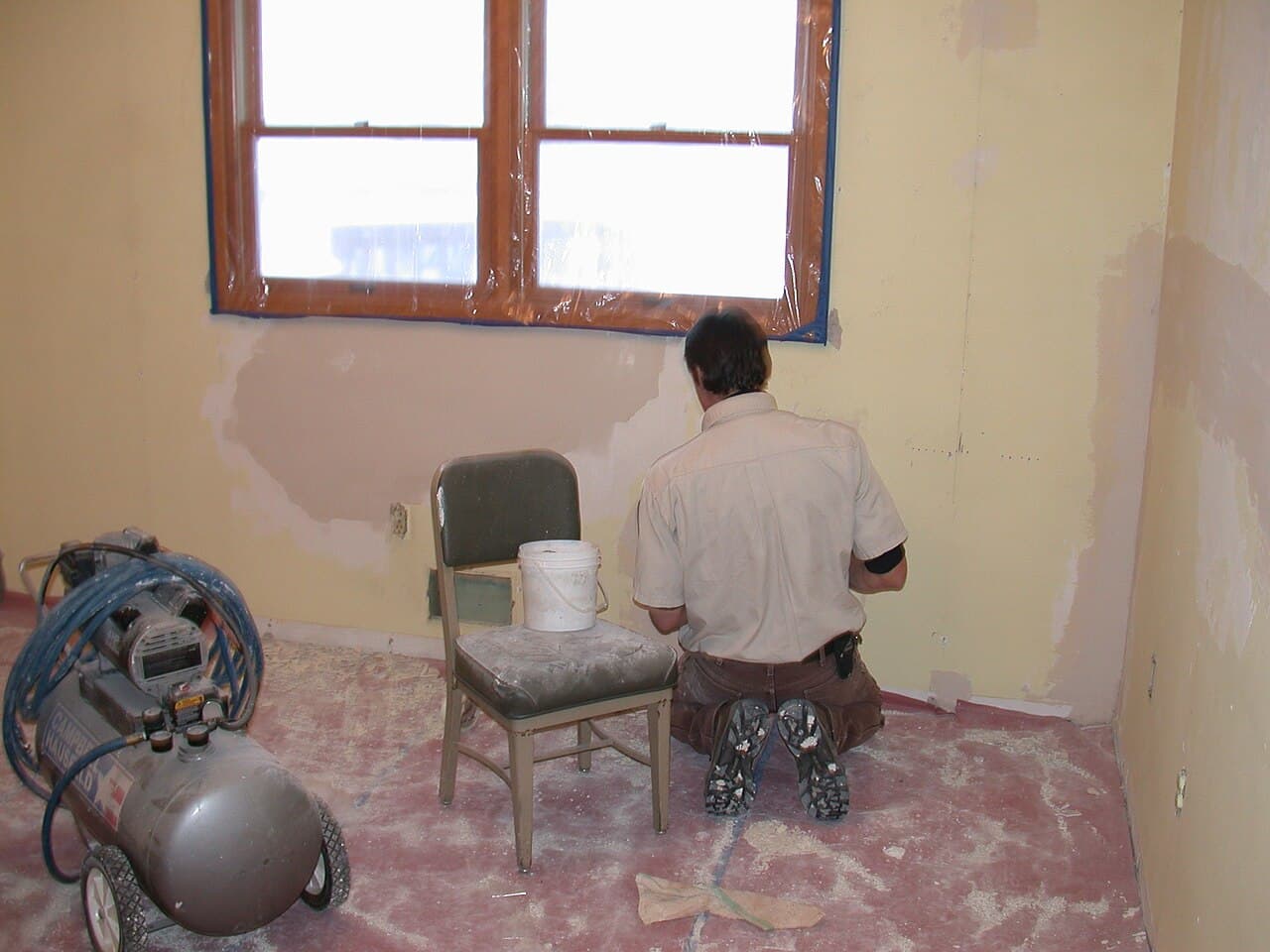
The patch soaked up the paint differently
This is the most common cause. Bare joint compound and painted drywall do not absorb paint the same way, so the patch dries to a different sheen, a dull or shiny spot often called flashing. USG says these problems, which painters call joint banding or photographing, are usually caused by differences in porosity and surface texture between the drywall's face paper and the joint compound, and are magnified by gloss paints.[1]
Primer is the fix. Priming seals the filler and helps keep it from absorbing the new paint.[5] USG calls for a prime coat of its drywall primer or undiluted latex flat wall paint with high solids content before painting,[4] and defines a high-solids pigmented drywall primer as one with more than 50% solids by weight.[2] On the popular shortcut, its white paper is blunt: "Not all 2-in-1 paint & primers are created equal and might not equalize the porosity."[2]
The sheen is unforgiving
Benjamin Moore's touch-up guidance is that flat and matte finishes touch up more easily than glossier ones.[6] It also warns that a gloss finish reflects light and can accentuate blemishes, so it should not go on areas that are not completely smooth.[7] A patch that vanishes under flat ceiling paint can stand out under eggshell or satin. If you are repainting anyway and the room is not a kitchen or bath, a lower sheen hides repairs better.
The texture does not match
Most walls are not perfectly smooth. Even a "smooth" wall carries the fine stipple of the roller that painted it, and many homes have orange-peel or knockdown texture. A patch troweled glass-smooth looks like a flat window in that surface. Benjamin Moore's advice is to match the surface texture as well as the color and sheen, using the same brush or roller as the original paint job and working in the same direction.[6]
The same effect happens on smooth walls at a finer scale. USG says fasteners, panels and joints may be visible under critical lighting when the wall is painted with sheen, because of the difference between the texture of the panel face and the smoothed joint compound.[2]
The patch is not flat
A ridge around the edge, a slight hump, or a dip where the filler shrank all cast shadows. USG recommends spreading compound in graduated arcs rather than flush with the surface, because recesses or ridges cast distinct shadows in critical lighting.[3] In practice that means a wider, thinner final coat that tapers to nothing several inches beyond the hole, not a tight little patch the size of the damage.
Shrinkage is part of this. Compound that is painted before it has fully dried can keep sinking. USG's guidance is that allowing each coat of ready-mixed compound to dry thoroughly lets all of its shrinkage happen before the next coat goes on.[3]
Sanding left marks
Over-eager sanding causes its own halo. USG warns: "Roughened paper contains raised fibers that are conspicuous after painting."[2] It also notes that coarse abrasives can leave scratches in the compound that show through paint.[2] The cure for fuzzy paper is a thin skim of compound over it, then gentle sanding. Better still, use a damp sponge: "Wet sanded areas may be more easily concealed with paint finishes than dry sanded areas."[2]
The light is doing it
Low-angle light from a window or a hallway fixture exaggerates everything. USG's guidance puts it plainly: "Increased lighting that is cast upon a drywall surface, artificial or natural, can accentuate even slight surface variations".[3] A patch you see only at 8 a.m. may not be worth more work. One you see all day is.
Touch-up or repaint
Even a perfectly primed, flat patch can show if the paint around it has faded or yellowed, or if the touch-up paint is from a different batch. Benjamin Moore suggests considering repainting the entire wall, since touch-ups may not turn out perfect.[6] Repaint from corner to corner, so any slight color shift lands at an inside corner where the eye accepts it.
Stop and call a pro if
- A yellow or brown ring keeps bleeding through, or the patch is soft or damp. That is a leak, past or present, to find before painting again.
- The paint bubbles over the patch. Applying primer or paint to walls that are still damp can cause blistering,[8] and repeated bubbling points to moisture in the wall.
- Dark spots keep appearing. Benjamin Moore warns that mildew painted over will grow through new paint,[8] and the moisture source needs fixing first.
- The same patch cracks again and again, which suggests movement in the wall or framing.
- The whole wall shows joints and patches in strong light, and you want it uniform. That calls for skim coating the entire surface, which is finisher's work.
- The house was built before 1978 and fixing the patch means sanding old paint. If you hire it out, anyone paid to do work that disturbs painted surfaces in a pre-1978 home must be certified in lead-safe work practices.[9]
Related help
Start with how to patch a small hole in drywall for the full repair, see what drywall repair costs in Virginia, browse interior painting or drywall repair, find painting businesses around Blacksburg, or read the other handyman answers.
If you would rather someone else get it invisible, describe the drywall repair once and local businesses quote it.
Common questions
- What is flashing on a painted wall?
- Flashing is a patch or joint that shows through the paint as a spot of different sheen, usually duller or shinier than the wall around it. It happens because bare joint compound and painted drywall absorb paint differently. USG says a primer that equalizes porosity gives the best chance of minimizing it.
- Will a second coat of paint hide the patch?
- Sometimes, but often not. If the patch was never primed, extra coats of finish paint may still look different over it. If the patch has a ridge, dip or different texture, more paint will not change that. Fix the shape first, prime the patch, then repaint the whole wall.
- Is paint-and-primer-in-one enough over a patch?
- Not always. USG's guidance warns that not all 2-in-1 paint and primers are created equal and some might not equalize the porosity. A separate coat of a high-solids drywall primer, or undiluted high-solids flat latex paint as USG suggests, is the safer choice over fresh compound.
- Why does my patch only show at certain times of day?
- Light coming across the wall at a low angle, from a window in the morning or a lamp at night, throws tiny ridges and texture differences into shadow. USG notes that increased lighting can accentuate even slight surface variations. Check your repair in the light you actually live with.
- Why is my patch bubbling or turning yellow?
- Bubbling often means paint went onto compound or a wall that was still damp. A yellow or brown ring is usually a water stain bleeding through, which means a leak, past or present. Find out which before repainting, because more paint will not fix either one.
Sources
- [1] Sheetrock Brand First Coat Primer Submittal Sheet (J1095), United States Gypsum Company. Checked October 27, 2026.
- [2] Finishing & Decorating Gypsum Panels, White Paper (J2010), United States Gypsum Company. Checked October 27, 2026.
- [3] Wallboard Finished Appearance, Managing Expectations and Best Practices (WB2625), United States Gypsum Company. Checked October 27, 2026.
- [4] Sheetrock Brand Patch and Repair Pack Plus 3 Application Tips (J1805), United States Gypsum Company. Checked October 27, 2026.
- [5] How to Fix Cracks and Holes in Walls, Benjamin Moore. Checked October 27, 2026.
- [6] How to Touch Up Paint, Benjamin Moore. Checked October 27, 2026.
- [7] Choosing an Interior Paint Finish: Sheen and Gloss 101, Benjamin Moore. Checked October 27, 2026.
- [8] How to Prepare Walls for Painting, Benjamin Moore. Checked October 27, 2026.
- [9] Lead Renovation, Repair and Painting Program, U.S. Environmental Protection Agency. Checked October 27, 2026.
Want a pro to handle it?
Describe the job once. Licensed local businesses send quotes, and you pay only when you book one.
Get a quote from a local pro