What should I ask a contractor before installing a heat pump?
Ask for their DPOR licence number and class, then how they will size the system (a Manual J load calculation, not a rule of thumb), which model and cold-climate rating they propose, how backup heat will be sized and set, whether they will test the ducts, airflow and refrigerant charge, who pulls the permit, and what the written contract and warranty cover.
Free to ask. Local shops send quotes, and you pay only when you book one.
By Kasra Taheri, Founder, LoclisUpdated
Researched and drafted with AI, then checked claim by claim against the sources listed below before it was published. Prices and rules change; the dates beside each source say when it was last checked.
This is a job for a licensed pro in Virginia
This page explains what the work involves, the permits, what a licensed pro does and what drives the cost. It does not give step-by-step instructions, because this work needs a licence, a permit or both, and doing it wrong can injure someone. Before you hire, check the licence on Virginia's DPOR record.
Start with the licence, then ask how they will size and set up the system. A good heat pump contractor in Virginia will give you a DPOR licence number you can check, a load calculation for your house, a specific model with its cold-climate rating and backup heat, a plan for the ducts, the permit, and a written contract that meets the state's minimum terms.
Licence and certification
What is your DPOR licence number, class and specialty? The class has to fit the contract value: Class C covers a single contract over $1,000 but less than $30,000, and Class B covers $30,000 or more but less than $150,000.[1] On top of the class, the Board for Contractors requires a master tradesman licence as a condition of licensure for HVAC contractors.[1] Under the board's rules, practicing in a classification, specialty service or class of licence the contractor does not hold is a prohibited act.[2] Look the business up on DPOR's License Lookup[4] and see how to check if a contractor is licensed in Virginia. ENERGY STAR advises that you find out about licence and insurance requirements for contractors in your state,[6] so ask for proof of insurance too.
Are the technicians EPA certified to handle refrigerant? Under EPA's Section 608 rules, technicians who maintain, service, repair, or dispose of equipment that could release refrigerants into the atmosphere must be certified.[5] Technicians earn certification by passing an EPA-approved test, administered by an EPA-approved certifying organization,[5] so ask which organization certified each technician who will handle the refrigerant.
Sizing and equipment
Will you do a load calculation, and can I have a copy? According to ENERGY STAR, your contractor should verify the proper size system for your home using a tool called "Manual J", a calculation of how much heating and cooling the house needs.[8] ENERGY STAR also warns that "A bigger system isn't always better"[6] and says a contractor should size the system based on the size of your house, its level of insulation and its windows.[6] ENERGY STAR explains the cost of getting it wrong: "Oversized equipment may cycle too frequently, resulting in less comfort and a shortened lifespan."[7] Contractors should use the actual characteristics of your home and not just rely on a 'rule of thumb'.[7]
Some Virginia localities ask for the same numbers. Spotsylvania County's HVAC design worksheet, which the mechanical contractor completes, asks for the load calculation, the heating output capacity and the auxiliary heat output capacity of the equipment, and the heating and cooling airflow in CFM.[9] Those are good numbers to ask for wherever you live.
Which model, and is it rated for cold climates? Ask for the outdoor and indoor model numbers, capacity, SEER2 and HSPF2 ratings. ENERGY STAR advises: "If you live in a climate where winter temperatures regularly dip below freezing, talk to your contractor to choose an ENERGY STAR unit suited to your particular home."[8] ENERGY STAR's cold-climate certification tests heat pumps down to 5°F,[8] which matters more in the Blue Ridge than on the coast.
Backup heat and the thermostat
What backup heat will I have, how big, and when will it come on? The backup is usually electric heat strips in the air handler or, if you keep a furnace, gas heat. Keeping a relatively new furnace and adding a heat pump creates a dual-fuel system for a modest extra cost over an AC system,[8] according to ENERGY STAR.
Ask how the thermostat will be set up, because that decides how often the expensive backup runs. Ask at what outdoor temperature backup heat will be allowed to come on and why, and to be shown the thermostat before they leave. For what backup heat does on a cold day, see how a heat pump works in cold weather.
Ducts, airflow and refrigerant charge
Will you inspect and test the ducts? ENERGY STAR recommends that the contractor inspect your home's duct system, perform a leakage test, and make necessary repairs.[7] Spotsylvania County's HVAC design worksheet lists the testing options for ductwork: a test by an approved testing agency after construction or at rough-in, or no testing for a ductless system.[9]
Will you measure airflow and set the refrigerant charge? ENERGY STAR suggests you ask the contractor to make sure your new system's airflow meets manufacturer performance specifications[7] and to test and adjust the system's refrigerant charge.[7] Ask for the readings in writing.
Where the outdoor unit goes
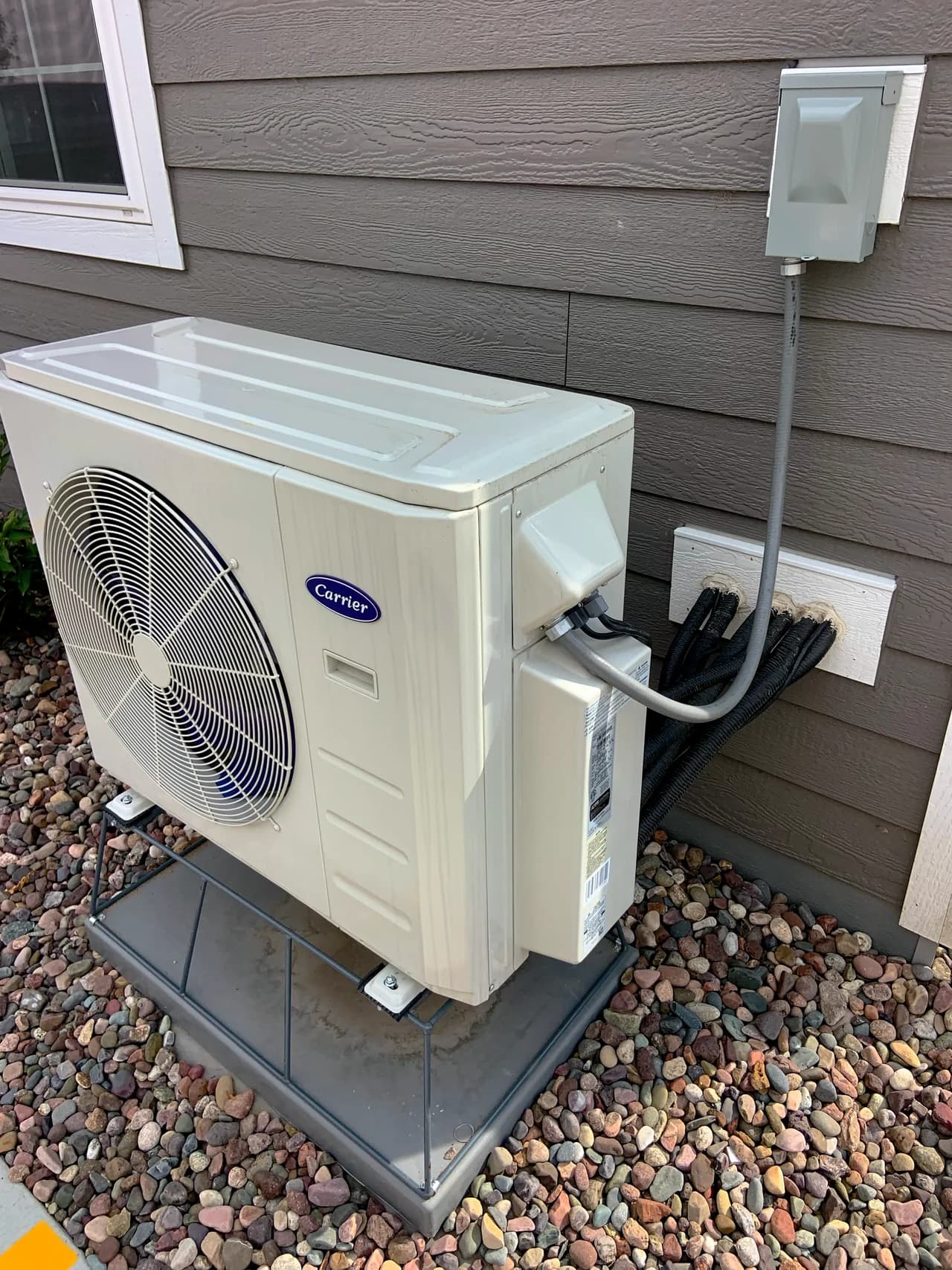
Where will the outdoor unit sit, and how will it stay clear? Carrier's general guideline is to keep at least 24 inches of clear space around the heat pump, while following the clearance requirements for your specific model.[11] It also warns that water from melting snow or ice can leak onto the coil and then freeze, for example from a leaky gutter.[11] A spot under a roof valley or a dripping gutter is worth avoiding.
Permit and inspection
Who pulls the permit, and is it in the price? Under the Uniform Statewide Building Code, a permit has to be obtained before work starts on mechanical systems and any equipment the code regulates.[3] The same section exempts "Replacement of mechanical appliances provided such equipment is not fueled by gas or oil" for dwellings in Groups R-3, R-4 and R-5, and in Group R-2 where it serves a single-family dwelling,[3] so swapping one electric heat pump for another in a house may not need a permit application under the state code, while a new installation is not a replacement. Local practice still matters: Fairfax County's permit library says a mechanical permit is required for new, replacement, repair or conversion of HVAC systems.[10] Ask what your own building department requires. If you want the work inspected anyway, when the owner or the owner's agent asks for a permit on exempt work, the code says one is issued and the related inspections are required.[3] Whoever applies must show the building official proof of a contractor licence, or file a written statement that they are not subject to licensing,[3] which is one reason a licensed contractor normally handles it. For more, see do you need a permit to replace an HVAC system in Virginia.
Price, references and the contract
Can I talk to recent customers? "Ask contractors for customer references and call them."[6] And ask for the energy figures: "Contractors should be able to show you calculations of savings for ENERGY STAR heating and cooling equipment."[6] Get written, itemized estimates from more than one contractor and compare cost, energy efficiency and warranties.[6] For typical prices, see how much a heat pump costs in Virginia.
Will the contract include the terms Virginia requires? For residential work, the Board for Contractors sets these minimum terms for the written contract:
- when work is to begin and the estimated completion date[2]
- the total cost, and the amounts and schedule of progress payments, including a specific statement of the down payment[2]
- a listing of the specified materials and work to be performed, when the consumer specifically asks for one[2]
- a plain-language exculpatory clause about events beyond the contractor's control, with a statement that delays caused by such events do not constitute abandonment and are not counted in the timeframes for payment or performance[2]
- a statement that the contractor will comply with all local requirements for building permits, inspections and zoning[2]
- the cancellation rights of both parties[2]
- your signed acknowledgment that you have been given and have read the DPOR statement of protection available to consumers through the Board for Contractors[2]
- the contractor's name, address, licence number, class of licence and classifications or specialty services[2]
- a statement that any change to cost, materials, work or completion date must be in writing and signed by all parties[2]
- a notice about the Virginia Contractor Transaction Recovery Fund and how to contact the board about a claim[2]
Ask also who registers the equipment warranty and what labor warranty the contractor gives.
Will this qualify for a rebate? Be careful with any yes about the state's Home Energy Rebates. Virginia Energy says DOE requires all projects to be completed by a Verified Contractor to qualify for a rebate, and Virginia's list of Verified Contractors has not yet been established.[12]
When to call a licensed pro
Installing a heat pump means refrigerant lines, line-voltage wiring and often duct changes, so the whole job belongs to a licensed HVAC contractor. Your part is the questions above and the paperwork.
Loclis lists DPOR-licensed HVAC businesses with their licence number and class. Browse heat pump services, find HVAC businesses in Blacksburg, or read more heating and cooling answers.
Describe the job once and licensed local HVAC businesses quote it, so you can put these questions to each of them.
Common questions
- What licence does a heat pump installer need in Virginia?
- A contractor licence of the right class for the contract size, with the HVAC specialty, and the Board for Contractors requires a master tradesman licence as a condition of licensure for HVAC contractors. Class C covers single contracts over $1,000 but under $30,000. Look the business up on DPOR's License Lookup before you sign.
- Should a contractor size my heat pump to match the old unit?
- Not without checking. ENERGY STAR says the contractor should verify the size with a Manual J calculation of your home's heating and cooling needs, and warns that oversized equipment may cycle too frequently, resulting in less comfort and a shortened lifespan. A rule of thumb or the old label is not a load calculation.
- Who pulls the permit for a heat pump installation?
- Normally the licensed contractor. Under the Uniform Statewide Building Code, whoever applies must show proof of a contractor licence or file a statement that they are not subject to licensing. Virginia's contract rules also require a statement that the contractor will comply with local permit, inspection and zoning requirements.
- Can a contractor promise me a Virginia heat pump rebate?
- Not for the federally funded Home Energy Rebates, which had not launched when Virginia Energy last updated its FAQ on October 13, 2026. Virginia Energy says projects must be done by a Verified Contractor and that its list of Verified Contractors has not yet been established.
- What should the written contract include?
- Under Virginia's Board for Contractors rules: start and estimated completion dates, the total cost, the payment schedule and down payment, a list of materials and work if you ask for one, a plain-language clause on delays beyond the contractor's control, the permit and inspection statement, cancellation rights, your signed acknowledgment of DPOR's statement of protection, the contractor's name, address, licence number and class, a rule that changes are in writing and signed, and a notice about the Contractor Transaction Recovery Fund.
Sources
- [1] Va. Code § 54.1-1100, Definitions, Code of Virginia, Virginia General Assembly. Checked October 26, 2026.
- [2] 18VAC50-22-260, Filing of charges; prohibited acts, Virginia Administrative Code, Board for Contractors. Checked October 26, 2026.
- [3] 13VAC5-63-80, Section 108 Application for permit, Virginia Administrative Code, Uniform Statewide Building Code. Checked October 26, 2026.
- [4] License Lookup, Virginia Department of Professional and Occupational Regulation. Checked October 26, 2026.
- [5] Section 608 Technician Certification Requirements, U.S. Environmental Protection Agency. Checked October 27, 2026.
- [6] 10 Tips for Hiring a Heating and Cooling Contractor, ENERGY STAR, U.S. Environmental Protection Agency. Checked October 26, 2026.
- [7] HVAC Quality Installation, ENERGY STAR, U.S. Environmental Protection Agency. Checked October 26, 2026.
- [8] Air-Source Heat Pumps, ENERGY STAR, U.S. Environmental Protection Agency. Checked October 26, 2026.
- [9] Mechanical (HVAC Only) Application Packet, Spotsylvania County, Virginia. Checked October 26, 2026.
- [10] Mechanical (MECHR) - Residential, Fairfax County, Virginia. Checked October 26, 2026.
- [11] Heat Pump Troubleshooting Guide, Carrier. Checked October 26, 2026.
- [12] Home Energy Rebates Frequently Asked Questions, Virginia Department of Energy. Checked October 26, 2026.
Want a pro to handle it?
Describe the job once. Licensed local businesses send quotes, and you pay only when you book one.
Get a quote for HVAC Repair