How much does hoarding cleanup cost in Virginia?
No public source sets a price for hoarding cleanup in Virginia. The cost depends on how much has to go, how heavy it is, how carefully it must be sorted, and whether pests, mold, animal waste or damage need specialist work. Disposal fees set a floor: Fairfax County charges residents $98 a ton for bulk trash from July 2026 to June 2027.
Free to ask. Local shops send quotes, and you pay only when you book one.
By Kasra Taheri, Founder, LoclisPublished
Researched and drafted with AI, then checked claim by claim against the sources listed below before it was published. Prices and rules change; the dates beside each source say when it was last checked.
Step by step
Read when to stop and call a pro, further down this page, before you start.
Step 1: Photograph every space
Take photos of each room, the basement, attic, garage and yard, and the route out to the street, so every company quotes the same job.
Step 2: List the hazards
Note pests, mold, animal waste, soft or sagging floors and anything chemical, since each one changes the crew, the equipment and the price.[5]
Step 3: Name what must be found
Tell each company about papers, cash, photos or heirlooms the crew has to search for, because careful sorting takes more hours than a straight haul.
Step 4: Set hazardous waste aside
Keep paint, fuel, pesticides and batteries out of the load and use your locality's household hazardous waste program instead.[11]
Step 5: Check public pickup first
Ask your trash service what bulk pickups it includes; Fairfax County collection customers get five free special pickups a year.[3]
Step 6: Get three written quotes
Ask at least three companies for written, itemized prices based on the same description, and do not automatically take the lowest.[10]
Step 7: Sanity-check the disposal line
Compare each quote's disposal charge with your local landfill's published per-ton rate.[1]
Step 8: Ask about local programs
Call your local social services office or area agency on aging about cleanup, repair or support programs before paying full price.[6]
No public agency publishes a price for hoarding cleanup in Virginia, and an honest quote is impossible without seeing the house. What you can know in advance is what drives the bill, what the landfill will charge for the disposal part, and which local programs can take some of the cost. Here is how to read the quotes you get.
What drives the price
How much has to go, and how heavy it is. Haulers pay landfills by the ton, and hoarded homes are often paper-heavy. EPA's volume-to-weight table puts loose newsprint at 360 to 800 pounds per cubic yard, against 250 to 300 pounds for uncompacted mixed household and commercial trash.[4] A room stacked with newspapers and magazines can cost far more to dump than a room of the same size full of clothes.
How carefully it has to be sorted. A straight haul-away is the cheapest kind of cleanout and the hardest on the person who lives there. Sorting alongside your relative, searching for documents, cash, photos and keepsakes, and setting aside donations all take crew hours. Most families want some of both, and the balance you choose moves the price more than anything else.
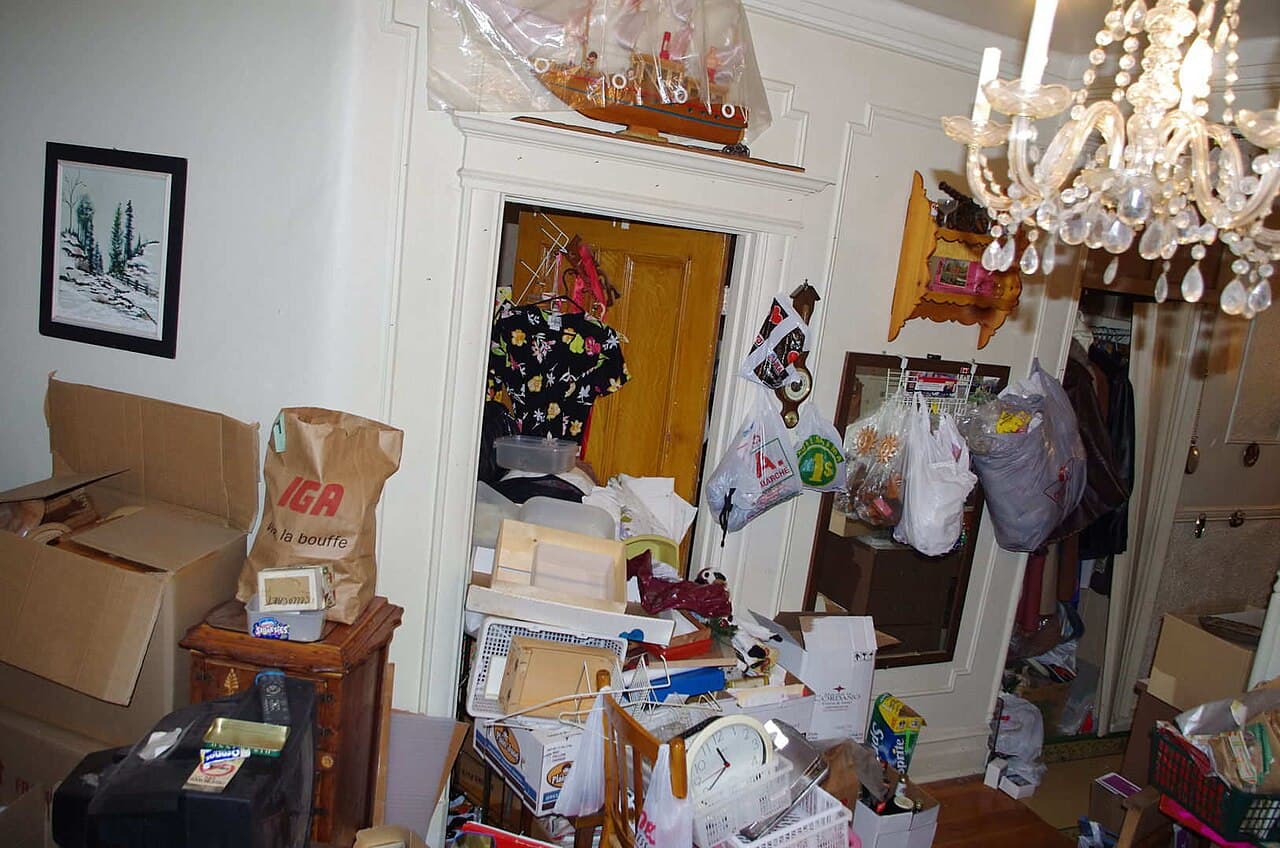
What is under the piles. Walkways, counters, floors and walls with moisture build-up can breed bacteria and mold, and unsanitary surfaces draw flies, mice, rats and cockroaches.[5] Pest treatment, odor removal and disinfecting are often separate trades with separate prices. EPA's rule of thumb is that mold covering more than about 10 square feet, or following a lot of water damage, calls for its professional remediation guidance.[8]
What the house needs afterwards. Weight and neglect cause real damage. Overloaded floors can crack joists, sag floors and ceilings, and compromise bearing walls,[5] and building and trade permits may be required to make emergency repairs.[5] The Board for Contractors says a valid Virginia contractor's licence is required when the work is valued at $1,000 or more,[10] and the statute counts remediation, cleanup or containment of premises to remove contaminants as an improvement.[9] If the quote includes flooring, drywall or remediation, ask for the company's DPOR licence number.
Access and logistics. Stairs, long carries, a tight street and the number of days the job runs all add time. A container on the street may need a permit; see whether you need a permit for a dumpster on the street.
What disposal costs, as published
These are what the public pays at county and regional facilities. They are not cleanout prices, but they are the floor under every quote and a way to check the disposal line.
Fairfax County. Fairfax County's residential disposal fees for July 2026 to June 2027 charge $98 a ton for bulk or unbagged trash, with a $39 minimum,[1] $21 for one to five bags and $28 for six to ten bags,[1] $17 each for a sofa, recliner, dresser or desk, dining table, carpet or pad, or mattress and box spring,[1] and $15 for each appliance that needs its refrigerant or a capacitor removed.[1]
Montgomery County and the New River Valley. When we checked on October 27, 2026, the Montgomery Regional Solid Waste Authority listed mattresses, furniture and other large items at $76 per ton,[2] construction material at $53 per ton,[2] and a $19 Freon removal fee for each appliance not certified as Freon-free.[2]
Free pickups. Fairfax County residents whose trash the county collects get five free special pickups per fiscal year, each limited to 2 cubic yards,[3] though about 90 percent of Fairfax residents use a private collector instead.[3] Ask your own trash service what it includes.
Keep chemicals out of the load. Fairfax County residents can drop off household hazardous waste free of charge,[11] but other localities run their own programs, so ask yours before the crew loads anything hazardous.
Help that can lower the cost
Local government can sometimes carry part of the load, especially when the home is unsafe. Fairfax County's solid waste program lists assistance with waste and debris removal in extreme situations among its roles in hoarding cases,[7] and its Department of Housing and Community Development offers rehabilitation loans to help owners bring blighted structures into compliance.[7] The county also points residents to its Home Repair for the Elderly Program for minor repairs, and to Rebuilding Together for safety and health repairs to owner-occupied homes.[6]
Treatment is a separate cost and an important one. Fairfax County notes that it does not provide the mental or physical health care side of hoarding disorder, so those services go through personal health insurance.[6] Outside Fairfax, ask your local social services office or area agency on aging what exists where your relative lives.
What to ask for in a written quote
Virginia's Board for Contractors advises getting at least three written bids on the same specifications,[10] being wary of any bid far below the others,[10] keeping a deposit to no more than 10 percent of the price or $1,000, whichever is less,[10] and never paying the whole bill until the job is complete.[10] The same habits work for a cleanout. In each quote, look for:
- Labor: crew size, expected days or hours, and the hourly or daily rate if the job runs long.
- Disposal: how it is measured (truckloads, tons or containers) and the rate.
- Sorting: whether the crew sorts with your relative, searches for named items, and sets aside donations.
- Specialist work: pest treatment, odor removal, disinfecting or mold work, each priced separately.
- Exclusions: hazardous waste, appliances, tires and anything else they will not take.
- Changes: what happens to the price if the job is bigger than described, agreed in writing before the work continues.
For more on choosing a company, see what to look for in a hoarding cleanup company, and for ordinary hauling prices, how much junk removal costs in Virginia.
Stop and call a pro if
- Floors are soft or sagging, or ceilings below are bowing.
- There are rodents beyond a few droppings, live or dead animals, or large amounts of animal or human waste.
- Mold covers more than about 10 square feet, or there has been a leak or flood.
- You find needles, chemicals, fuel or containers you cannot identify.
- The person who lives there is in danger and refusing help; your local social services office is the right first call.
Getting quotes on Loclis
Browse more junk removal and moving answers, see hoarding cleanout businesses, or find junk removal and moving businesses around Blacksburg. To compare prices on the same job, describe the cleanout once on Loclis with photos, and local businesses can quote on it.
Common questions
- Why do hoarding cleanout quotes vary so much?
- Because the jobs do. One company may plan to haul everything in a day; another may plan several days of sorting with your relative, searching for papers and keepsakes. Pests, mold, animal waste and damaged floors add specialist work. Ask each company to itemize labor, disposal and any cleaning or treatment so you can compare like with like.
- Is hoarding cleanup charged by the hour, the truckload or the job?
- All three are common. Hauling is often priced by volume or truckload, sorting and cleaning by the hour or by the crew-day, and specialist cleaning or pest treatment as separate line items. A written quote should say which applies to each part and what happens if the job turns out bigger than described.
- Why are papers and magazines so expensive to remove?
- Weight. EPA's conversion table puts loose newsprint at 360 to 800 pounds per cubic yard, well above ordinary household trash, and landfills charge haulers by the ton. A room of stacked paper can weigh far more than a room of clothes or furniture.
- Does homeowners insurance pay for a hoarding cleanout?
- Do not assume it does. Coverage depends on your policy and on what caused any damage. Call your insurer, describe the situation and ask for the answer in writing before work starts.
- Can the county help pay for it?
- Sometimes, in part. Fairfax County lists debris removal assistance in extreme situations, rehabilitation loans and a home repair program for older and disabled residents. Programs differ by locality, so ask your local social services office or area agency on aging what is available where your relative lives.
Sources
- [1] Residential Disposal Fees and Regulations, Fairfax County Department of Public Works and Environmental Services. Checked October 27, 2026.
- [2] Disposal Guide, Montgomery Regional Solid Waste Authority. Checked October 27, 2026.
- [3] Special Pickup, Fairfax County Department of Public Works and Environmental Services. Checked October 27, 2026.
- [4] Volume-to-Weight Conversion Factors (April 2016), U.S. Environmental Protection Agency. Checked October 27, 2026.
- [5] Dangers and Health Risks, Fairfax County Department of Code Compliance. Checked October 27, 2026.
- [6] Hoarding Disorder: Do You Need Help?, Fairfax County Department of Code Compliance. Checked October 27, 2026.
- [7] Fairfax County's Hoarding Strategies: A Governmental Approach, Fairfax County Department of Code Compliance. Checked October 27, 2026.
- [8] A Brief Guide to Mold, Moisture and Your Home, U.S. Environmental Protection Agency. Checked October 27, 2026.
- [9] Code of Virginia § 54.1-1100. Definitions (contractors), Virginia General Assembly, Legislative Information System. Checked October 27, 2026.
- [10] What You Should Know Before You Hire a Contractor, Virginia Department of Professional and Occupational Regulation, Board for Contractors. Checked October 27, 2026.
- [11] Household Hazardous Waste, Fairfax County Department of Public Works and Environmental Services. Checked October 27, 2026.
Want a pro to handle it?
Describe the job once. Licensed local businesses send quotes, and you pay only when you book one.
Get a quote from a local pro