What should I look for in a hoarding cleanup company?
Look for a crew that works with the person who lives there, not around them: one that agrees in writing what may be thrown away, sorts for valuables, and handles pests, mold and waste safely. Check the paperwork too. Repairs or remediation over $1,000 need a DPOR-licensed contractor, and in Fairfax County a refuse hauler needs a county Certificate to Operate.
Free to ask. Local shops send quotes, and you pay only when you book one.
By Kasra Taheri, Founder, LoclisPublished
Researched and drafted with AI, then checked claim by claim against the sources listed below before it was published. Prices and rules change; the dates beside each source say when it was last checked.
Step by step
Read when to stop and call a pro, further down this page, before you start.
Step 1: Write down the job
List the rooms, the hazards you know about, the items that must be found, and who decides what is kept, so every company quotes the same job.
Step 2: Ask how they work with the owner
Ask whether the crew sorts alongside the person who lives there and gets their consent before anything is thrown away.[1]
Step 3: Ask what they do about hazards
Ask how they handle rodent droppings, mold, animal waste and sharps, and what protective gear the crew uses.[3]
Step 5: Check local hauling permits
In Fairfax County, confirm the hauler is on the county's list of permitted solid waste collection companies.[7]
Step 6: Ask where the load goes
Ask which landfill, transfer station, donation outlet and recycler they use, and how they handle hazardous waste.
Step 7: Get three written quotes
Get at least three written quotes on the same description, and be wary of one far below the rest.[6]
Step 8: Agree the contract terms
Get the scope, price, payment schedule and what happens if the job grows in writing, with a deposit of no more than 10 percent or $1,000, whichever is less.[6]
Step 9: Pay as work is done
Do not pay cash, do not let payments get ahead of the work, and hold the final payment until the job is finished.[6]
The right hoarding cleanup company treats the job as work with a person, not just a house. Look for a crew that sorts alongside the person who lives there and agrees in writing what may be thrown away, handles pests, mold and waste safely, and has whatever licences and permits the job actually needs. Then hold it to the same contract and payment rules you would use for any contractor.
How they work with the person who lives there
This is the difference between a hoarding cleanout and an ordinary junk haul. Fairfax County's guidance for families is to always obtain consent before throwing anything away, because being separated from possessions without approval can trigger a major stress reaction or depression.[1] It also warns against arguing over a particular item,[1] and against threatening or forcing a person to discard all of their possessions.[1] A company you hire should work the same way.
Experienced firms exist, and public agencies point families to them. Fairfax County lists hiring professional organizers to help classify things and do heavy disposing, alongside hoarding coaches, support groups and therapists, as part of the private help people with hoarding disorder use.[1]
Questions that show how a company works:
- Who decides what is kept, and how do you handle disagreements on the day?
- Will you sort with the person, and at what pace?
- How do you search for documents, cash, photos and heirlooms, and where do found items go?
- What do you donate or recycle, and do we get a list?
- Will the same crew lead come back for every session?
How they handle hazards
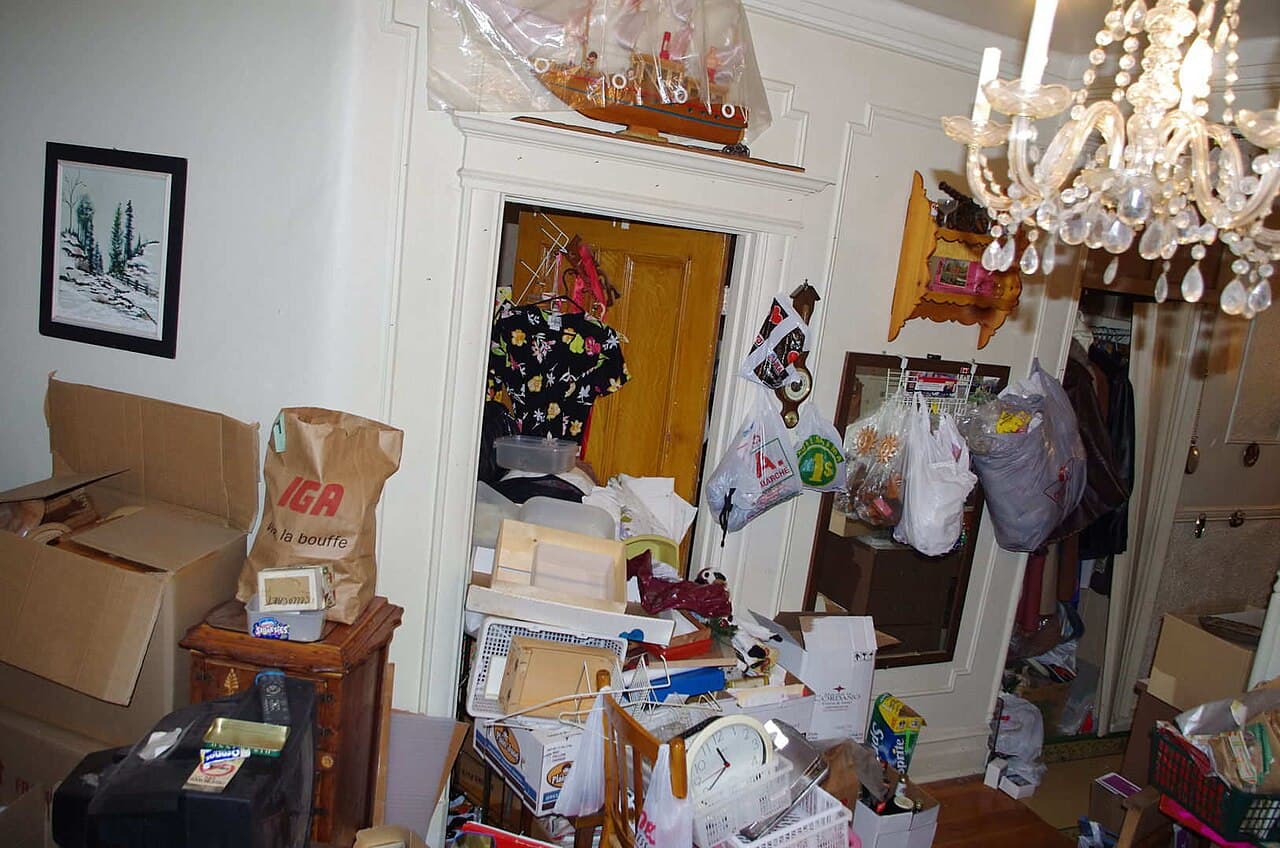
Hoarded homes can hide real health risks under the piles. Fairfax County warns that mice and rats in hoarded homes can spread hantavirus, leptospirosis, lymphocytic choriomeningitis, tularemia and salmonella,[2] and that ammonia from animal urine is a strong lung irritant.[2] The Virginia Department of Health's advice for rodent droppings is to wear gloves, wet the area with disinfectant or a bleach solution, and never sweep or vacuum dry droppings.[3] A company that plans to shovel and sweep dry debris is not taking that seriously.
Ask about mold and structure as well. EPA points to professional remediation guidance when mold covers more than about 10 square feet or follows a lot of water damage.[4] Overloaded floors can crack joists and roof trusses and, in extreme cases, cause partial collapse,[2] so a careful crew looks at floors and ceilings before it moves heavy piles. Ask what protective gear the crew wears, how they handle sharps and chemicals, and who they bring in for pest treatment or mold.
Licences and permits that apply
Contractor licence for repairs and remediation. The Board for Contractors says a valid Virginia contractor's licence is required when the work is valued at $1,000 or more,[6] and the contractor statute counts remediation, cleanup or containment of premises to remove contaminants as an improvement.[5] If the quote includes flooring, drywall, remediation or other repairs over that amount, the company needs a DPOR licence in the right class. DPOR's consumer guide lets you verify licence status online through its License Lookup or by calling (804) 367-8511,[6] and notes that Virginia law requires licensed contractors to provide a written contract for residential work.[6]
Local hauling permits. Some localities regulate who may haul trash. Fairfax County's code requires refuse collectors serving county residents to hold a permit called a Certificate to Operate,[7] and contracting with a company that does not have one is a violation of county code, subject to civil penalties.[7] The county publishes the list of permitted companies, which it says is not an endorsement.[7] Elsewhere, ask your locality's solid waste office whether it has a similar rule.
Where the load goes. Ask for the landfill or transfer station the company uses. Virginia law makes it a misdemeanor to dump trash on public property, or on private property without the owner's written consent,[8] with a fine of $500 to $2,500, up to 12 months in jail, or both.[8]
Red flags in the quote and contract
DPOR's consumer guide lists warning signs worth applying to any home service company: you cannot verify the company's name, address, phone number or credentials,[6] you are pressured with scare tactics or a price good only if you sign today,[6] the company refuses to give references,[6] or you are asked to pay for the whole job in advance or in cash.[6]
A quote without a scope is another one. It should say which rooms, how many crew days, how disposal is measured, what specialist work is included, and how the price changes if the job grows. For more on the price side, see how much hoarding cleanup costs in Virginia.
If something goes wrong, raise it with the company in writing first. After that, the Office of the Attorney General's Consumer Protection Section handles many complaints against businesses operating in Virginia and offers an agency search for the ones it does not,[10] and complaints about a licensed contractor go to the Board for Contractors.[6]
Stop and call a pro if
- The person who lives there is in danger and refusing help. Adult Protective Services takes reports about adults 60 or older, or 18 to 59 and incapacitated, through local social services offices or the 24/7 hotline at (888) 832-3858.[9]
- Floors are soft or sagging, or a ceiling below is bowing, before anyone moves heavy piles.
- There is a rodent infestation, animal or human waste, or mold over about 10 square feet; those need trained cleanup or remediation crews.
- Utilities are off, wiring is chewed, or a gas appliance is buried; those need licensed tradespeople.
Finding a company on Loclis
If you are helping a relative, start with how to help a family member clean out a hoarded house, and for general hauling questions, what to ask a junk removal company before booking. Browse more junk removal and moving answers, see hoarding cleanout businesses, or find junk removal and moving businesses around Blacksburg. When you are ready, describe the cleanout once on Loclis and local businesses can quote on the same job.
Common questions
- Does a hoarding cleanup company need a licence in Virginia?
- It depends on the work. Virginia's contractor statute requires a DPOR licence for construction, removal, repair or improvement work worth over $1,000 in one contract, and it counts remediation or cleanup of premises to remove contaminants as an improvement. Some localities also regulate haulers: Fairfax County requires refuse collectors to hold a county Certificate to Operate. Ask which licences the company holds and check them on DPOR's License Lookup.
- Should the person who lives there be present during the cleanout?
- Usually, yes, or at least involved in the decisions. Fairfax County's guidance is to get consent before throwing anything away and to include the person in the clean-up plan. A good company will ask how decisions are made before it quotes.
- What if the company finds cash, documents or valuables?
- Agree on it before work starts: what the crew should look for, where found items go, and who they hand them to. Put that in the written agreement, and ask whether the company has handled the same request before.
- Can a cleanout company also deal with mold and pests?
- Some can and some subcontract it. Ask who does the work, how they handle droppings and mold, and whether those services are priced separately. Large mold problems, more than about 10 square feet, call for remediation professionals, and repairs or remediation over $1,000 need a licensed contractor.
- Where do I complain about a cleanout company in Virginia?
- Start with the company in writing. If that fails, the Attorney General's Consumer Protection Section takes many consumer complaints and offers an agency search for the right office, and complaints about a licensed contractor go to DPOR's Board for Contractors.
Sources
- [1] Hoarding Disorder: Do You Need Help?, Fairfax County Department of Code Compliance. Checked October 27, 2026.
- [2] Dangers and Health Risks, Fairfax County Department of Code Compliance. Checked October 27, 2026.
- [3] Hantavirus Pulmonary Syndrome (HPS), Virginia Department of Health. Checked October 27, 2026.
- [4] A Brief Guide to Mold, Moisture and Your Home, U.S. Environmental Protection Agency. Checked October 27, 2026.
- [5] Code of Virginia § 54.1-1100. Definitions (contractors), Virginia General Assembly, Legislative Information System. Checked October 27, 2026.
- [6] What You Should Know Before You Hire a Contractor, Virginia Department of Professional and Occupational Regulation, Board for Contractors. Checked October 27, 2026.
- [7] Permitted Solid Waste Collection Companies, Fairfax County Department of Public Works and Environmental Services. Checked October 27, 2026.
- [8] Code of Virginia § 33.2-802. Dumping trash, Virginia General Assembly, Legislative Information System. Checked October 27, 2026.
- [9] File an APS Report, Virginia Department for Aging and Rehabilitative Services. Checked October 27, 2026.
- [10] File a Complaint, Office of the Attorney General of Virginia, Consumer Protection Section. Checked October 27, 2026.
Want a pro to handle it?
Describe the job once. Licensed local businesses send quotes, and you pay only when you book one.
Get a quote from a local pro