How do I help a family member clean out a hoarded house?
Start with the person, not the piles. Agree on small goals together and never throw anything away without their consent, because forced cleanouts cause serious distress and rarely last. Make the house safe first: doors that open fully, clear stairs and bedroom windows, a 3-foot path and working smoke alarms. Bring in professionals for rodents, large mold, animal waste or sagging floors.
Free to ask. Local shops send quotes, and you pay only when you book one.
By Kasra Taheri, Founder, LoclisPublished
Researched and drafted with AI, then checked claim by claim against the sources listed below before it was published. Prices and rules change; the dates beside each source say when it was last checked.
Step by step
Read when to stop and call a pro, further down this page, before you start.
Step 1: Agree on one goal together
Ask what your relative most wants to be able to do at home, such as cook or sleep in the bed, and start with that one small, concrete goal.[1]
Step 2: Agree how decisions are made
Settle before you start that nothing leaves the house without your relative's consent, and stick to it.[1]
Step 3: Clear the doors first
Move items from behind the front, back and side doors so each one swings completely open.[1]
Step 4: Clear stairs, halls and bedroom windows
Empty the stairs and hallways completely and clear anything blocking windows in rooms where people sleep.[1]
Step 5: Open a 3-foot path
Where only narrow paths remain, widen the main route through the house to about 3 feet and take down stacks that reach toward the ceiling.[1]
Step 6: Check the smoke alarms
Make sure a working smoke alarm sits on every level, with open space around it so smoke can reach it, and test it.[1]
Step 8: Dress for the work
Wear sturdy shoes, long sleeves and rubber, latex, vinyl or nitrile gloves, and air out rooms that have been shut up before working in them.[4]
Step 9: Wet rodent droppings before wiping
Mist droppings with disinfectant or 1 1/2 cups of bleach in a gallon of water, then wipe them up; never sweep or vacuum them dry.[4]
Step 10: Start with the easy decisions
Bag anything moldy, broken, rotting or attracting pests first, with your relative's agreement; those items are usually the easiest to let go.[1]
Step 11: Touch each item once
Have your relative pick up each item and decide on the spot whether it is thrown away, given away, put away or donated.[1]
Step 12: Keep cleared space clear
Once an area is clear, agree that nothing moves back into it, and celebrate that progress before moving on.[1]
Step 13: Set aside hazardous waste
Keep paint, fuel, pesticides and batteries out of the trash bags and take them to your locality's household hazardous waste program.[7]
The most useful thing you can do is go slowly and keep your relative in charge. Agree on small goals together, make the house safe before you make it tidy, and never throw things away behind their back. A cleanout done to someone rarely lasts. A cleanout done with them, alongside treatment for what drives the hoarding, has a much better chance.
Start with a conversation, not a dumpster
Hoarding disorder has been a recognised mental health diagnosis since 2013,[2] and the person living in the house often feels shame, fear or grief about their things. How you open the subject matters more than how many bags you fill on day one.
Fairfax County's code compliance office tells families to give the person choices and some decision-making power, to set small, concrete goals together, and to include them in any clean-up plan.[1] It also advises steering conversations away from sanitation and toward the person's health, happiness and future plans.[1] "I want you to be able to cook again" lands better than "this kitchen is filthy".
The same guidance sets some firm rules: never threaten or force someone to discard all their possessions, and always get consent before throwing anything away, because being separated from belongings without approval can trigger a major stress reaction or depression.[1] Do not argue over a particular item.[1] Keep your energy on the overall goal.
Treatment is part of the plan, not an extra. Fairfax County is blunt that cleaning out a house without getting the person treatment for the underlying condition will fail,[1] and that recidivism is common unless psychiatric help follows a cleanout.[2] A family doctor or your local community services board is a reasonable first call.
Make the house safe before you make it tidy
The first sessions should open the house up, not sort it. Doors that swing fully open, clear stairs and halls, reachable bedroom windows and working smoke alarms come before any decisions about keepsakes. Fairfax County's guidance is that at least two routes out of the house should always be kept clear,[3] and that occupants should be able to escape through an egress window within 5 seconds.[3]
Weight is the hidden danger. Overloaded floors and attics can crack floor joists and roof trusses, sag floors and ceilings, and in extreme cases cause a partial collapse.[3] If a floor feels soft or bouncy, or a ceiling below is sagging, stop moving heavy piles across it and get the structure looked at. Fairfax County notes that building and trade permits may be required for emergency repairs.[3]
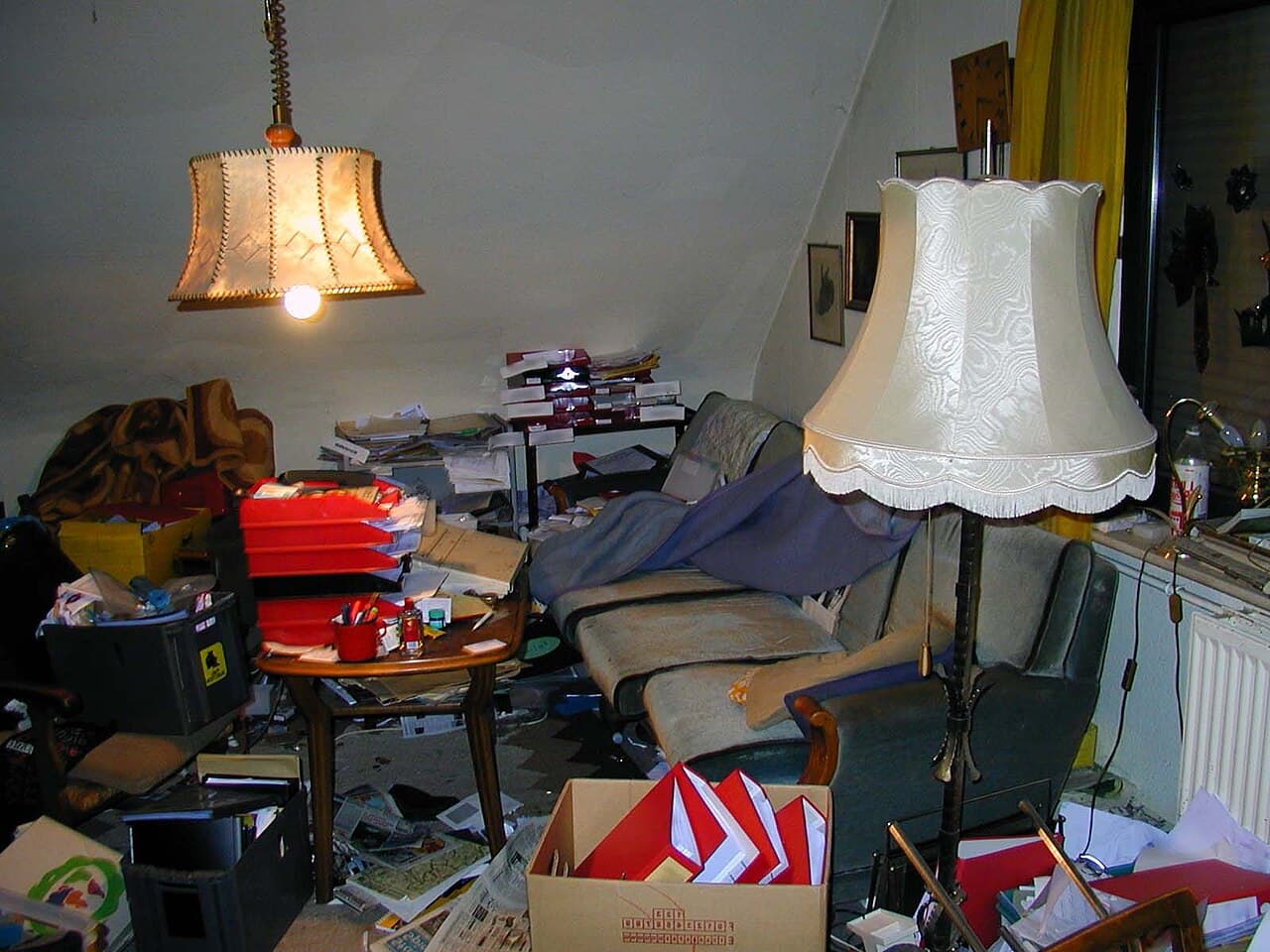
Protect yourself while you work
A hoarded house can hide pests, mold and animal waste under the piles. Fairfax County warns that mice and rats in hoarded homes can spread hantavirus, leptospirosis, lymphocytic choriomeningitis, tularemia and salmonella,[3] and that ammonia released from animal urine is a strong lung irritant.[3]
The Virginia Department of Health says to air out a closed building for at least 30 minutes before spending time inside,[4] to wet down dusty areas that may hold rodent droppings or urine with a commercial disinfectant or 1 1/2 cups of bleach in a gallon of water,[4] and to never sweep or vacuum dry droppings, because that puts dust in the air.[4] Gloves, sturdy shoes, long sleeves and plenty of heavy-duty bags make the work safer and faster.
Mold is a matter of size. EPA says a homeowner can usually handle mold covering less than about 10 square feet, roughly a 3-foot by 3-foot patch.[5] Anything larger, or mold that follows real water damage, is work for a professional.
Sort in short, steady sessions
Work one area at a time, in sessions your relative can manage, and let them make the calls. Many families find a few hours at a stretch is plenty; decision fatigue is real, and a session that ends on a good note makes the next one easier.
Keep the categories simple: throw away, give away, put away, donate. Start with what is plainly trash, such as spoiled food, broken items and anything moldy, before moving to clothes, papers and keepsakes. Once a space is cleared, agree that nothing moves back into it.
Plan where it all goes before the bags pile up. Check your locality's bulk pickup, compare a hauler with a dumpster (see what size dumpster you need), and keep chemicals out of the trash. Fairfax County residents can drop off household hazardous waste such as paint, gasoline, pesticides and batteries free of charge,[7] and most Virginia localities run a similar program.
When your relative cannot or will not agree
Fairfax County's guidance also reminds families that adults have rights about the way they live, and that low levels of clutter may not be a code violation.[1] Pushing harder rarely helps. But when the home has become dangerous, there is help beyond the family.
Virginia's Department for Aging and Rehabilitative Services lists an unkempt home or a buildup of garbage or debris, insect or animal infestations, and a lack of heat, electricity or running water among the signs of self-neglect.[9] Adult Protective Services takes reports about adults 60 or older, or 18 to 59 and incapacitated,[8] reports can be anonymous,[8] and you can file one through an online portal, your local social services office, or the 24/7 hotline at (888) 832-3858.[8]
Localities split the rest between agencies. Loudoun County, for example, sends fire hazards such as piled combustibles or blocked exits to its Fire Marshal,[10] and points families toward its mental health department for treatment options.[10] Call 911 for anything that is an emergency right now.
Stop and call a pro if
- Floors are soft, sagging or cracked, ceilings below are bowing, or the piles are heavy enough that moving them could bring something down.
- There are live or dead animals, large amounts of animal or human waste, a strong ammonia smell, or a rodent infestation beyond a few droppings.
- Mold covers more than about 10 square feet, or there has been a leak or flood under the piles.
- You find needles, chemicals, fuel or containers you cannot identify.
- Utilities are off, wiring is damaged or chewed, or a gas appliance is buried; leave those to licensed tradespeople.
- Your relative becomes very distressed, or the work is straining your relationship. A neutral professional often helps.
Getting help on Loclis
For the cost side, see how much hoarding cleanup costs in Virginia, and for choosing a crew, what to look for in a hoarding cleanup company. Browse more junk removal and moving answers, see hoarding cleanout businesses, or find junk removal and moving businesses around Blacksburg. When you are ready, describe the cleanout once on Loclis and local businesses can quote on the same job.
Common questions
- Can I just clean the house while my relative is away?
- It is the approach most likely to backfire. Fairfax County's guidance says to always get consent before throwing anything away, because being separated from belongings without approval can trigger a major stress reaction or depression, and that a cleanout without treatment for the underlying condition will fail. The exception is a genuine emergency, which is a job for the county, not a surprise weekend.
- What should we clear first?
- Safety before tidiness: doors that swing fully open, clear stairs and hallways, bedroom windows that can be reached, a path about 3 feet wide, and working smoke alarms on every level. After that, start with the room your relative most wants back, such as the kitchen or a bedroom.
- Is it safe to clean up mouse droppings myself?
- For ordinary droppings, the Virginia Department of Health's advice is to wear gloves, air out closed spaces for at least 30 minutes, wet the droppings with disinfectant or a bleach solution, and wipe them up rather than sweeping or vacuuming. A heavy infestation, dead animals or large amounts of animal waste are better left to pest control and cleanup professionals.
- Who do I call if my relative refuses help and the house is dangerous?
- For an adult 60 or older, or an incapacitated adult, you can report to Adult Protective Services through your local social services office or the 24/7 hotline at (888) 832-3858. For fire hazards or unsafe structures, your locality's fire marshal or code enforcement office is the contact. In an emergency, call 911.
- Should we hire a hoarding cleanout company?
- Often, yes, for the heavy lifting, hauling and anything hazardous. Fairfax County's own guidance says that in extreme cases families should consult professionals rather than clean alone. The company should work at your relative's pace and agree in advance what can be thrown away.
Sources
- [1] Hoarding Disorder: Do You Need Help?, Fairfax County Department of Code Compliance. Checked October 27, 2026.
- [2] What is Hoarding?, Fairfax County Department of Code Compliance. Checked October 27, 2026.
- [3] Dangers and Health Risks, Fairfax County Department of Code Compliance. Checked October 27, 2026.
- [4] Hantavirus Pulmonary Syndrome (HPS), Virginia Department of Health. Checked October 27, 2026.
- [5] A Brief Guide to Mold, Moisture and Your Home, U.S. Environmental Protection Agency. Checked October 27, 2026.
- [6] Heating Fire Safety, U.S. Fire Administration. Checked October 27, 2026.
- [7] Household Hazardous Waste, Fairfax County Department of Public Works and Environmental Services. Checked October 27, 2026.
- [8] File an APS Report, Virginia Department for Aging and Rehabilitative Services. Checked October 27, 2026.
- [9] Recognizing Abuse, Neglect and Exploitation, Virginia Department for Aging and Rehabilitative Services. Checked October 27, 2026.
- [10] What Can I Do About Hoarding?, Loudoun County. Checked October 27, 2026.
Want a pro to handle it?
Describe the job once. Licensed local businesses send quotes, and you pay only when you book one.
Get a quote from a local pro