How much does home theater installation cost in Virginia?
There is no reliable single Virginia price, because the cost depends on the job: a plug-in soundbar, a surround system with a receiver, in-wall wiring, or a built-out room. Get at least three written bids that cover the same work, check each contractor's licence, and keep the first deposit to no more than 10 percent of the price or $1,000, whichever is less.
Free to ask. Local shops send quotes, and you pay only when you book one.
By Kasra Taheri, Founder, LoclisPublished
Researched and drafted with AI, then checked claim by claim against the sources listed below before it was published. Prices and rules change; the dates beside each source say when it was last checked.
Step by step
Read when to stop and call a pro, further down this page, before you start.
Step 1: List what you want
Write down the TV size, number of speakers, source devices and whether cables should stay visible or run inside the walls.
Step 2: Count the inputs
Note every device that needs an HDMI input; a console, a sound bar and a cable box together need 3.[5]
Step 3: Decide the wiring
Decide which cables can run along baseboards and which you want hidden, since hidden runs drive most of the labor.
Step 4: Check licences
Look up each contractor's licence on the DPOR licence lookup before you ask for a price.[1]
Step 5: Ask for three written bids
Give each contractor the same list and ask for itemized written bids on identical specifications.[1]
Step 6: Compare line by line
Compare equipment and model numbers, labor, wire and mounting hardware, cleanup, warranty and what is left out.
Step 7: Agree the deposit
Agree a small initial deposit and tie later payments to finished work, in a written contract.[1]
A home theater can cost very little or a great deal, and Virginia has no single going rate, and a price quoted for one house tells you little about yours. What you can do is understand what drives the price and get quotes you can compare.
What drives the cost
Scope. A soundbar with a subwoofer you plug in yourself is one job. A receiver with five or seven speakers is another, and a projector, screen and acoustic treatment is a third. Start by deciding which one you want. If it is a plug-in system, how to set up surround sound in a living room shows what you can do without a contractor.
Equipment. The receiver, speakers, TV or projector and cables are often most of the bill. ENERGY STAR's example is that "Accommodating just standard elements of an entertainment system, like a game console, a sound bar, and a cable box, requires 3 HDMI inputs."[5] A receiver with more inputs costs more, so count yours before you shop.
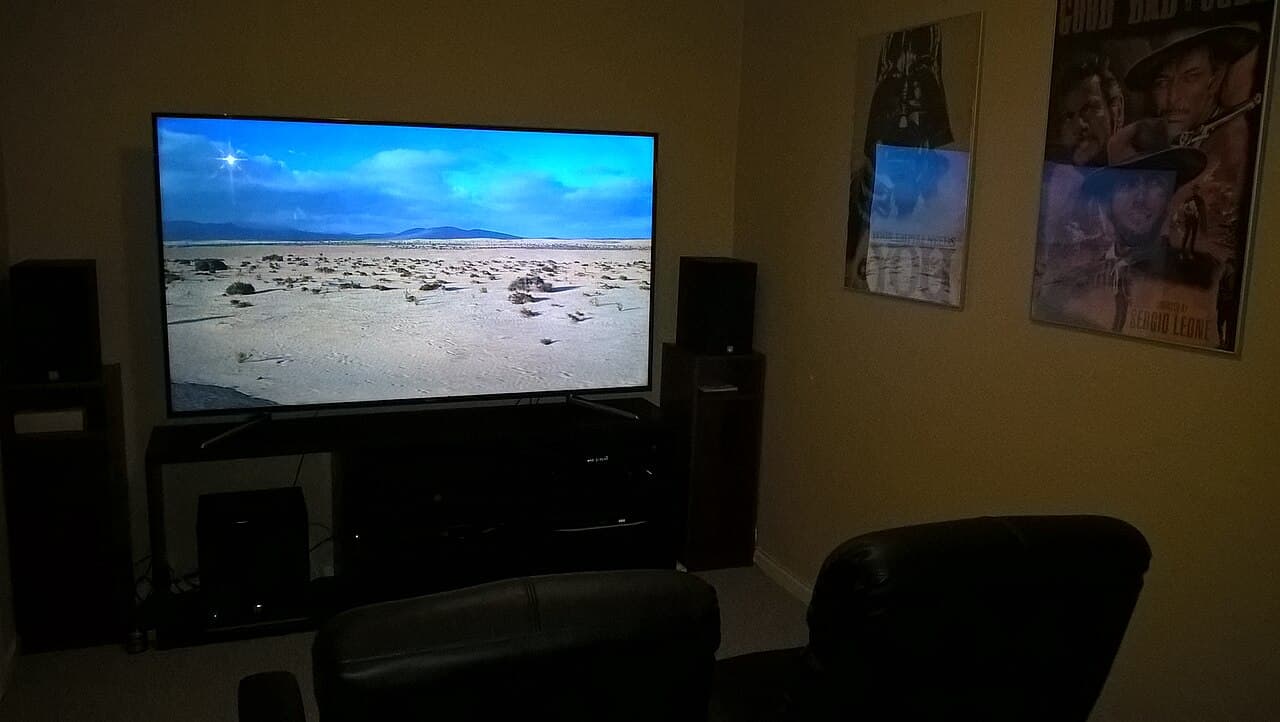
Wiring. Hidden cabling is labor-heavy. Wire inside a wall or ceiling means drilling through framing, fishing cable and patching drywall. The installer needs to know what is in the wall and whether the path goes through fire-rated construction.
Mounting. A wall-mounted TV needs solid backing and the right brackets. Heavy TVs and speakers are a hazard if mounted poorly.
Calibration and setup. Some installers include calibration, remote programming and a walkthrough. Others bill them separately. Ask.
Licences and permits in Virginia
DPOR's consumer guide says that if the work is valued at $1,000 or more, a valid Virginia contractor's license is required for the license category.[1] Class C contractors perform or manage construction, removal, repair, or improvements when (i) the total value referred to in a single contract or project is over $1,000 but less than $30,000.[2] For sound systems and similar work, Virginia's specialty definition covers the installation, repair, improvement, or removal of electronic or communications systems annexed to real property including telephone wiring, computer cabling, sound systems.[3]
On permits, Virginia's building code lists among the work that needs no permit the installation of wiring and equipment that (i) operates at less than 50 volts,[4] but not when it is "located in a plenum, penetrate fire rated or smoke protected construction" or part of certain fire or life-safety systems.[4] Any new outlet or circuit is electrical work with its own rules.
How to get quotes you can compare
Virginia law requires all licensed contractors to provide a written contract for residential work.[1] DPOR also advises getting at least three written bids or estimates using identical plans and specifications.[1] Give each contractor the same list, and ask each bid to show:
- equipment by brand and model number
- the number of speakers and where each goes
- which wiring is hidden and which is exposed
- mounting hardware, patching and cleanup
- calibration, programming and a walkthrough
- labor and equipment warranties, in writing
Then compare line by line. A bid that is much lower often leaves something out.
DPOR suggests an initial deposit of no more than 10% of the total price or $1,000, whichever is less.[1] Pay the balance against finished work.
Stop and call a pro if
- The quote asks for most of the money up front or will not be put in writing.
- The contractor cannot show a Virginia licence number that matches the name on the contract.
- The job needs a new outlet, circuit or any change to house wiring. That is electrical work, not part of a speaker install.
- Cables must run through a fire-rated wall or a plenum space. The permit exemption does not apply there.
- You have not confirmed what is inside the wall where a TV or speaker will be mounted.
Getting help in Virginia
Read should I hire a pro to install a home theater to decide how much to hand off. Browse security and smart home answers or Security & Smart Home pros.
When you are ready, describe your home theater job once and licensed local pros quote it.
Common questions
- Is there a typical price for a home theater installation in Virginia?
- Not one that holds up. A plug-in soundbar and a hidden-wire theater with a projector are different jobs, and the price follows the labor and equipment. The reliable approach is to get written, itemized bids for the same specification and compare them.
- What makes one quote higher than another?
- Usually the scope: how many speakers, whether wires run inside walls, how the TV is mounted, the quality of the receiver and speakers, and whether calibration, cleanup and a warranty are included. Compare line by line, not by the total.
- Do I need a licensed contractor for a home theater?
- Virginia's Board for Contractors says that if the work is valued at $1,000 or more, a valid Virginia contractor's license is required for the license category. Sound-system installation falls under the electronic and communications specialty. Look up the licence on DPOR before you sign.
- How much deposit is reasonable?
- DPOR's consumer guide suggests an initial deposit of no more than 10% of the total price or $1,000, whichever is less. Tie later payments to finished work, and put the schedule in the written contract.
- Does low-voltage wiring need a building permit?
- Virginia's building code lists the installation of wiring and equipment that operates at less than 50 volts among the work that does not need a permit, but not when it runs through a plenum or penetrates fire-rated construction. Ask the contractor and your locality, especially for in-wall runs.
Sources
- [1] What You Should Know Before You Hire a Contractor, Virginia Board for Contractors, Department of Professional and Occupational Regulation. Checked October 27, 2026.
- [2] Va. Code § 54.1-1100, Definitions, Code of Virginia, Virginia General Assembly. Checked October 27, 2026.
- [3] 18VAC50-22-30, Definitions of specialty services (Board for Contractors Regulations), Virginia Administrative Code, Board for Contractors. Checked October 27, 2026.
- [4] 13VAC5-63-80, Section 108 Application for permit (Virginia Uniform Statewide Building Code), Virginia Administrative Code, Virginia General Assembly. Checked October 27, 2026.
- [5] Televisions, ENERGY STAR, U.S. Environmental Protection Agency. Checked October 27, 2026.
Want a pro to handle it?
Describe the job once. Licensed local businesses send quotes, and you pay only when you book one.
Get a quote from a local pro