Should I hire a pro to install a home theater?
Do it yourself if everything plugs in: a soundbar or receiver with speakers on stands, cables along the baseboard. Hire a pro for in-wall or ceiling wiring, a new outlet, a projector or a wall-mounted heavy TV. In Virginia, work valued at $1,000 or more needs a licensed contractor, and sound-system installation is a licensed specialty.
Free to ask. Local shops send quotes, and you pay only when you book one.
By Kasra Taheri, Founder, LoclisPublished
Researched and drafted with AI, then checked claim by claim against the sources listed below before it was published. Prices and rules change; the dates beside each source say when it was last checked.
Step by step
Read when to stop and call a pro, further down this page, before you start.
Step 1: Sort your project
Decide whether it is a plug-in setup or includes in-wall cables, new outlets, a wall mount or a built room.
Step 2: Check the permit rule
Ask your locality whether in-wall low-voltage cable needs a permit where you live, since Virginia exempts only some of it.[4]
Step 3: Look up licences
Look up each candidate's contractor licence on DPOR before you talk price.[1]
Step 4: Get written bids
Collect at least three written bids on identical specifications.[1]
Step 5: Sign a written contract
Sign a written contract that lists the work, price, payments and warranty.[1]
Hire a pro when the job goes into the walls, ceiling or house wiring, or when the TV is heavy and the wall is unknown. Keep it yourself when everything plugs in and cables stay along the baseboard. A plug-in soundbar or surround system is within most people's reach; how to set up surround sound in a living room walks through it.
Jobs you can usually keep
- A soundbar or receiver and speakers on stands, wired along the floor edge or wireless
- A TV on a stand, anchored to the wall
- Setup, calibration, streaming apps and remote programming
Jobs worth hiring out
In-wall or ceiling speakers and cable. The work means cutting drywall, working past framing and insulation, and keeping cables clear of house wiring. Virginia's building code lists among the work that needs no permit the installation of wiring and equipment that (i) operates at less than 50 volts,[4] but not when it is "located in a plenum, penetrate fire rated or smoke protected construction."[4] A licensed pro knows where that line falls.
A new outlet or circuit. A dedicated outlet behind the TV or for an amplifier is electrical work, not part of a low-voltage install.
Heavy wall mounts and projectors. A wall that cannot be confirmed solid, a ceiling mount or a large TV are all hazards. In the CPSC's review of 363 reported tip-over fatalities, 62 percent (226 deaths) involved televisions falling,[5] and 303 involved children.[5]
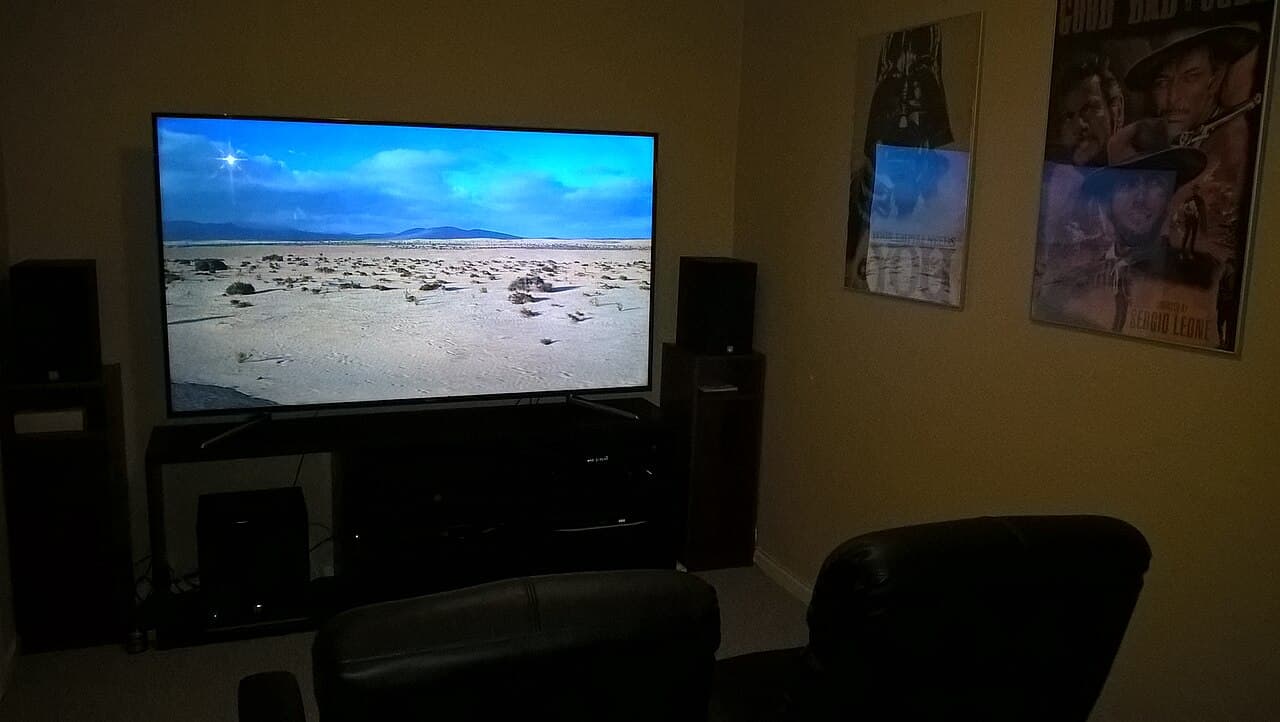
A dedicated room. Acoustic treatment, a screen wall, lighting and wiring together are a small construction project. Hire a contractor.
Licences in Virginia
DPOR's consumer guide says that if the work is valued at $1,000 or more, a valid Virginia contractor's license is required for the license category.[1] Class C contractors perform or manage construction, removal, repair, or improvements when (i) the total value referred to in a single contract or project is over $1,000 but less than $30,000.[2] Sound-system installation falls under the electronic and communications specialty, defined as the installation, repair, improvement, or removal of electronic or communications systems annexed to real property including telephone wiring, computer cabling, sound systems.[3]
Look up the contractor on DPOR's licence lookup before you talk price.
Hiring well
Virginia law requires all licensed contractors to provide a written contract for residential work.[1] DPOR advises getting at least three written bids or estimates using identical plans and specifications,[1] and suggests an initial deposit of no more than 10% of the total price or $1,000, whichever is less.[1] Ask each bid to name equipment by model, show where every speaker and cable goes, and say how holes will be patched. For what prices depend on, see how much home theater installation costs in Virginia.
Stop and call a pro if
- You are about to cut into a wall or ceiling and do not know what is behind it.
- A cable has to go through a fire-rated wall or a plenum space.
- You need a new outlet or circuit.
- The wall you want to mount on is not confirmed solid, or the TV is large.
- A contractor wants a large deposit or will not put the job in writing.
Getting help in Virginia
Browse security and smart home answers or Security & Smart Home pros.
When you are ready, describe your home theater job once and licensed local pros quote it.
Common questions
- Can I run speaker wire inside the wall myself?
- It is a judgment call, not a safe default. The work means cutting drywall and fishing cable past framing, insulation and house wiring, and the permit exemption for low-voltage wiring does not cover runs through a plenum or fire-rated construction. Many homeowners hire this part.
- Do I need a permit for a home theater in Virginia?
- Not for ordinary low-voltage wiring: Virginia's building code lists wiring and equipment that operates at less than 50 volts among the work that does not need a permit. A new outlet or circuit, or work in a plenum or through fire-rated construction, is different. Ask your locality.
- Who is licensed to install sound systems in Virginia?
- Virginia's specialty definition for electronic and communications service contracting covers sound systems annexed to real property, and an electrical contractor's licence also covers this work. Look up the licence on the DPOR licence lookup.
- Is mounting a big TV a DIY job?
- It can be, if you find solid backing and use the right bracket, but the stakes are real. The CPSC found that 62 percent (226 deaths) of 363 reported tip-over fatalities involved televisions falling. If you are unsure about the wall, hire a pro.
- How do I know a home theater installer is legitimate?
- Check the licence number on DPOR, ask for a written contract and get at least three written bids on identical specifications.
Sources
- [1] What You Should Know Before You Hire a Contractor, Virginia Board for Contractors, Department of Professional and Occupational Regulation. Checked October 27, 2026.
- [2] Va. Code § 54.1-1100, Definitions, Code of Virginia, Virginia General Assembly. Checked October 27, 2026.
- [3] 18VAC50-22-30, Definitions of specialty services (Board for Contractors Regulations), Virginia Administrative Code, Board for Contractors. Checked October 27, 2026.
- [4] 13VAC5-63-80, Section 108 Application for permit (Virginia Uniform Statewide Building Code), Virginia Administrative Code, Virginia General Assembly. Checked October 27, 2026.
- [5] Preliminary Evaluation of Anchoring Furniture and Televisions Without Tools (CPSC/EXHR/TR-15/001, May 2015), U.S. Consumer Product Safety Commission. Checked October 27, 2026.
Want a pro to handle it?
Describe the job once. Licensed local businesses send quotes, and you pay only when you book one.
Get a quote from a local pro