How much does it cost to recaulk a tub or shower in Virginia?
We found no official published rate for recaulking in Virginia, so the real number is a written quote. Materials are a small part of it; the price is mostly labour, and it rises with how much old caulk has to be cut out, any mold to clean first, how many joints are included, and damage found behind the old bead.
Free to ask. Local shops send quotes, and you pay only when you book one.
By Kasra Taheri, Founder, LoclisPublished
Researched and drafted with AI, then checked claim by claim against the sources listed below before it was published. Prices and rules change; the dates beside each source say when it was last checked.
Step by step
Read when to stop and call a pro, further down this page, before you start.
Step 1: List every joint
Write down each joint you want redone: tub to wall, shower corners, the shower base, the sink and any others in the room.
Step 2: Photograph the old caulk
Take close photos showing the old bead, any mold, gaps, loose tile or soft spots, so quotes are based on what is really there.
Step 3: Group small jobs
Add other small bathroom or household repairs to the same visit, since one trip spread over several jobs usually costs less per job.
Step 4: Ask for a written quote
Ask for a written price that says whether removal of the old caulk, mold cleaning and the sealant itself are included.
Step 5: Compare like for like
Get at least three written bids for the same list of work, and do not automatically take the lowest.[2]
Step 7: Keep the deposit small
Limit any deposit to 10% or $1,000, whichever is less, never pay cash, and do not pay in full until the work is done.[2]
We found no official price list for recaulking a tub or shower in Virginia, so the honest answer is a written quote for your bathroom. What you can control is what goes into that quote. The sealant itself costs little; most of the price is the labour of getting the old caulk out, cleaning the joint and laying a neat new bead, plus whatever turns up behind the old one.
What you are actually paying for
Materials are a small part. On GE's data sheet for its Advanced Silicone 2 kitchen and bath sealant, a 10.1-ounce cartridge lays a 3/16-inch bead roughly 51 feet long,[4] which is more than the joints around a typical tub and shower need. A pro may use a premium mold-resistant product, but it is rarely what drives the total.
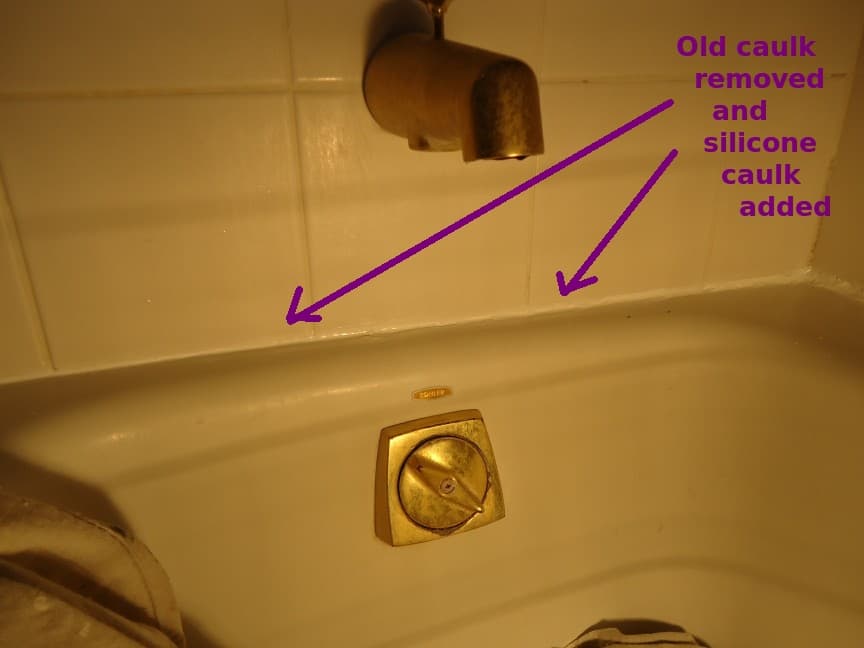
Removing the old caulk is most of the time. There is no substance that will dissolve silicone,[4] so old silicone has to be cut, peeled and scraped out, then the film it leaves cleaned off. Thick, hard or many-layered caulk takes far longer than a single thin bead. A business that lays new caulk over old to save time is selling you a shorter-lived job.
Mold adds a step. EPA's guidance is "Do not paint or caulk moldy surfaces."[5] A careful pro cleans and dries the joint first, which can mean coming back after it has dried.
How many joints. A quote for the tub-to-wall joint is a different job from one covering the shower corners, the base, the sink, the backsplash and the floor line. Decide what you want done before you ask.
What is behind the old bead. If the wall is soft, tiles are loose or grout is crumbling, the job has turned into tile or water damage repair, and the price will change.
Questions to ask in the quote
- Is it priced by the hour, with a minimum, or as a flat price per tub or shower?
- Does it include cutting out all of the old caulk, not just the loose parts?
- Which sealant will be used, 100% silicone or a paintable acrylic or hybrid, and in what colour?
- Does it include cleaning mold from the joint, and what happens if damage is found underneath?
- How long should you keep water off the new bead, and will they come back if it fails early?
- Can other small repairs go on the same visit?
Sending clear photos of the joints, close up and from a step back, gets you more accurate quotes and fewer surprises on the day.
Licences, contracts and deposits in Virginia
Recaulking by itself is not plumbing, electrical or HVAC work, and most recaulking jobs are small. Virginia's contractor licence classes start above $1,000: a Class C licence covers a single contract over $1,000 but less than $30,000.[1] If your job, together with any repairs added to it, goes over that, the business should be licensed by the Board for Contractors,[2] and you can check it on DPOR's lookup.
With a licensed business, the paperwork protects you. Under the Board's rules, licensed contractors doing residential work must use a legible written contract, though routine maintenance and service contracts are excluded.[3] The contract has to state, among other things, when work will start, the total cost, the payment schedule including the down payment, the materials and work to be done, and the contractor's name, address, licence number and class.[3] Any change to the cost, materials, work or completion date must be in writing and signed by everyone.[3]
DPOR's consumer guide adds practical rules that fit any size of job: get at least three written bids for the same work, and do not automatically take the lowest.[2] It also says to limit a deposit to 10% of the price or $1,000, whichever is less, do not pay 100% of the bill until the job is 100% complete, and never pay cash.[2] And hiring a licensed contractor makes you eligible for compensation from the Contractor Transaction Recovery Fund[2] if the work goes badly wrong.
When it is a different, bigger job
Mold is the most common reason a recaulking quote turns into something else. If the moldy area is less than about 10 square feet, EPA says that in most cases you can handle it yourself;[5] beyond that, or after a lot of water damage, it points to professional remediation guidance. Virginia's Consumer Protection Act requires mold remediation contractors to be certified by a nationally or internationally recognized certifying body,[6] so ask for that certification if a quote includes remediation.
Doing it yourself instead
If the joint is sound and the only problem is tired, stained or peeling caulk, recaulking is a reasonable DIY job: one tube, a gun, a blade, alcohol and patience. Our guide to recaulking a bathtub walks through it.
Stop and call a pro if
- The wall or tile behind the old caulk is soft, loose or stained.
- There is a stain on the ceiling below the bathroom, or the floor next to the tub feels spongy.
- Mold covers a large area or keeps coming back from behind the surface.
- The fix needs anything moved or replaced in the plumbing, not just resealed.
For more on pricing small jobs, see what a handyman costs in Virginia and whether to hire someone to recaulk your bathroom. You can browse tile and grout repair or handymen around Blacksburg, or describe the job once and local businesses quote it.
Common questions
- Is there a standard price to recaulk a bathtub in Virginia?
- No standard rate is published that we could find, and businesses price it differently: some by the hour with a minimum, some as a flat price per tub or shower. A written quote for your specific joints, based on photos or a visit, is the only reliable number.
- Why do quotes for the same tub vary so much?
- Usually because they assume different amounts of work. One quote may include cutting out all the old silicone, cleaning mold and sealing every joint in the room; another may only cover the tub-to-wall joint. Ask each business to list exactly what is included so you are comparing the same job.
- Does a handyman need a licence to recaulk my shower in Virginia?
- Recaulking alone is not plumbing, electrical or HVAC work. Virginia's contractor licence classes start with a single contract over $1,000, so a small recaulking job usually falls below that. If the total, with any added repairs, is over $1,000, check the business on DPOR's licence lookup.
- Is it cheaper to do it myself?
- In materials, yes: a single cartridge of silicone covers far more than one tub needs, plus a few inexpensive tools. What you are paying a pro for is the slow part, getting every trace of old caulk out cleanly, and a neat bead. If the wall behind is damaged, though, the job is no longer just caulking.
- What if the quote includes mold removal?
- Cleaning a little surface mold off a joint before sealing is normal. Virginia requires businesses doing mold remediation to be certified, and EPA treats more than about 10 square feet of mold, or a lot of water damage, as a job for professional guidance. That is priced as remediation, not recaulking.
Sources
- [1] Va. Code § 54.1-1100, Definitions, Code of Virginia. Checked October 27, 2026.
- [2] What You Should Know Before You Hire a Contractor (2017), Virginia Board for Contractors, Department of Professional and Occupational Regulation. Checked October 27, 2026.
- [3] 18VAC50-22-260, Filing of charges; prohibited acts, Virginia Administrative Code, Board for Contractors. Checked October 27, 2026.
- [4] Advanced Silicone 2 Kitchen & Bath Sealant technical data sheet (revision August 15, 2025), Henkel Corporation (GE Sealants). Checked October 27, 2026.
- [5] A Brief Guide to Mold, Moisture and Your Home, U.S. Environmental Protection Agency. Checked October 27, 2026.
- [6] Mold - Environmental Health, Virginia Department of Health. Checked October 27, 2026.
Want a pro to handle it?
Describe the job once. Licensed local businesses send quotes, and you pay only when you book one.
Get a quote from a local pro