How much does lawn edging cost in Virginia?
There is no standard Virginia rate for lawn edging; local crews price it job by job. The price depends mostly on how many feet of sidewalk, driveway and bed edge you have, how overgrown the first cut is, how fast your grass creeps, how often it is done, and whether it is bundled into weekly mowing. Ask for edging as its own line on a written quote.
Free to ask. Local shops send quotes, and you pay only when you book one.
By Kasra Taheri, Founder, LoclisUpdated
Researched and drafted with AI, then checked claim by claim against the sources listed below before it was published. Prices and rules change; the dates beside each source say when it was last checked.
Step by step
Read when to stop and call a pro, further down this page, before you start.
Step 1: Measure the edges
Pace off the sidewalk, driveway, curb, patio and bed edges so every crew prices the same length.
Step 2: Name the grass
Note whether the lawn is tall fescue, Kentucky bluegrass, bermudagrass or zoysia, since the creeping grasses need edging most often.[1]
Step 3: Photograph the worst runs
Take photos of the places where grass has crept furthest over the concrete, so the first cut is priced honestly.
Step 4: Ask for line items
Ask for the first-time edge, the per-visit edge and the cleanup as separate lines on the written quote.
Step 5: Ask which tool
Ask whether the crew cuts hard edges with a blade edger or only runs a string trimmer along them.
Step 6: Ask about cleanup
Ask that clippings be blown back onto the lawn, not into the street or a storm drain.[5]
Step 7: Check spray credentials
If the quote includes spraying cracks or edges, ask for the company's Virginia Pesticide Business License.[6]
Step 8: Compare with doing it
Weigh the quote against the tools, safety gear and time it takes to do the same edges yourself.
There is no standard Virginia rate for lawn edging. Crews price it by the job, either as a separate charge or folded into a weekly mowing price, and the number depends on how much edge your yard has, what shape it is in and how fast your grass grows back over it. The useful thing to know is what drives the price, so you can ask for a quote that is easy to compare.
Two different jobs
Most quotes mix two kinds of work, and it helps to price them separately.
- The first edge. Cutting a crisp line back into an edge that has been left for a season or more. The crew cuts through runners, peels back sod that has grown onto the concrete and cleans it up. It is slow, and it is a one-time charge.
- Maintenance edging. Following the existing line at each visit, usually with a string trimmer and now and then with a blade edger. It takes minutes per visit once the line is set.
What drives the price
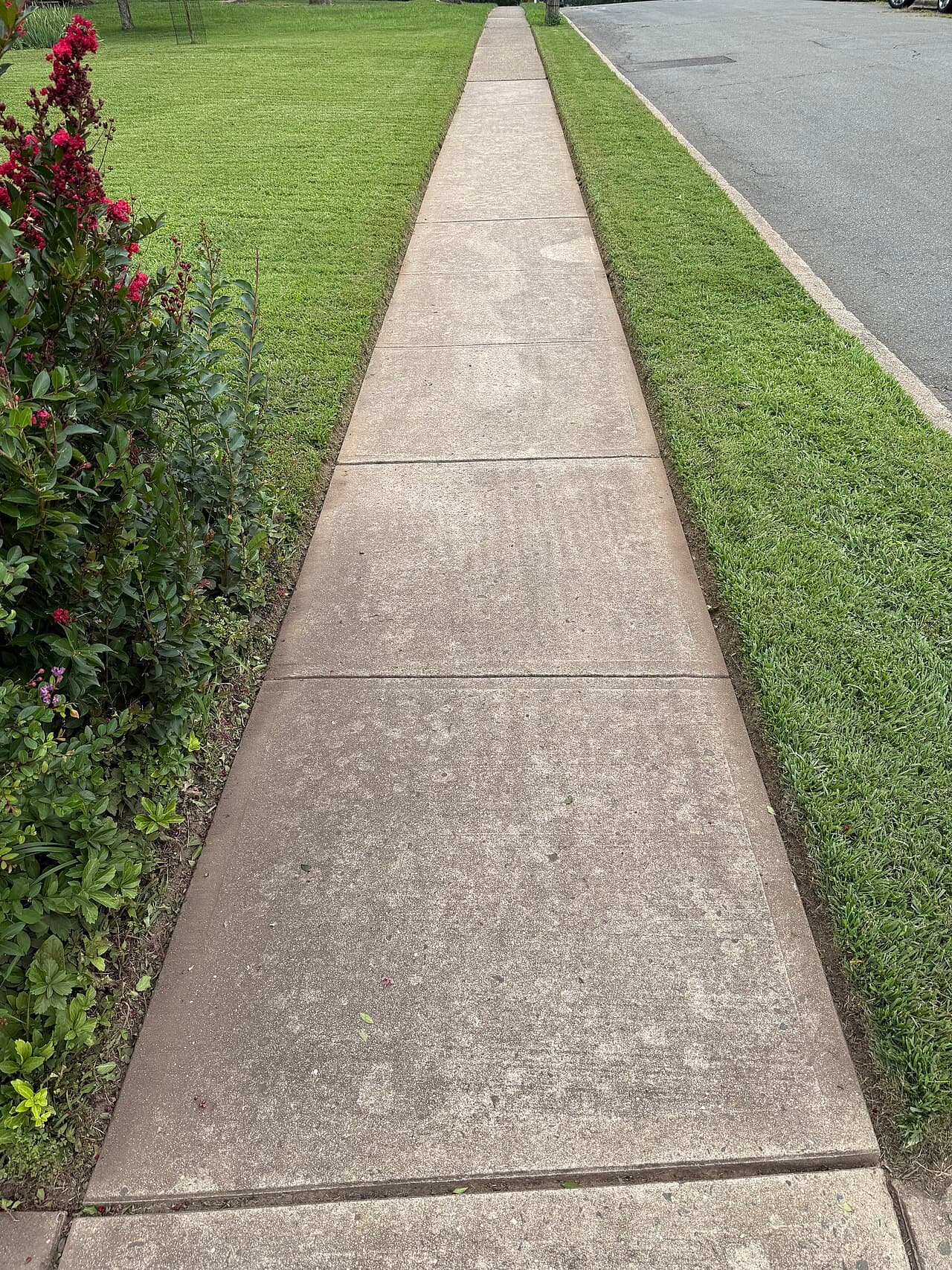
How much edge you have. Sidewalks, the driveway, the curb, patio borders and planting beds all add up. A corner lot with a front walk, a long driveway and curbing on two sides has several times the edge of an interior lot with a short walk. Measure it before you ask for quotes so every crew is pricing the same thing.
How overgrown it is. Grass that has crept well onto the slab, or rooted into the joints, turns a quick trim into real digging.
Your grass. Virginia Tech rates bermudagrass's overall maintenance as high, primarily because of mowing and edging requirements during the growing season.[1] Kentucky bluegrass has an aggressive lateral growth habit from rhizomes,[1] while zoysiagrass has less stem encroachment into landscape and garden beds than bermudagrass,[1] and Virginia Tech still recommends tall fescue to be managed as a non-creeping grass.[1] A fescue lawn usually needs the least edging, and a bermudagrass lawn the most.
How often it is done. Edging normally rides along with mowing. Virginia Cooperative Extension recommends mowing often enough that only one third of the leaf height comes off at any one mowing, which it says will probably be every five to six days during the active growing season.[2] Henrico County's Extension office pairs weekly mowing for a regular-maintenance cool-season lawn, twice a week for a high-quality manicured one, and every 10 to 14 days for a reduced-maintenance lawn.[3] More visits mean more edging charges over a season, even if each one is small.
The season. Warm-season grasses such as bermudagrass go dormant for 4 to 5 months from late fall to early spring,[1] so there is little to edge in winter. Ask whether a seasonal contract keeps charging for edging during dormancy.
Cleanup. A crew that blows clippings back onto the lawn is doing it right. Prince William County lists grass clippings and leaf litter among the potential sources of illicit discharges to the storm drain system,[5] so debris swept into the gutter is not a shortcut you want to pay for. Bagging and hauling the sod strips from a first edge costs more than spreading them.
Spray add-ons. Some crews offer to spray the cracks and edges. Under Virginia's rules, anyone using pesticides on someone else's property in exchange for compensation must work for a company with a Pesticide Business License.[6] Virginia law defines a pesticide to include any substance intended for preventing, destroying, repelling, or mitigating weeds,[7] so a weed spray along the cracks counts. Hire only a company that holds that licence.
Doing it yourself
If you already own a string trimmer, maintenance edging costs only line and time. A half-moon hand edger is an inexpensive way to cut the first line on a short walk, and a powered blade edger or trimmer attachment makes long runs faster. Budget for safety glasses whichever tool you use: Husqvarna's edger manual warns that stones, broken glass, nails, wire and string can be thrown or wrap around the blade,[4] and calls for a 15-metre (50-foot) safety zone around the edger.[4] For the technique, see how to edge a lawn along a sidewalk.
Getting a quote you can compare
Ask each business to put the following on its written quote:
- the edges included, by name, and their rough length
- the price of the first edge, separate from the per-visit price
- the tool used on hard edges (blade edger or string trimmer)
- how often edging is done, and whether it stops during dormancy
- where the clippings go
- for any spray, the company's pesticide business license
If edging is bundled into a mowing price, ask for the same mowing price without it. That one number tells you what the edging is really costing. For help deciding, read whether edging is worth adding to a weekly lawn service.
Stop and call a pro if
- The edge has disappeared under a thick mat of runners across long stretches of sidewalk and driveway.
- Bermudagrass is spreading through the cracks and into beds, and you want a herbicide program.
- The sidewalk slabs have heaved or broken; that is a concrete repair question before it is an edging one.
- You cannot keep people and pets well clear while a powered edger is running.
Browse the lawn and landscaping answers, see edging and trimming services, or look up lawn and landscaping businesses around Blacksburg. For a written price, describe the job once and local businesses quote it.
Common questions
- Is edging included in a standard mowing price?
- Sometimes, and the word means different things to different crews. Some include a string-trimmer pass along every hard surface at each visit; others charge separately for cutting a crisp edge with a blade edger. Ask what is included in writing before you compare prices.
- Why does the first edging cost more than later visits?
- The first cut on an edge that has not been done in a while means cutting through a mat of runners, lifting the sod that has grown over the concrete and hauling or spreading it. Later visits only trim the new growth along a line that is already there, which takes far less time.
- Does my grass type change the price?
- It can. Virginia Tech rates bermudagrass as high maintenance largely because of its mowing and edging needs, and Kentucky bluegrass also creeps from rhizomes. Bunch-type tall fescue, the grass Virginia Tech recommends managing as non-creeping, spreads much less and usually needs less edging.
- Can a lawn crew spray weeds in my sidewalk cracks?
- Only if it is set up to. In Virginia, anyone applying pesticides on someone else's property for pay has to work for a company with a Pesticide Business License, and the state's definition of a pesticide covers products meant to destroy weeds. Ask to see the licence before you agree to a spray add-on.
- Is it cheaper to edge myself?
- Over time, usually, if you already own a string trimmer. The costs are the tool, trimmer line or a blade edger, safety glasses and your time. What you save in money you pay in labor, so compare a crew's per-visit edging price with how many minutes the job takes you.
Sources
- [1] Selecting Turfgrass for Virginia (SPES-748), Virginia Cooperative Extension, Virginia Tech. Checked October 26, 2026.
- [2] Mowing To Recycle Grass Clippings (430-402), Virginia Cooperative Extension, Virginia Tech. Checked October 26, 2026.
- [3] SMART Lawns (revised March 2022), Virginia Cooperative Extension, Henrico County Office. Checked October 26, 2026.
- [4] Edger Attachment Operator's Manual, Husqvarna. Checked October 26, 2026.
- [5] Stormwater Pollution Reduction, Prince William County, Department of Environmental Services. Checked October 26, 2026.
- [6] Becoming a Certified Pesticide Applicator, Virginia Department of Agriculture and Consumer Services. Checked October 26, 2026.
- [7] Va. Code § 3.2-3900, Definitions (Virginia Pesticide Control Act), Code of Virginia, Virginia General Assembly. Checked October 27, 2026.
Want a pro to handle it?
Describe the job once. Licensed local businesses send quotes, and you pay only when you book one.
Get a quote from a local pro