Why does my lawn edge keep growing into the sidewalk cracks?
Usually because the grass at the edge spreads sideways and the cracks hold soil. Bermudagrass and Kentucky bluegrass send creeping stems over and under the concrete, and any crack or joint where soil settles gives them, and weeds, a place to root. Cut the runners back, clean the soil out, seal or fill the cracks, and edge on a regular schedule.
Free to ask. Local shops send quotes, and you pay only when you book one.
By Kasra Taheri, Founder, LoclisPublished
Researched and drafted with AI, then checked claim by claim against the sources listed below before it was published. Prices and rules change; the dates beside each source say when it was last checked.
Step by step
Read when to stop and call a pro, further down this page, before you start.
Step 1: Identify the grass
Pull a runner from a crack and look for creeping stems above ground (stolons) or below ground (rhizomes).[1]
Step 2: Cut a fresh edge
Recut the line where the lawn meets the sidewalk so new runners have to start over from the edge.
Step 3: Wet the soil first
Water the cracks before weeding so the roots pull out more easily.[3]
Step 4: Pull out the runners
Work the grass and roots out of each crack with a narrow weeding knife or a paving knife.[3]
Step 5: Sweep the joints
Sweep soil and clippings out of cracks and joints regularly so new seeds and runners have nothing to root in.[3]
Step 6: Seal or fill the gaps
Seal cracks in concrete and fill paver joints, polymeric sand being one option, once they are clean.[3]
Step 7: Raise the fescue
In a tall fescue lawn invaded by bermudagrass, mow at 3.5 to 4 inches to shade the bermudagrass out.[2]
Step 8: Edge on a schedule
Trim the edge at each mowing and recut it with a blade edger whenever grass starts lapping over the concrete.
Step 9: Read any herbicide label
If you use a weed killer in the cracks, read and follow the label, which is the law.[2]
Grass keeps coming back into the sidewalk cracks for two reasons that work together. The grass at the edge of your lawn spreads sideways, and the cracks and joints in the concrete hold enough soil for it to root. Fixing it means dealing with both: the grass, by edging and sometimes by changing how you mow, and the cracks, by cleaning and sealing them.
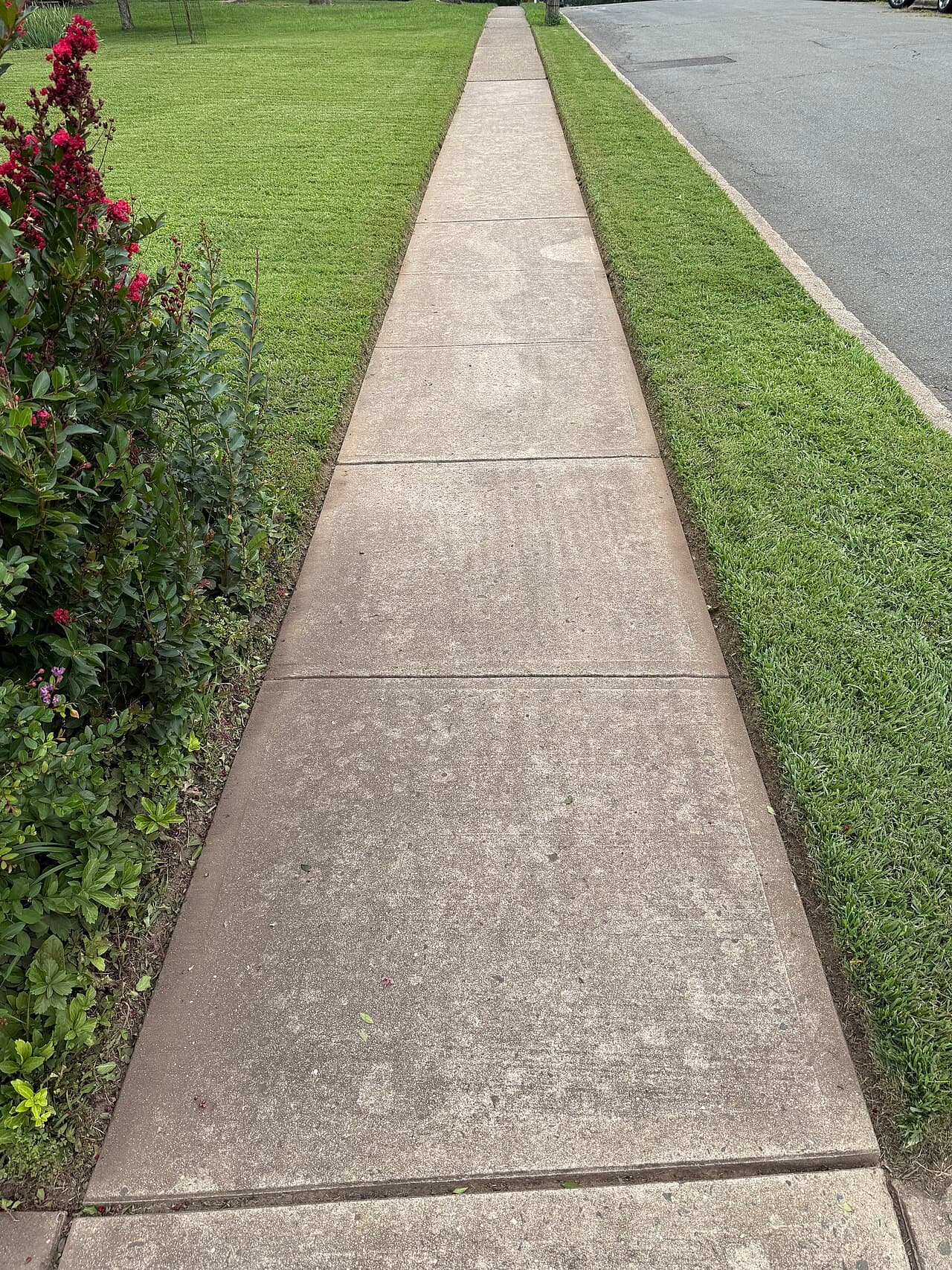
Reason one: your grass creeps
Lawn grasses grow in two ways. Bunch-type grasses thicken by sending up new shoots from the base. Creeping grasses also send out stems sideways, either above ground (stolons) or as rhizomes (below ground stems),[1] and those stems are what run across the slab and drop into the cracks.
- Bermudagrass is the usual culprit. Bermudagrass has both rhizomes and stolons and an extremely fast lateral spread rate,[1] which is why it ends up in beds, gardens and pavement.
- Kentucky bluegrass spreads by rhizomes, and its aggressive lateral growth habit from rhizomes can make it a competitive weed in plant beds.[1]
- Zoysiagrass has rhizomes and stolons too, but spreads very slowly,[1] so it creeps onto concrete less.
- Tall fescue, one of the best-adapted lawn grasses across Virginia,[1] barely creeps. Virginia Tech says tall fescue is managed as a bunch-type grass that produces lots of tillers.[1]
That last point is a useful clue. If your lawn is tall fescue and you still find long runners in the cracks, the runner is probably not your fescue. Often it is bermudagrass that has moved in. Virginia Tech notes that lawns of cool-season grass contaminated with bermudagrass show distinct brown patches in the colder months, when the bermudagrass is fully dormant,[2] so look for tan streaks along the walk in winter.
Reason two: the cracks hold soil
A sidewalk crack is a planter once dirt washes into it. Cornell's turf weed specialists explain that weeds grow easily in cracks, joints and depressions in hard surfaces where soil is allowed to settle,[3] that weeds are more likely to spread inward from the edges close to vegetation,[3] and that plants that reproduce vegetatively nearby may spread under pavement and come up through cracks and joints.[3] Clippings and soil left on the walk after mowing and edging feed the same process.
It is worth fixing, not just for looks. Plants growing in pavement can cause and expand cracks in pavement, destabilize joints and seals, and shorten the life of the surface.[3]
Reason three: the edge is not being cut
When the edge goes uncut for a few weeks in the growing season, runners lie across the concrete and root into the first joint they reach. A string trimmer along the edge at each mowing, with a blade edger to recut the line when it starts to blur, keeps most runners from ever reaching the cracks. See how to edge a lawn along a sidewalk and how often to edge.
Reason four: the fescue is mowed too short
If bermudagrass is moving into a tall fescue lawn, mowing height matters as much as edging. Virginia Tech's turf specialists say bermudagrass cannot tolerate low light,[2] and that tall fescue mowed at 4 inches can completely kill bermudagrass without herbicides.[2] Their cultural program for a fescue lawn calls for 3.5 to 4.0 inch mowing heights[2] and good fall fertility. Short-cut fescue lets the bermudagrass take over the edge and keep feeding runners into the cracks.
About weed killers
Herbicides can help in cracks, but they are not a substitute for the steps above. Virginia Tech lists glyphosate as the non-selective option for severe bermudagrass,[2] which also means it kills any lawn grass it touches, and regrowth from roots under the slab is common. Whatever you use, read and follow the label. If you would rather have a crew spray, remember that in Virginia anyone using pesticides on someone else's property for pay must work for a company with a Pesticide Business License.[4] Paver patios have the same problem in their joints; see how to keep weeds from growing between pavers.
Stop and call a pro if
- The cracks are wide, the slabs have heaved or sunk, or pieces are breaking out. Clean them out and read how to fix cracks in a concrete driveway or whether to repair or replace cracked concrete.
- Tree roots are lifting the sidewalk.
- Bermudagrass has spread through the lawn, beds and pavement and you want a herbicide program.
- The sidewalk is public. Ask your town or county public works office before filling or sealing it.
Browse the lawn and landscaping answers, see edging and trimming services, or look up lawn and landscaping businesses around Blacksburg. To have the edges cleaned up and kept, describe the job once and local businesses quote it.
Common questions
- Is the grass in my sidewalk cracks bermudagrass?
- Often, if it is wiry, fine-bladed and runs along the surface on long stems. A quick check is winter: a cool-season lawn invaded by bermudagrass shows distinct brown patches in the cold months while the bermudagrass is dormant. Your local Extension office can identify a sample for you.
- Will edging alone stop grass growing in the cracks?
- It slows it. Edging cuts off the runners at the lawn side, but anything already rooted in a crack keeps growing, and soil in the joint lets new runners and seeds take hold. Edging works best with pulling out what is there, sweeping the joints clean and sealing the cracks.
- Can I just pour weed killer in the cracks?
- You can use a product labeled for that use, following its label exactly, but a non-selective weed killer such as glyphosate kills any lawn grass it reaches, so it is easy to brown out the lawn edge. Keep spray off the turf, and expect regrowth from roots under the slab.
- Do grass and weeds in cracks damage the sidewalk?
- They can. Plants in hard surfaces can cause and expand cracks, loosen joints and seals and shorten the life of the pavement, so it is worth keeping cracks clean and sealed.
- Who fixes a cracked public sidewalk in front of my house?
- It depends on the locality. Before you fill, seal or replace a slab along the street, ask your town or county public works office who is responsible for that sidewalk.
Sources
- [1] Selecting Turfgrass for Virginia (SPES-748), Virginia Cooperative Extension, Virginia Tech. Checked October 26, 2026.
- [2] Selective Bermudagrass Control for Lawns (SPES-350), Virginia Cooperative Extension, Virginia Tech. Checked October 26, 2026.
- [3] Hard Surfaces, Cornell University, Turfgrass and Landscape Weed ID. Checked October 26, 2026.
- [4] Becoming a Certified Pesticide Applicator, Virginia Department of Agriculture and Consumer Services. Checked October 26, 2026.
Want a pro to handle it?
Describe the job once. Licensed local businesses send quotes, and you pay only when you book one.
Get a quote from a local pro