Is it worth adding edging to a weekly lawn service?
Usually, if you have long sidewalk, driveway or curb edges, or a creeping grass such as bermudagrass or Kentucky bluegrass that runs onto the concrete between visits. With a bunch-type tall fescue lawn and short edges, a string-trimmer pass at each mowing may be enough. Either way, get the weekly price with and without edging, in writing, and check what edging means to that crew.
Free to ask. Local shops send quotes, and you pay only when you book one.
By Kasra Taheri, Founder, LoclisPublished
Researched and drafted with AI, then checked claim by claim against the sources listed below before it was published. Prices and rules change; the dates beside each source say when it was last checked.
Step by step
Read when to stop and call a pro, further down this page, before you start.
Step 1: Check your grass
Find out whether your lawn is tall fescue, Kentucky bluegrass, bermudagrass or zoysia, because creeping grasses need edging most.[1]
Step 2: Measure the edges
Add up the sidewalk, driveway, curb and bed edges so you know how much work the add-on covers.
Step 3: Ask what edging means
Ask whether the crew cuts hard edges with a blade edger or only runs a string trimmer along them.
Step 4: Get both prices
Ask for the weekly price with and without edging, plus any one-time charge for the first cut.
Step 5: Match the season
For bermudagrass or zoysia, ask to pause edging during the 4 to 5 months of winter dormancy.[1]
Step 6: Set the cleanup rule
Ask that clippings be blown back onto the lawn, not into the street or a storm drain.[4]
Step 7: Check spray credentials
If edging comes with spraying cracks, ask for the company's Virginia Pesticide Business License.[5]
Step 8: Review after a month
Look at the edges after several visits and keep or drop the add-on based on how they hold up.
For most Virginia yards with long runs of sidewalk, driveway or curb, adding edging to a weekly service is worth it: the crew is already there with the tools, and a clean line is far easier to keep than to win back. It is least worth it on a bunch-type tall fescue lawn with short edges, where a trimmer pass at each mowing keeps things tidy and you can recut the hard edge yourself when it starts to blur.
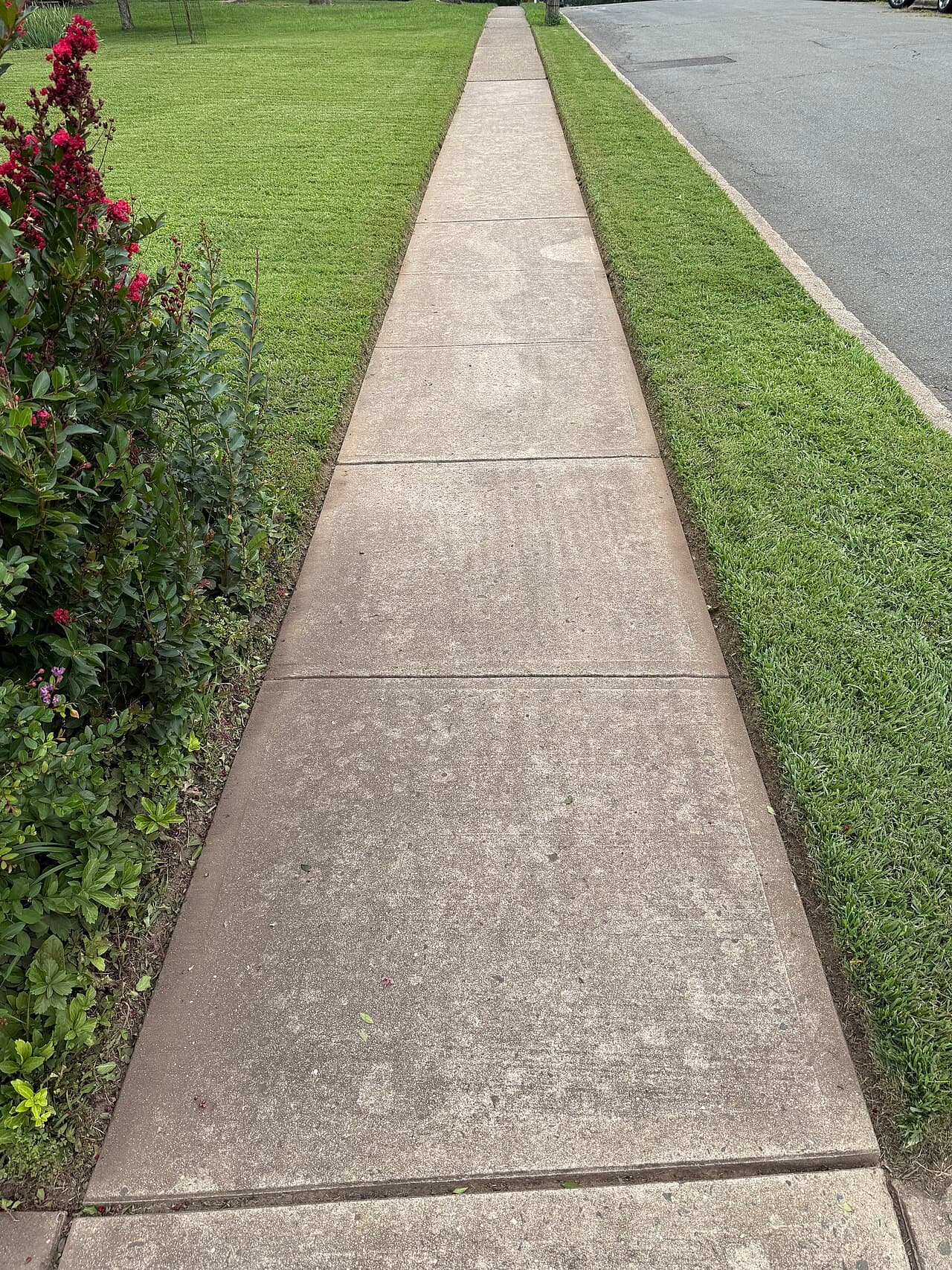
Your grass decides most of it
The single biggest factor is how fast your grass creeps over concrete.
- Bermudagrass. Virginia Tech rates bermudagrass as high maintenance during the growing season, primarily because of mowing and edging requirements.[1] Its fast-growing rhizomes and stolons carry it into plant beds and gardens,[1] and across sidewalk edges the same way.
- Kentucky bluegrass. It has aggressive creeping potential from rhizomes,[1] so it also benefits from regular edging.
- Zoysiagrass. Dense and slow to spread, with less stem encroachment into landscape and garden beds than bermudagrass.[1]
- Tall fescue. One of the best-adapted lawn grasses across Virginia,[1] it is a bunch-type grass, and Virginia Tech still recommends managing it as a non-creeping grass.[1] Its edges hold their shape longest.
If you have bermudagrass or bluegrass and more than a short front walk, edging at each visit usually pays for itself in the time it saves you. If you have tall fescue, consider paying for a crisp first edge, then a trim at each visit, with the blade edger used only when needed.
Match the add-on to the season
Grass in Virginia does not grow evenly through the year, and neither should your edging bill. Warm-season grasses such as bermudagrass and zoysia go dormant and lose their green color for 4 to 5 months from late fall to early spring,[1] so there is little to edge in winter. Henrico County's Extension office notes that tall fescue looks good in spring, early summer and fall but can go dormant in the heat of summer unless it is watered.[2]
Weekly service itself is the right rhythm for most lawns. The Henrico office pairs weekly mowing for a regular-maintenance cool-season lawn[2] with removing no more than one third of the grass blade at each mowing.[2] Edging on that same visit keeps the line from getting away from you.
The case for doing it yourself
Edging is not hard, and if you already own a string trimmer it costs little more than line and a few minutes. The catch is safety and time. Husqvarna's edger manual warns that stones and debris thrown up by an edger can cause blindness or other serious injury,[3] and calls for keeping children, animals and helpers outside a 15-metre (50-foot) zone[3] while it runs. On a corner lot along a busy sidewalk, that is easier for a crew that does it every day. For the technique, see how to edge a lawn along a sidewalk.
What to ask before you add it
- What does "edging" mean to you? A string-trimmer pass along every hard surface and a blade-edger cut are different jobs at different prices.
- What is the weekly price with and without it? The difference is what the add-on really costs.
- Is there a charge for the first cut? An overgrown edge takes much longer the first time.
- Does it pause in winter? For bermudagrass and zoysia, it should.
- Where do the clippings go? Prince William County lists grass clippings and leaf litter among the potential sources of illicit discharges to the storm drain system.[4] The crew should blow clippings back onto the lawn.
- Does the add-on include spraying? In Virginia, anyone who uses pesticides on someone else's property for pay must work for a company with a Pesticide Business License.[5] VDACS does not issue an active certificate to a for-hire applicator unless the applicator holds, or works for someone who holds, a valid Pesticide Business License.[6]
Try it for a month. If the edges look the same with and without the add-on, drop it. For what drives the price, see how much lawn edging costs in Virginia.
Stop and call a pro if
- The edge has vanished under a mat of runners along long stretches of concrete.
- Bermudagrass is moving through the sidewalk cracks and into beds, and you want a herbicide program rather than more cutting.
- The sidewalk slabs have heaved or broken, which needs concrete repair before neat edging is possible.
Browse the lawn and landscaping answers, compare lawn mowing services and edging and trimming services, or look up lawn and landscaping businesses around Blacksburg. To get it priced, describe the job once and local businesses quote it.
Common questions
- What is the difference between trimming and edging?
- Trimming usually means running a string trimmer around things the mower cannot reach, such as fences, trees and the grass along hard surfaces. Edging usually means cutting a clean vertical line where the lawn meets a sidewalk, driveway, curb or bed, often with a blade edger. Crews use the words differently, so ask which one a quote includes.
- Does edging need to be done every week?
- Not always. A quick trim along the edges at each mowing keeps most lawns neat, and the hard edge needs recutting only when the grass starts to lap over the concrete. That happens fastest with creeping grasses such as bermudagrass and Kentucky bluegrass, and slowest with bunch-type tall fescue.
- Can I edge myself and pay only for mowing?
- Yes, and many homeowners do. If you already own a string trimmer and have short edges, a few minutes after each mowing may be all it takes. Wear eye protection and keep people and pets well back, because an edger throws stones and debris.
- Should the crew spray my sidewalk cracks too?
- Only a properly licensed one. In Virginia, anyone using pesticides on someone else's property for pay has to work for a company with a Pesticide Business License. Ask for it before agreeing to a spray add-on, and ask which product they use and how close to your beds and vegetable garden it goes.
- Will a crew damage my sprinkler heads or lighting cable?
- It can happen with a blade edger. Walk the edges with the crew lead on the first visit, point out sprinkler heads, lighting cable and pet fence wire near the edge, and ask in writing who pays if one is cut.
Sources
- [1] Selecting Turfgrass for Virginia (SPES-748), Virginia Cooperative Extension, Virginia Tech. Checked October 26, 2026.
- [2] SMART Lawns (revised March 2022), Virginia Cooperative Extension, Henrico County Office. Checked October 26, 2026.
- [3] Edger Attachment Operator's Manual, Husqvarna. Checked October 26, 2026.
- [4] Stormwater Pollution Reduction, Prince William County, Department of Environmental Services. Checked October 26, 2026.
- [5] Becoming a Certified Pesticide Applicator, Virginia Department of Agriculture and Consumer Services. Checked October 26, 2026.
- [6] Commercial Applicator, Virginia Department of Agriculture and Consumer Services. Checked October 26, 2026.
Want a pro to handle it?
Describe the job once. Licensed local businesses send quotes, and you pay only when you book one.
Get a quote from a local pro