How much does pool leak repair cost in Virginia?
We found no Virginia source that dates a price for pool leak repair, so we do not quote one. The cost depends on where the leak is, how hard it is to find, the type of pool, which trades are needed and the permit. Get itemized written quotes from licensed pros, and limit the deposit to 10% or $1,000, whichever is less.
Free to ask. Local shops send quotes, and you pay only when you book one.
By Kasra Taheri, Founder, LoclisPublished
Researched and drafted with AI, then checked claim by claim against the sources listed below before it was published. Prices and rules change; the dates beside each source say when it was last checked.
Step by step
Read when to stop and call a pro, further down this page, before you start.
Step 1: Run the bucket test
Confirm the pool is losing more water than evaporation explains, using the 24-hour bucket test.[1]
Step 2: Note where it seems to be
Write down any wet spots, air bubbles or equipment drips so every contractor starts from the same facts.
Step 3: Ask for written quotes
Ask two or three companies for itemized written quotes that cover locating the leak, the repair and what the warranty covers.
Step 4: Check each licence
Look up each company on the DPOR website; work valued at $1,000 or more needs a Virginia Contractor's License.[4]
Step 5: Ask about the permit
Ask who pulls any permit and whether the fee is in the quote.
Step 6: Compare like with like
Line the quotes up item by item: detection, repair, draining and refilling, chemicals, permit, warranty.
Step 7: Limit the deposit
Agree a deposit of no more than 10% of the total or $1,000, whichever is less, in the written contract.[4]
There is no source we can point to for a Virginia price on pool leak repair, so this page does not invent one. What it can do is tell you what moves the number, so a written quote makes sense when it arrives. A repair at the equipment pad is a small job; a leak in the shell or under the deck is a large one, and finding it is part of the bill.
What decides the price
Where the leak is. The EPA lists the places pool leaks turn up: the pool liner, the pump seal, pool piping, the pool-to-pipe connection, pool edges, and pipe joints.[1] A leaking pump seal or a loose fitting on the equipment pad is quick to reach. Pipe buried under a deck, or a crack in a shell, means opening up or draining the pool, and the price follows the labor.
Finding it. If the cause is not obvious, someone has to locate it before it can be fixed. Ask whether detection is a separate fee, and whether it is credited toward the repair if you hire the same company.
The kind of pool. Vinyl liner, fiberglass, plaster and above-ground pools fail in different ways and take different repairs. A liner patch is not a liner replacement, and the quote should say which one it is.
Which trades are involved. Virginia's specialty definition for swimming pool construction contracting covers the construction, repair, improvement, or removal of in-ground swimming pools, but says that no trade related plumbing, electrical, backflow, or HVAC work is included in this specialty.[3] If the fix touches house plumbing or pump wiring, expect a licensed plumber or electrician on the job and on the invoice.
Permits. Virginia's Uniform Statewide Building Code requires a building permit for any swimming pool that has a surface area greater than 150 square feet or is more than 24 inches deep, according to Roanoke County.[6] Whether a repair needs one is a local call, so ask the contractor who pulls the permit and whether the fee is in the quote, or call your building department.
Water and chemicals. A leak costs money until it is fixed. Tampa's water department says it takes about 600 gallons to fill up an average pool by 2 inches,[2] and a refilled pool also needs its chemistry rebalanced. The EPA warns that small leaks can quickly turn into big leaks if they go unattended,[1] so a cheap repair now usually beats a large one later.
Confirm the leak before you pay for one
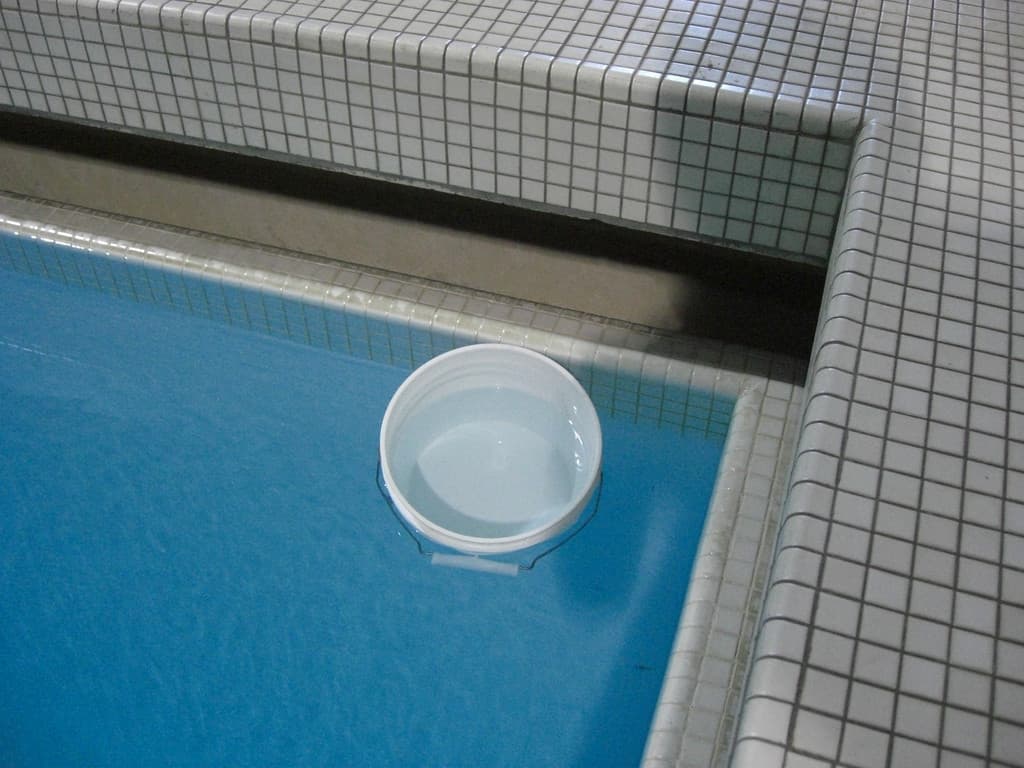
Run the bucket test first. The EPA's version has you shut down the pool systems, set a marked bucket on a step, and compare after 24 hours; if pool water loss is greater than bucket water loss, the pool may have a leak.[1] The steps are in how to find a leak in your pool. A pool that is only evaporating needs no repair, and a contractor will usually ask what the test showed.
Getting a quote you can compare
Ask two or three companies for written quotes that say what is being done, not just a total. For each, ask:
- how the leak will be located, and what that step costs
- what the repair is (patch, replacement part, re-sealed fitting, new liner) and where the leak is expected to be
- whether draining and refilling, chemicals, and the permit are included
- what the warranty covers, for how long, and what happens if the loss continues
Check the licence before anything else. If the work you are considering is valued at $1,000 or more, a valid Virginia Contractor's License is required for the license category in which the contractor is to work.[4] Under Va. Code § 54.1-1100, a Class C contractor takes jobs over $1,000 but less than $30,000 on a single contract.[5] Look the company up on the DPOR website, as the Board for Contractors advises.[4]
Paying for it
Virginia law requires all licensed contractors to provide a written contract for residential work.[4] The Board for Contractors suggests an initial deposit of no more than 10% of the total price or $1,000, whichever is less.[4] Custom or special-order items may justify a larger deposit, so ask why if one is requested. Pay the rest as the work is finished, not in advance.
Stop and call a pro if
- A contractor will not put the price or the work in writing.
- You are asked for more than the deposit limit or for cash before work begins.
- The quote has no licence number, or the number does not match the company on the DPOR lookup.
- Water is near pump or light wiring. That needs a licensed electrician.
- The pool keeps losing water after a repair. Go back to the contractor with your before and after bucket test readings and ask for the warranty in the contract.
Getting help in Virginia
For the next question, read who to call to fix a leaking pool. If you do not have a leak, how to clean a swimming pool covers the routine work, and pool and spa answers lists the rest. You can also browse local pool pros.
When you are ready, describe the leak and licensed local pros can quote it.
Common questions
- Is there a typical price for fixing a pool leak in Virginia?
- Not one we can cite. Repairs run from a small fitting or seal at the equipment to opening the deck or draining the pool, and the difference is large. Get written quotes that name the repair.
- Does leak detection cost extra?
- Often it is quoted separately. Ask whether the fee is credited toward the repair if you hire the same company, and what you get in writing if no leak is found.
- Does my water bill go up because of a pool leak?
- Yes. Tampa's water department says it takes about 600 gallons to fill an average pool by 2 inches, so repeated top-ups add up. Check how your own utility treats pool water.
- Do I need a licensed contractor for a small leak repair?
- Virginia requires a licence for work valued at $1,000 or more, according to the Board for Contractors. A small seal or fitting at the equipment may fall below that, but you still need the right trade for plumbing or wiring.
- How much deposit is reasonable?
- The Board for Contractors suggests no more than 10% of the total price or $1,000, whichever is less, unless the job needs special-order items.
Sources
- [1] Jump Into Pool Water Efficiency (EPA-832-F-22-015, September 2022), U.S. Environmental Protection Agency, WaterSense. Checked October 27, 2026.
- [2] How to Check for Leaks, City of Tampa Water Department. Checked October 27, 2026.
- [3] 18VAC50-22-30. Definitions of specialty services, Virginia Administrative Code, Virginia General Assembly. Checked October 27, 2026.
- [4] What You Should Know Before You Hire a Contractor, Virginia Board for Contractors, DPOR. Checked October 27, 2026.
- [5] Va. Code § 54.1-1100. Definitions, Code of Virginia, Virginia General Assembly. Checked October 27, 2026.
- [6] Residential: Installing a Swimming Pool or Hot Tub, Roanoke County, Virginia, Building Safety. Checked October 27, 2026.
Want a pro to handle it?
Describe the job once. Licensed local businesses send quotes, and you pay only when you book one.
Get a quote from a local pro