How do I find a leak in my pool?
Do a bucket test. On a calm day, switch off the pump, cleaner and automatic fill, set a bucket of water on a pool step, mark the water level inside the bucket and outside it, and wait 24 hours. If the pool dropped more than the bucket, it may have a leak. Then check the equipment, the auto-fill and the ground around the pool.
Free to ask. Local shops send quotes, and you pay only when you book one.
By Kasra Taheri, Founder, LoclisPublished
Researched and drafted with AI, then checked claim by claim against the sources listed below before it was published. Prices and rules change; the dates beside each source say when it was last checked.
Step by step
Read when to stop and call a pro, further down this page, before you start.
Step 1: Choose a calm day
Pick a day without rain or heavy winds.[1]
Step 2: Turn everything off
Shut down the filtration system, pool cleaner and automatic fill, and close the pool for 24 hours.[1]
Step 3: Set the bucket
Fill a 2.5- to 5-gallon bucket to about 1 inch from the top and set it on a step with at least two-thirds submerged.[1]
Step 4: Mark both levels
Mark the water level inside the bucket and the still pool water outside it with tape or a marker.[1]
Step 5: Wait 24 hours
Leave everything alone for 24 hours; Tampa's water department allows up to 72 for a slow leak.[2]
Step 6: Compare the drops
If the pool lost more water than the bucket, the pool may have a leak.[1]
Step 7: Repeat with the pump running
Run the same test with the pump on and compare; a bigger loss with the pump on points toward the plumbing.
Step 8: Walk the equipment
Look for wet ground, drips at the pump seal and bubbles in the return line or strainer.[1]
Step 9: Test the auto-fill
Shut off the automatic fill for 24 hours, and plug the overflow drain to see whether the fill valve is stuck open.[1]
A pool that keeps dropping is either evaporating or leaking, and a bucket test tells you which. Set a bucket of water on a pool step, mark the water level inside the bucket and outside it, and compare the two a day later. Evaporation lowers both equally; a leak lowers the pool more.
Know what a normal loss looks like
Some loss is normal. The EPA's pool water efficiency guide says that if your pool is losing more than 2 inches of water per week, or 3 inches in hot, dry areas with high evaporation rates, then it is likely you have a leak.[1] Wet spots around the pool, or air bubbles in the water return pipeline or in the pump strainer, can also be signs of leakage.[1]
To know your weekly loss, add water by hand for a while rather than letting an automatic fill do it quietly. The EPA suggests exactly that, so you are aware of your pool's weekly water loss.[1]
Run the bucket test
The EPA calls this the do-it-yourself leak test, and the City of Tampa's water department describes it the same way.
- Pick a day without rain or heavy winds. Shut down all pool systems (filtration systems, pool cleaners, automatic fills, etc.) and close the pool for 24 hours.[1]
- Fill a 2.5- to 5-gallon bucket to about 1 inch from the top and set the bucket in the pool (on a bench or step) so that at least two-thirds of the bucket is submerged in the pool, with the bucket water level a little higher than the pool level.[1]
- Mark the initial water level inside the bucket with a marker or a piece of tape, then mark or measure the still pool water outside it the same way.[1]
- Leave it for 24 hours, then record both levels again. If pool water loss is greater than bucket water loss, the pool may have a leak.[1]
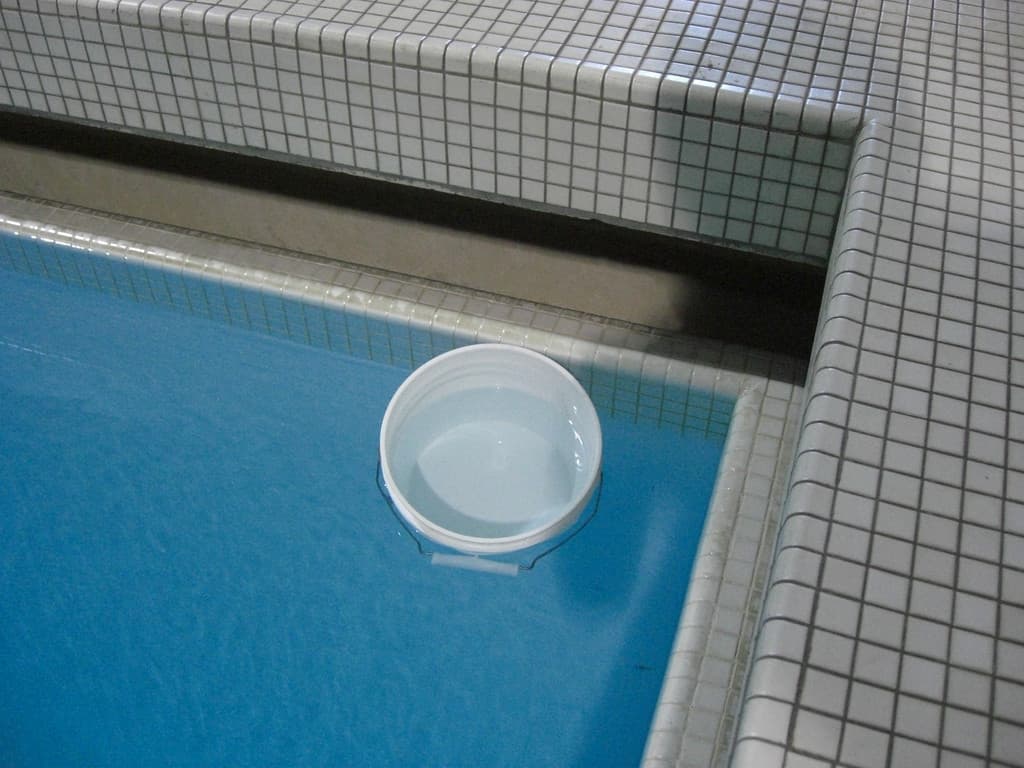
Tampa lets the test run longer, 24 to 72 hours, with the same instruction to compare the two losses.[2] A longer test shows a slow leak more clearly. If the two levels fall by the same amount, the water is evaporating, not escaping, and you can stop worrying.
Narrow down where it is going
If the bucket says you have a leak, look for the clues before you call anyone.
Repeat the test with the pump running. If the pool loses noticeably more water while the pump runs, the leak is often in the pressurized plumbing, the pump or the filter. If it loses about the same either way, the shell, liner, skimmer or a fitting in the wall is more likely. This is a rule of thumb, not a diagnosis.
Walk the equipment pad. Look for wet ground, drips at the pump seal and strainer lid, and wet fittings around the filter. The EPA lists the places leaks turn up: the pool liner, the pump seal, pool piping, the pool-to-pipe connection, pool edges, and pipe joints.[1] Keep your hands away from any wiring that is wet.
Watch the water return and the strainer. Air bubbles in the return line or the pump strainer can be a sign of a leak.[1]
Check the automatic fill. Fill valves can sometimes malfunction and send water to a pool's overflow drain. To confirm yours shuts off properly, plug the overflow drain and monitor whether the pool level is rising; if it is, the valve may be stuck open and should be repaired or replaced.[1] If your pool has an automatic refill, the EPA says to shut it off for 24 hours once every three months to test for leaks.[1]
Look at the surroundings. Soggy patches in the lawn, a sunken area of decking or a crack in the coping all point toward the water's path. Take photos and note the date; a contractor will ask.
What a leak costs you while you wait
Water adds up quickly. Tampa's water department says it takes about 600 gallons to fill up an average pool by 2 inches.[2] The EPA warns that small leaks can quickly turn into big leaks if they go unattended.[1] Do not leave a confirmed loss for the rest of the summer.
Stop and call a pro if
- The bucket test shows a leak and you cannot find it. A pool leak-detection specialist or a licensed pool contractor can pressure-test lines and inspect the shell.
- The water loss is large, or the level drops overnight.
- You see cracks, a bulging wall or a sunken deck. That is a structural problem, not a plumbing one.
- Water is near the pump motor, the light or other wiring. Stay clear and call a licensed electrician.
- Air bubbles keep showing up in the return line or pump strainer. The EPA lists them as a sign of leakage, and a pro can trace where the air is getting in.[1]
Getting help in Virginia
If the test shows a leak, read who to call to fix a leaking pool and what pool leak repair costs in Virginia. For the routine side of keeping a pool in shape, see how to clean a swimming pool, browse all pool and spa answers or look at local pool pros.
When you are ready, describe the leak and licensed local pros can quote it.
Common questions
- How much water should a pool lose in a week?
- The EPA says more than 2 inches a week, or 3 inches in hot, dry areas with high evaporation rates, likely means a leak. Less than that is usually evaporation and splashing.
- Can I do the bucket test with the pump running?
- The EPA's version has you shut down all pool systems first. Run it that way for the main result. A second test with the pump on can help show whether the leak is in the plumbing.
- How long should the bucket test run?
- The EPA says 24 hours. Tampa's water department says 24 to 72 hours, which can reveal a slow leak.
- Does rain ruin the test?
- Yes. Rain and heavy wind change the water levels, so the EPA says to run the test on a day without either.
- What if my pool has an automatic fill?
- Turn it off during the test. The EPA also says to shut it off for 24 hours once every three months to test for leaks, and to check that the valve is not stuck open.
- Should I drain the pool to find the leak?
- Not before you talk to a pool contractor. Many leaks can be found with the water in, and emptying a pool is a decision to make with a professional, not alone.
Sources
- [1] Jump Into Pool Water Efficiency (EPA-832-F-22-015, September 2022), U.S. Environmental Protection Agency, WaterSense. Checked October 27, 2026.
- [2] How to Check for Leaks, City of Tampa Water Department. Checked October 27, 2026.
Want a pro to handle it?
Describe the job once. Licensed local businesses send quotes, and you pay only when you book one.
Get a quote from a local pro