How do I dispose of an old washer and dryer?
Washers and dryers count as scrap metal, not trash, so do not put them out with regular garbage. Unplug them, shut off the water, drain the hoses and clean them out. Then use your locality's scheduled pickup, a convenience center or transfer station, or a store or hauler that takes the old pair when delivering a new one.
Free to ask. Local shops send quotes, and you pay only when you book one.
By Kasra Taheri, Founder, LoclisPublished
Researched and drafted with AI, then checked claim by claim against the sources listed below before it was published. Prices and rules change; the dates beside each source say when it was last checked.
Step by step
Read when to stop and call a pro, further down this page, before you start.
Step 1: Find your locality's rule
Check whether your city, county or trash hauler offers appliance pickup, and what it charges, before you move anything.[1]
Step 2: Unplug and shut off the water
Unplug the washer, then turn off its water supply at the valves.[5]
Step 3: Disconnect the hoses over a bucket
Unscrew the inlet hoses from the washer and the drain hose from its standpipe, holding the ends low over a bucket so leftover water does not run onto the floor.
Step 4: Empty and clean both machines
Pull the lint from the dryer's filter, take clothes and detergent out of both drums, and leave the doors propped open so they dry.
Step 5: Leave a gas dryer to a pro
If the dryer runs on gas, do not disconnect it yourself; have a licensed gas fitter or your gas utility cap the line.[6]
Step 6: Secure the doors and cords
Tape the door or lid shut and coil each power cord against the back so nothing snags on the way out.
Step 7: Move them with a helper
Tilt each machine onto an appliance hand truck with a second person, keeping the load upright and strapped, and pad door frames and corners.
Step 8: Set out or drop off
Put the machines where your collector asks on the scheduled day, or haul them to a convenience center or transfer station that takes them.[2]
The short version
Treat a washer and dryer as scrap metal. They are not regular trash, and most Virginia localities have a separate way to collect them: a scheduled bulk or metal pickup, a convenience center or transfer station, or a hauler or store that carries them out. Your job is to prepare them and pick one of those routes.
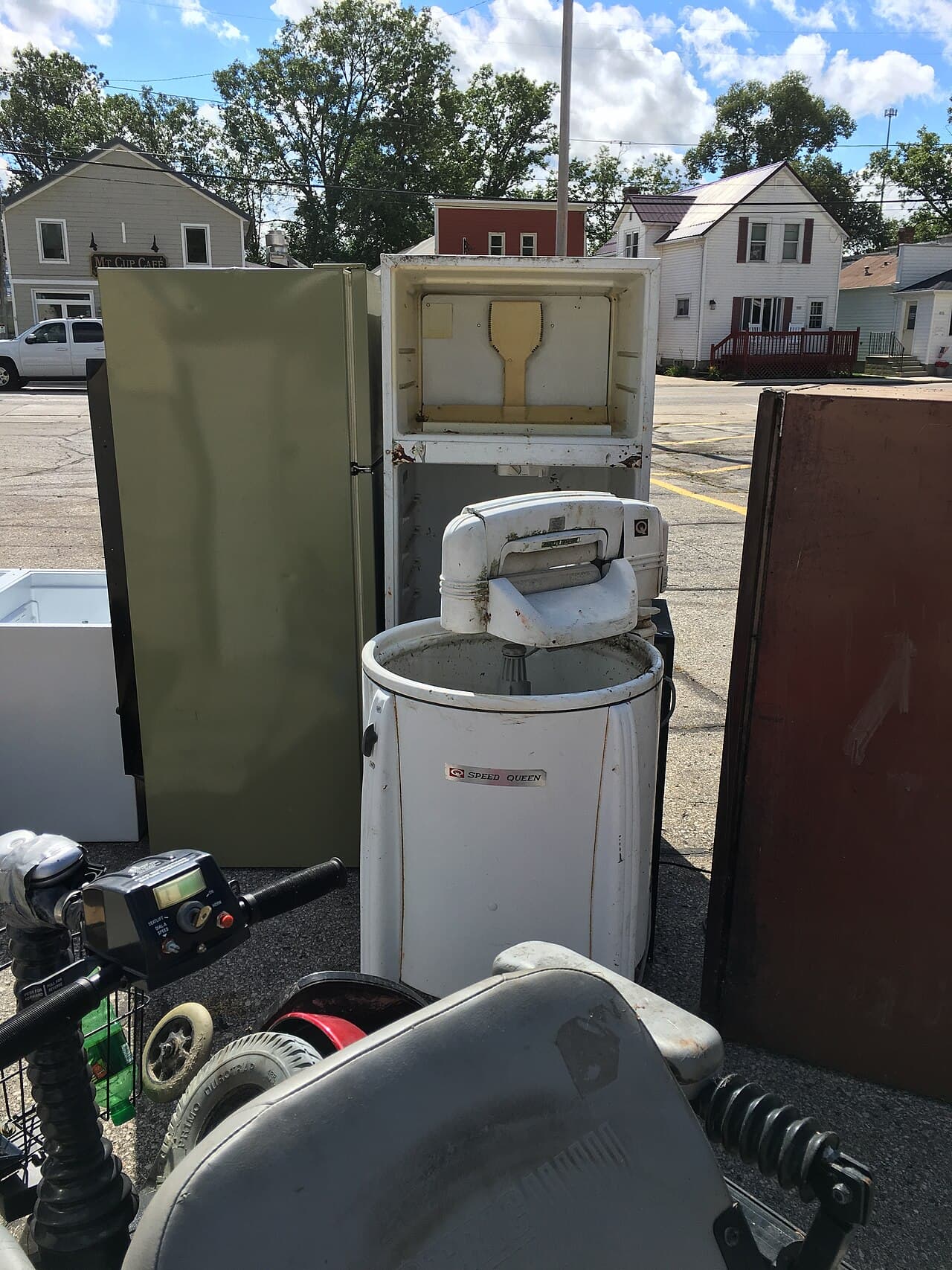
Find out what your locality offers
Rules differ from one locality to the next, so start with a call or a look at your city, county or hauler's page.
- Fairfax County. County collection customers get five free special collections per fiscal year, July 1 to June 30, and washers and dryers go in the "Metal" category with stoves, water heaters and bedframes.[1] You must schedule special collections in advance, set the items out at the curb by 6 a.m. on the collection day, and keep metal piles separate from other materials.[1] Special pickups are limited to 2 cubic yards, about 6 feet long by 3 feet wide by 3 feet high, with a charge for larger piles, and items must be less than 6 feet long.[1]
- Chesapeake. Chesapeake collects appliances as household bulk items on request by phone at 757-382-2489, and does not take hazardous waste or construction debris in the same pickup.[3]
- Richmond. When we checked on October 26, 2026, Richmond charged $50 per appliance for a collection request, and residents could also take bulk items to the East Richmond Road Convenience Center or the Hopkins Road Transfer Station.[4]
- Chesterfield County. With fees that took effect July 1, 2026, Chesterfield County's convenience centers charge $10 per item for non-Freon appliances including washers and dryers.[2] The centers also have a scrap metal box with no recycling fee for any clean, reusable metal.[2]
Elsewhere, ask your trash hauler. Many private haulers will take appliances for a fee, and a few counties run a drop-off site that does.
Get the machines ready
Preparation is the only real work, and it is mostly about water and power.
Unplug the washer and turn off its water supply.[5] Then unscrew the two inlet hoses and the drain hose, holding the ends low over a bucket; a washer always holds some water. Take clothes, detergent and stray socks out of both drums, pull the lint from the dryer's filter, and leave the doors open for a day so nothing grows inside.
Tape the door or lid shut before the move, and coil the power cords against the back. A loose cord or an unlatched door is what gets caught on a stair rail.
A gas dryer is a different job
An electric dryer just unplugs. A gas dryer is connected to a gas line, and that connection is not a do-it-yourself job. Columbia Gas of Virginia says to leave gas line projects, including replacing a gas dryer, to the professionals.[6] Have a licensed gas fitter or your gas utility cap the line and take the dryer out, then dispose of it as you would an electric one. If you smell gas at any point, leave the house and call your gas utility or 911 from outside.
Moving them out
A washer or dryer is heavy and awkward, so plan for two people and an appliance hand truck. Keep each machine upright, strap it to the hand truck, and pad door frames and corners. If you are hauling them yourself, secure them upright in the truck bed so they cannot tip or slide. Some drop-off sites may ask for proof that you live in the locality, so check before you load up.
If lifting is not realistic, a junk-removal crew or the store delivering your new pair will carry them out. See how much appliance removal costs in Virginia and whether a store will take your old appliance when you buy a new one.
Do not dump them
Leaving a washer at the roadside or on someone's land will cost you far more than a pickup fee. Virginia law makes it unlawful to dump trash or refuse on public property, including a highway right-of-way, or on private property without the owner's written consent.[7] A conviction is a misdemeanor punishable by up to 12 months in jail and a fine of $500 to $2,500.[7]
Stop and call a pro if
- The dryer is gas. Do not disconnect the connector yourself; a licensed gas fitter or the utility should cap the line.[6]
- You smell gas. Leave the house and call your gas utility or 911 from outside.
- The shutoff valves will not close or the hoses leak. A plumber should replace the valves rather than you forcing them.
- The machines are in a basement or up a tight stair. A crew with the right gear is safer than two people on a staircase.
- Water has pooled under the washer. Check for a leaking supply or drain line before you cover the floor.
Getting help in Virginia
If you would rather not carry them, Loclis lists local pros who haul appliances away. The same rules apply to a fridge, which has refrigerant that needs recovering: see how to get rid of an old refrigerator in Virginia. Browse more junk and moving answers or see junk removal and moving pros near you.
When you are ready, describe what needs to go once and local haulers quote it.
Common questions
- Can I put an old washer or dryer out with the regular trash?
- Usually not. Localities treat them as scrap metal or bulk items with their own pickup. Fairfax County lists washers and dryers under its scheduled metal pickups, and Chesapeake collects appliances as bulk items on request. Call your city, county or hauler before you set one out.
- Does it cost money to get rid of them?
- Often a little. With fees effective July 1, 2026, Chesterfield County charged $10 per washer or dryer at its convenience centers, and when we checked on October 26, 2026 Richmond charged $50 per appliance for a collection request. Some counties include a number of free pickups, so ask first.
- Will the store take my old pair when I buy a new one?
- Many retailers will haul the old machines away at delivery, sometimes for a fee. Ask before you order, since the offer varies by store and by delivery type. The linked guide on store take-back goes through what to ask.
- What if my dryer is gas?
- Do not disconnect it yourself. Columbia Gas of Virginia says to leave gas line projects, including replacing a gas dryer, to the professionals. Have a licensed gas fitter or your gas utility cap the line, then dispose of the dryer like an electric one.
- Can I just leave them at the curb or in the woods?
- No. Virginia law makes it unlawful to dump refuse on public property or on private property without the owner's written consent, and a conviction is a misdemeanor with a fine of $500 to $2,500. Use an approved pickup or drop-off.
Sources
- [1] Special Pickup, Fairfax County Department of Public Works and Environmental Services. Checked October 27, 2026.
- [2] Convenience Centers, Chesterfield County Waste and Resource Recovery. Checked October 27, 2026.
- [3] Bulk Trash Collection, City of Chesapeake Waste Management Division. Checked October 27, 2026.
- [4] Bulk and Brush, City of Richmond Department of Public Works. Checked October 27, 2026.
- [5] Non Usage or Vacation Care for a Washing Machine, Whirlpool Product Help. Checked October 27, 2026.
- [6] Safe Appliance Installation, Columbia Gas of Virginia. Checked October 27, 2026.
- [7] Va. Code § 33.2-802, Dumping trash; penalty, Code of Virginia, Virginia General Assembly. Checked October 27, 2026.
Want a pro to handle it?
Describe the job once. Licensed local businesses send quotes, and you pay only when you book one.
Get a quote from a local pro