How do I get rid of an old refrigerator in Virginia?
Ask the store delivering your new refrigerator to haul the old one away, or check whether your electric utility runs a turn-in program. Otherwise book your locality's appliance or bulk pickup, or take it to a county drop-off site, where many Virginia localities charge a small refrigerant fee. Before it sits anywhere unattended, take the doors off, as Virginia law requires.
Free to ask. Local shops send quotes, and you pay only when you book one.
By Kasra Taheri, Founder, LoclisPublished
Researched and drafted with AI, then checked claim by claim against the sources listed below before it was published. Prices and rules change; the dates beside each source say when it was last checked.
Step by step
Read when to stop and call a pro, further down this page, before you start.
Step 1: Check for a turn-in program
Ask your electric utility whether it runs an appliance turn-in program, and check its rules on working condition, age and size.[1]
Step 2: Ask the store first
If you are buying a new refrigerator, ask when you order whether the delivery crew will take the old one and what it costs.
Step 3: Find out who collects your trash
Check whether your county, city, town, HOA or a private hauler collects your trash, and whether it takes refrigerators at the curb or only at a drop-off site.
Step 4: Empty it completely
Take out all food, ice and loose shelves and drawers, since drop-off sites such as Chesterfield County's ask for all food waste removed.[8]
Step 5: Unplug and defrost
Unplug it a day ahead, prop the doors open, and lay towels down to catch melt water from the freezer.
Step 6: Close the ice maker valve
If it has an ice maker or water dispenser, close the small shut-off valve that feeds it before the refrigerator is pulled out.
Step 7: Take the doors off or strap them shut
Remove the doors, or strap them so a child cannot open them, before the refrigerator sits anywhere unattended.[3]
Step 8: Leave the tubing alone
Do not cut, bend or puncture the tubing or the compressor at the back; the refrigerant is recovered by the disposal site or a technician.[1]
Step 9: Move it on a hand truck
Strap it to an appliance hand truck with a helper, and pad door frames and floors on the way out.
Step 10: Set it out or haul it
Put it where your collector asks on the scheduled day, or strap it upright in a truck bed so it cannot tip or slide.
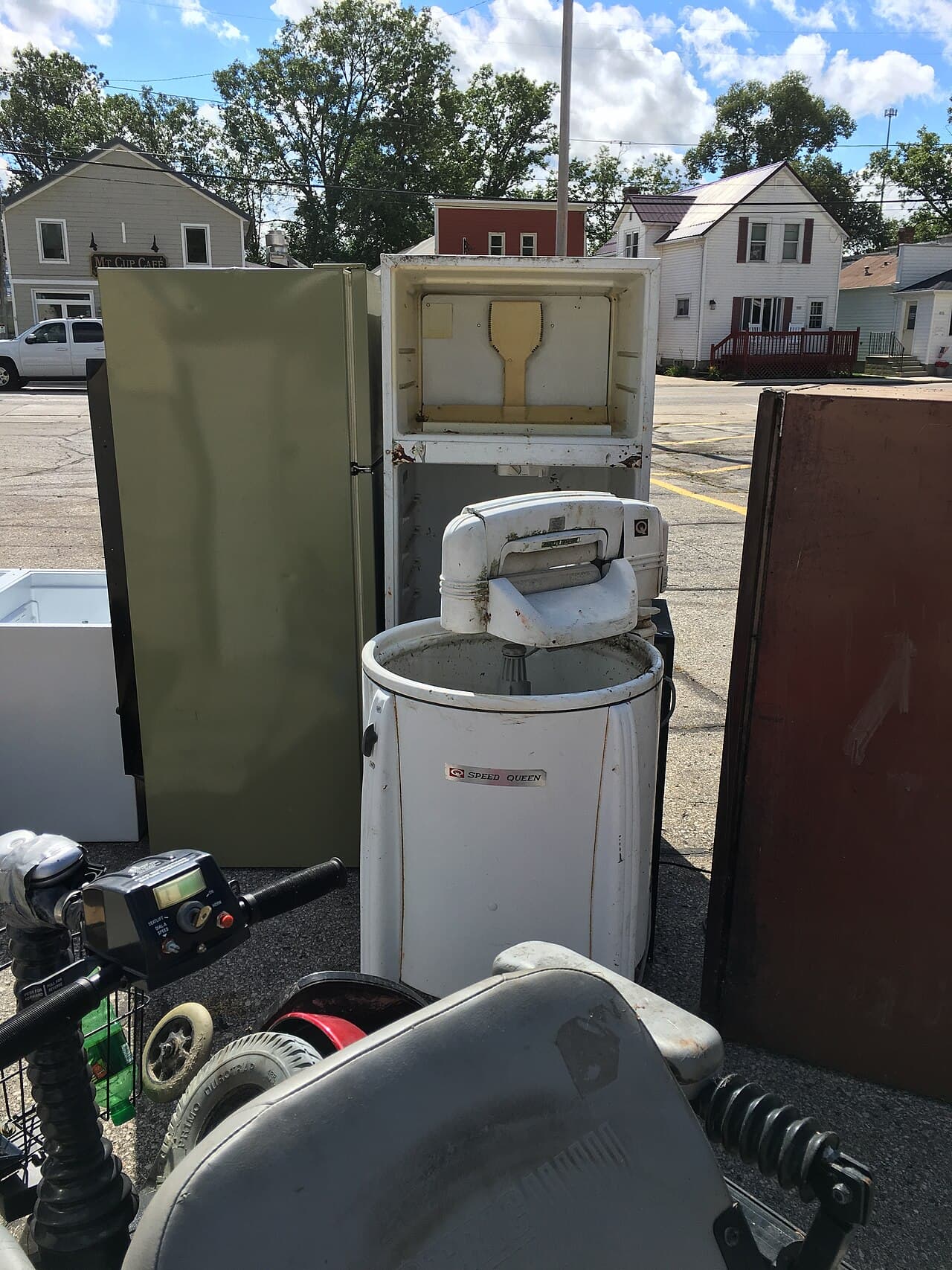
An old refrigerator leaves a Virginia home one of four ways: with the crew delivering your new one, through a utility turn-in program, on a scheduled pickup from whoever collects your trash, or in a truck to a county drop-off site. It usually cannot go out with the weekly trash: because of the refrigerant inside, most localities want it on its own appointment, at a drop-off site, or with its own fee.
Start with the store or your utility
If a new refrigerator is on the way, haul-away is usually the least work, since the old one leaves as the new one comes in. ENERGY STAR says many appliance retailers will pick up and recycle your old refrigerator when you buy a new one.[5] The EPA also notes that some retailers pick up and dispose of the old appliance when they deliver a new one, some take drop-offs at no charge, and a few give small vouchers or discounts in return.[1] IKEA, for example, charges $30 to remove an appliance when you buy a similar product in a store with in-home delivery, in select markets, and does not offer it on online orders.[6] That is the price we saw when we checked on October 27, 2026. Will the store take my old appliance when I buy a new one covers what to ask before you order.
No new purchase? The EPA's advice is to check first with your electric utility, since some run rebate or bounty programs that take old refrigerators, and to confirm your unit meets the program's rules, which can include working condition, a minimum age or a minimum size.[1]
Use your locality's pickup or drop-off
Find out who collects your trash: your county, city or town, an HOA contract, or a private company you pay. Rules for refrigerators differ a lot from place to place.
- Fairfax County. In Fairfax County, county collection customers get five free special collections per fiscal year, July 1 to June 30, and refrigerators and freezers are scheduled as a "Freon" pickup, separate from bulk and metal items.[7] About 90 percent of Fairfax County residents and businesses get trash service from a private company and should call that company instead.[7]
- Chesapeake. Chesapeake collects appliances as bulk household items on request, and asks residents to remove the doors from refrigerators and freezers before setting them out.[10]
- Chesterfield County. With fees that took effect July 1, 2026, Chesterfield County's two convenience centers charge $15 per item for refrigerators, freezers, air conditioners and dehumidifiers, and ask that refrigerators and freezers come in with all food waste removed.[8] The centers serve county residents, so bring identification or proof of Chesterfield County residency.[8]
- Montgomery County. When we checked on October 27, 2026, the Montgomery Regional Solid Waste Authority took appliances at its facility and charged a $19 Freon removal fee for any appliance not certified as Freon-free.[9]
- Roanoke Valley. Residents of Roanoke, Salem, Roanoke County and Vinton can bring household waste, appliances included, to the Roanoke Valley Resource Authority's Salem and Tinker Creek transfer stations at no charge under its residential disposal policy.[11]
- Everywhere else. Look up your locality's bulk, special or appliance pickup page, or call your hauler. If a truck has already left your refrigerator behind, why the trash company won't take bulky items explains the usual reasons.
Should you sell or donate it?
A newer, clean refrigerator that works well can find a second home. An old one is a different case. The EPA says almost all of a refrigerator's materials can be recycled, including the metal cabinet, the refrigerant and oil in the compressor, and the blowing agent in the foam insulation.[1] It also advises against reselling old units, because refrigerators near the end of their life use a lot of electricity.[1] ENERGY STAR puts the gap at about 20 percent: on average, an old refrigerator uses that much more energy than a model that has earned the ENERGY STAR.[5] The same logic applies to keeping it running as a garage or basement spare.
Get it ready to go
Empty it a day or two ahead. Take out every scrap of food, the ice bin and loose shelves, then unplug it and prop the doors open so the freezer can defrost onto towels. If it has an ice maker or water dispenser, close the shut-off valve on the small water line feeding it, usually behind the unit or under the kitchen sink.
Then deal with the doors. Virginia law makes it unlawful to discard, abandon or leave a refrigerator or other airtight container with more than two cubic feet of interior space anywhere without first removing the doors or hinges.[3] The rule does not apply to a refrigerator still in use, or one crated, strapped or locked so a child cannot get into it.[3] A violation is a Class 3 misdemeanor, which carries a fine of up to $500.[3][4] On most models the doors usually lift off once the top hinge cover and its screws come off. If it is going straight onto a delivery truck, ratchet straps around the cabinet are often enough.
Moving it is a two-person job. An appliance hand truck with a strap does most of the work, and a moving blanket on door frames and stair edges saves the paint.
Why the refrigerant matters
Older refrigerators and freezers were made with CFC and HCFC refrigerants and foam, which destroy the ozone layer if released, and older units may also hold mercury switches, contaminated oils or PCBs.[1] Federal rules put the duty to recover the refrigerant on the final person in the disposal chain, such as the scrap recycler or landfill.[2] If the refrigerant was already taken out, that final disposer needs a signed statement with the name and address of whoever recovered it and the date, and the EPA does not accept a sticker as proof.[2]
So never cut the lines to "empty" it yourself, and be wary of a scrap buyer who offers to. The EPA lists venting refrigerant and dumping appliances among the illegal practices that still happen, and warns that appliances left at the curb may be landfilled or otherwise disposed of unsafely.[1] If you hire someone, ask where the refrigerator is going.
Never dump it
Virginia law makes it unlawful to dump trash on public property, including a highway right-of-way, or on private property without the owner's written consent.[12] A conviction is a misdemeanor punishable by up to 12 months in jail and a fine of $500 to $2,500.[12] That includes leaving a refrigerator beside someone else's dumpster or at the edge of the road with a "free" sign.
Stop and call a pro if
- The refrigerator is built into the cabinetry, with trim panels or a custom front that has to come off to free it.
- The ice maker valve will not close, drips, or the water line is brittle or corroded.
- It will not clear a stair turn, a tight doorway or a deck step without taking off a railing or a door.
- You smell a sharp chemical odor or see oily residue around the tubing at the back, a sign the sealed system has leaked.
- You have a second refrigerator, a chest freezer or a load of other junk going too. See how much appliance removal costs in Virginia and how much junk removal costs in Virginia.
Getting it hauled through Loclis
Browse more junk removal and moving answers, see appliance and mattress removal businesses, or find junk removal and moving businesses around Blacksburg. To have the refrigerator carried out and taken away, describe the job on Loclis and compare quotes.
Common questions
- Can I put an old refrigerator out with my regular trash in Virginia?
- Usually not on a normal trash day. Many Virginia localities and private haulers treat a refrigerator as a special item because of its refrigerant, and collect it on a scheduled pickup or only at a drop-off site. Check your county, city or hauler's rules before you set it out.
- Do I have to remove the refrigerator doors?
- If it will sit anywhere unattended, yes. Virginia law requires removing the doors or hinges of a discarded refrigerator unless it is crated, strapped or locked so a child cannot get inside, and some localities, such as Chesapeake, ask for the doors off before a bulk pickup.
- What does it cost to drop off a refrigerator?
- Often a small per-item fee. With fees effective July 1, 2026, Chesterfield County charged $15 per refrigerator at its convenience centers, and when we checked on October 27, 2026 the Montgomery Regional Solid Waste Authority charged a $19 Freon removal fee unless the unit was certified Freon-free. Roanoke Valley residents could drop appliances off at no charge.
- Can I drain the refrigerant myself before I get rid of it?
- No. Leave the tubing and compressor alone. Venting refrigerant is illegal, and recovering it takes recovery equipment that meets EPA standards. The disposal site or an appliance technician handles it, and federal rules make the final disposer responsible for it.
- Should I sell or give away my old refrigerator?
- If it is fairly new and works well, a sale or donation can make sense. For an old one, the EPA advises recycling over resale, because aging refrigerators use a lot of electricity, and ENERGY STAR estimates an old unit uses about 20 percent more energy than a certified model.
- Will my utility pay me for an old refrigerator?
- Some utilities run turn-in programs that collect old refrigerators, sometimes with a rebate, and they often set rules on working condition, age and size. Check your electric utility's website or call before you book any other pickup.
Sources
- [1] Appliance Disposal, U.S. Environmental Protection Agency. Checked October 27, 2026.
- [2] Stationary Refrigeration Safe Disposal Requirements, U.S. Environmental Protection Agency. Checked October 27, 2026.
- [3] Va. Code § 18.2-319, Discarding or abandoning iceboxes, etc.; precautions required, Code of Virginia, Virginia General Assembly. Checked October 27, 2026.
- [4] Va. Code § 18.2-11, Punishment for conviction of misdemeanor, Code of Virginia, Virginia General Assembly. Checked October 27, 2026.
- [5] Refrigerators, ENERGY STAR, U.S. Environmental Protection Agency. Checked October 27, 2026.
- [6] Removal Services, IKEA. Checked October 27, 2026.
- [7] Special Pickup, Fairfax County Department of Public Works and Environmental Services. Checked October 27, 2026.
- [8] Convenience Centers, Chesterfield County Waste and Resource Recovery. Checked October 27, 2026.
- [9] Disposal Guide, Montgomery Regional Solid Waste Authority. Checked October 27, 2026.
- [10] Bulk Trash Collection, City of Chesapeake Waste Management Division. Checked October 27, 2026.
- [11] Residential Disposal, Roanoke Valley Resource Authority. Checked October 27, 2026.
- [12] Va. Code § 33.2-802, Dumping trash; penalty, Code of Virginia, Virginia General Assembly. Checked October 27, 2026.
Want a pro to handle it?
Describe the job once. Licensed local businesses send quotes, and you pay only when you book one.
Get a quote from a local pro