How much does appliance removal cost in Virginia?
Often little or nothing. Store haul-away with a new appliance is often included or a small add-on, and when we checked on October 27, 2026, Virginia county drop-off fees ran about $10 to $19 per appliance, with some residents paying nothing. A hired hauler costs more, driven by the number of items, refrigerant, stairs and any gas disconnection.
Free to ask. Local shops send quotes, and you pay only when you book one.
By Kasra Taheri, Founder, LoclisPublished
Researched and drafted with AI, then checked claim by claim against the sources listed below before it was published. Prices and rules change; the dates beside each source say when it was last checked.
Step by step
Read when to stop and call a pro, further down this page, before you start.
Step 1: List what is going
Write down each appliance and mark the ones that hold refrigerant, such as refrigerators, freezers, dehumidifiers and window air conditioners, since sites often price those separately.[1]
Step 2: Ask the store if you are replacing it
When you order a new appliance, ask whether haul-away of the old one is included, what it costs, and whether it applies to your order type.
Step 3: Price your locality's options
Look up your county or city's appliance pickup and drop-off fees, and check whether residents get free collections each year.
Step 4: Check for a utility turn-in program
Ask your electric utility whether it collects old refrigerators or freezers, and what condition, age and size it requires.[9]
Step 5: Empty and unplug plug-in units
Clear out food, clothes or dishes and unplug the appliance, so the crew is not paid to wait or turn it away.
Step 6: Book a pro for gas or hard-wired units
Have a qualified professional disconnect a gas range or dryer, or a hard-wired appliance, before any hauler moves it.[12]
Step 7: Photograph it and the way out
Take photos of each appliance, its label, and the route out, including stairs and narrow doors, and send them with your request.
Step 8: Get written, all-in quotes
Ask each hauler for a written price that includes labor, disposal and refrigerant fees, any stair or disconnection charges, and the minimum charge.
Step 9: Ask where it is going
Ask which recycler, scrap yard or landfill takes the appliance and who recovers the refrigerant.
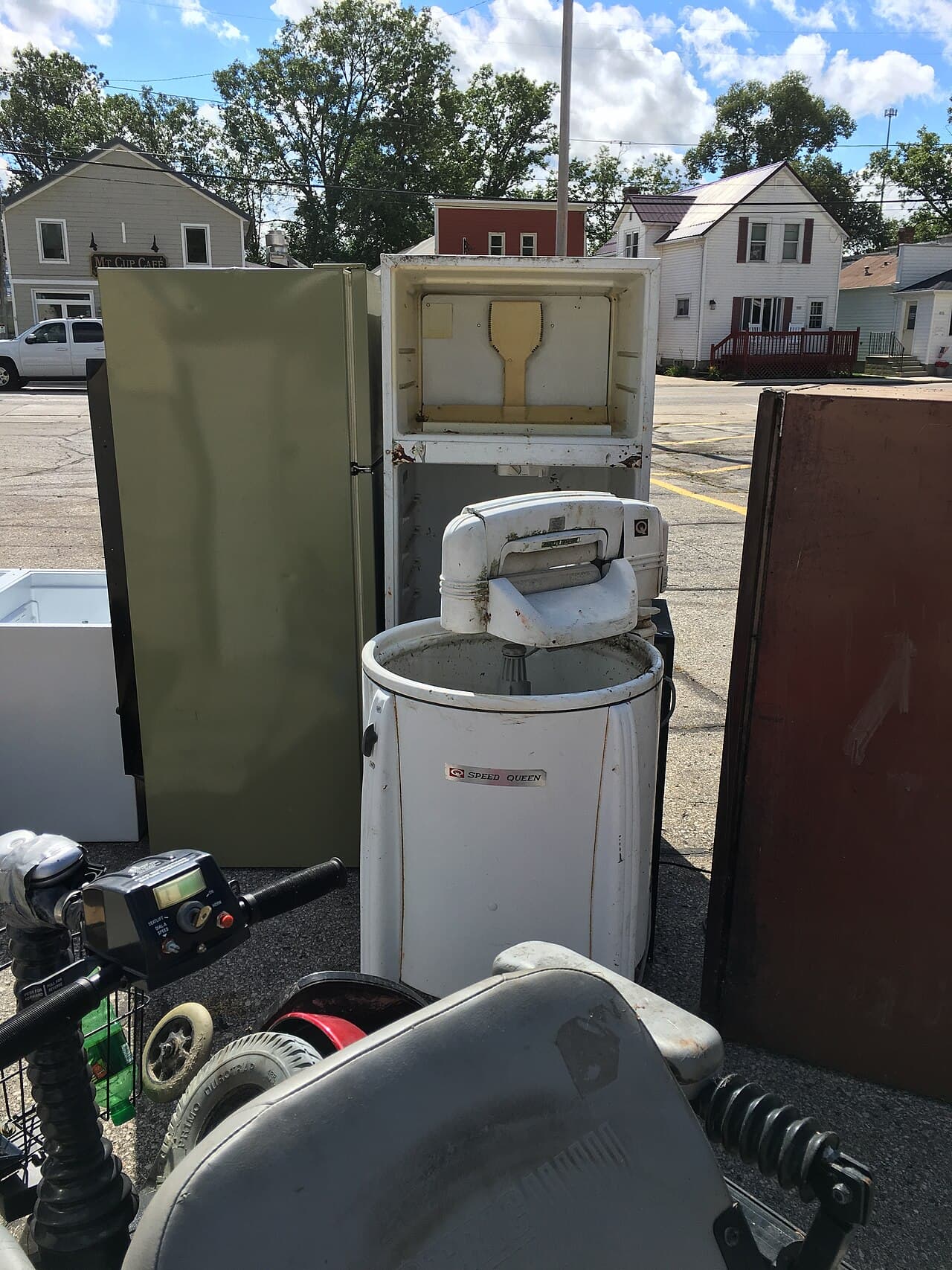
Getting rid of an appliance in Virginia can cost nothing, a small per-item fee, or a hauler's minimum charge, depending on who takes it. The cheapest routes are usually a store's haul-away when you buy a replacement, or your locality's own pickup or drop-off. A hired crew costs more, and the price moves with how many items there are, whether they hold refrigerant, how hard they are to get out, and whether anything has to be disconnected first.
Store haul-away when you buy a new one
If you are replacing the appliance, ask the store before you order. Policies differ by store and even by how you buy. Costco lists haul-away as included on select appliances bought online.[8] IKEA charges $30 to remove an old appliance when you buy a similar product in a store with in-home delivery, in select markets, and does not offer it on online orders.[7] Both are what we saw when we checked on October 27, 2026. The EPA suggests checking with your electric utility for a rebate or turn-in program before anything else, and notes that some retailers let you drop an old appliance off at the store at no charge, and some even give a small voucher or discount.[9] Will the store take my old appliance when I buy a new one covers the questions to ask.
What Virginia localities charge
Local fees are low, but they vary, and most drop-off sites serve residents only. These are the figures we found when we checked on October 27, 2026.
Curbside pickup. In Fairfax County, county collection customers get five free special collections per fiscal year, July 1 to June 30, scheduled in advance, including "Freon" pickups for refrigerators, freezers, dehumidifiers and air conditioners and metal pickups for stoves, washers, dryers and water heaters.[2] A special pickup is limited to about 2 cubic yards, a pile about 6 feet long, 3 feet wide and 3 feet high, and the county charges for larger piles.[2] About 90 percent of Fairfax County residents and businesses get trash service from a private company, and should call that company instead.[2] Richmond lists collection of appliances at $50 per appliance or request, apart from its every-other-week bulk and brush collection.[4]
Drop-off.
- Fairfax County. Fairfax County's residential disposal fees for July 2026 to June 2027 charge $15 for each appliance that requires the removal of refrigerant or a capacitor, such as a refrigerator, freezer, humidifier, dehumidifier, water cooler or air conditioner.[1]
- Chesterfield County. With fees that took effect July 1, 2026, Chesterfield County's convenience centers charge $15 per item for appliances with Freon, such as refrigerators, freezers, air conditioners and dehumidifiers, and $10 per item for appliances without it, such as washers, dryers, dishwashers, stoves and water heaters.[3] Microwaves go free.[3] The centers serve county residents with identification or proof of residency.[3]
- Montgomery County. When we checked on October 27, 2026, the Montgomery Regional Solid Waste Authority took appliances at its facility and charged a $19 Freon removal fee for any appliance not certified as Freon-free.[5]
- Roanoke Valley. Residents of Roanoke, Salem, Roanoke County and Vinton can bring household waste, appliances included, to the Roanoke Valley Resource Authority's Salem and Tinker Creek transfer stations at no charge under its residential disposal policy.[6]
Anywhere else, look up your county or city's landfill, transfer station or convenience center fee list, or call your trash hauler. If the truck has left an appliance at the curb before, why the trash company won't take bulky items explains the usual reasons.
What drives a hauler's price
A hauler prices each job on its own, but what moves the quote is predictable.
Refrigerant. Refrigerators, freezers, dehumidifiers and window air conditioners cost more to dispose of. Federal rules make the final disposer, such as a scrap recycler or landfill, responsible for recovering the refrigerant from household refrigerators, freezers and window air conditioners.[10] If the refrigerant was removed earlier, the final disposer needs a signed statement naming who recovered it and when.[10] Sites often pass that work on as a per-item fee, and haulers often pass it on to you.
Number of items and the minimum. Haulers usually have a minimum charge for a single item, so one washer can cost nearly as much as a washer and dryer together. Bundling appliances with other junk often lowers the cost per piece. How much junk removal costs in Virginia covers truckload pricing.
Access. A basement chest freezer, a second-floor laundry, a long carry or a tight stair turn means more labor and sometimes a third person.
Disconnection. A plug-in refrigerator or a washer on hoses is quick. A gas range or dryer is not a hauler's job. The CPSC warns that moving a gas appliance even slightly can cause an older, weakened gas connector to fail completely, possibly resulting in a deadly fire or explosion.[11] Columbia Gas of Virginia says a qualified professional should do all work on natural gas lines and equipment inside the home.[12] Budget for a separate visit to disconnect and cap the line; who can hook up a gas dryer or range in Virginia explains who does that work.
Timing. Same-day or weekend service usually costs more than a scheduled weekday slot.
What to get in writing
Ask each hauler for one all-in price: labor, disposal and refrigerant fees, stair or carry charges, any disconnection, and the minimum. Ask where the appliances are going and who recovers the refrigerant. A quote that is much lower than the others sometimes means the load is headed somewhere it should not go. What to ask a junk removal company before booking has a fuller checklist.
Stop and call a pro if
- The appliance runs on gas, or it is hard-wired rather than plugged in.
- Water lines to a refrigerator, washer or dishwasher will not shut off or are corroded.
- The appliance is built into cabinetry or has to come up or down a tight stair turn.
- You are clearing several appliances or a whole kitchen or laundry room at once.
Getting quotes through Loclis
Browse more junk removal and moving answers, read how to get rid of an old refrigerator in Virginia, or see appliance and mattress removal businesses and junk removal and moving businesses around Blacksburg. To get written prices for your appliances, describe the job on Loclis and compare quotes.
Common questions
- Is it cheaper to haul an appliance to the dump myself?
- Usually, if you have a truck and a helper. When we checked on October 27, 2026, Virginia drop-off fees ran about $10 to $19 per appliance at Fairfax County, Chesterfield County and the Montgomery Regional Solid Waste Authority, and Roanoke Valley residents paid nothing. Count your time, a hand truck rental and the risk of damage to floors and stairs.
- Why do refrigerators cost more to get rid of than washers?
- Refrigerators, freezers, dehumidifiers and window air conditioners hold refrigerant that has to be recovered before the metal is recycled. Sites such as Chesterfield County charge more for them: $15 per item with Freon against $10 for appliances without it, with fees effective July 1, 2026.
- Do junk removal companies charge extra for appliances?
- Many do, because they pay the same per-item refrigerant fees at the disposal site. Ask for a written quote that lists any appliance or refrigerant surcharge, the minimum charge, and extra charges for stairs or disconnection.
- Does store haul-away cost extra?
- It depends on the store and the order. When we checked on October 27, 2026, Costco listed haul-away as included on select appliances bought online, and IKEA charged $30 for removal with an in-store purchase and home delivery. Ask before you order, since haul-away usually has to be booked with the delivery.
- Who pays to disconnect a gas range or dryer before removal?
- You do, as a separate cost, unless the store or hauler includes it. Have a qualified professional disconnect and cap the gas line; the CPSC warns that moving a gas appliance can make an old connector fail. Get that cost in writing along with the removal quote.
Sources
- [1] Residential Disposal Fees and Regulations, Fairfax County Department of Public Works and Environmental Services. Checked October 27, 2026.
- [2] Special Pickup, Fairfax County Department of Public Works and Environmental Services. Checked October 27, 2026.
- [3] Convenience Centers, Chesterfield County Waste and Resource Recovery. Checked October 27, 2026.
- [4] Bulk and Brush, City of Richmond Department of Public Works. Checked October 27, 2026.
- [5] Disposal Guide, Montgomery Regional Solid Waste Authority. Checked October 27, 2026.
- [6] Residential Disposal, Roanoke Valley Resource Authority. Checked October 27, 2026.
- [7] Removal Services, IKEA. Checked October 27, 2026.
- [8] Appliances, Costco Wholesale. Checked October 27, 2026.
- [9] Appliance Disposal, U.S. Environmental Protection Agency. Checked October 27, 2026.
- [10] Stationary Refrigeration Safe Disposal Requirements, U.S. Environmental Protection Agency. Checked October 27, 2026.
- [11] Certain Older Gas Connectors May Be Dangerous, U.S. Consumer Product Safety Commission. Checked October 27, 2026.
- [12] Safe Appliance Installation, Columbia Gas of Virginia. Checked October 27, 2026.
Want a pro to handle it?
Describe the job once. Licensed local businesses send quotes, and you pay only when you book one.
Get a quote from a local pro