How do I get rid of an old swing set?
Give a sound set away first. Otherwise take it apart with a helper from the top down, free the ground anchors, and sort the pieces by material. Metal can go to a scrap buyer or a metal pickup, wood and plastic to bulk pickup or the landfill. Never burn old treated wood, and call 811 before digging out concrete footings.
Free to ask. Local shops send quotes, and you pay only when you book one.
By Kasra Taheri, Founder, LoclisPublished
Researched and drafted with AI, then checked claim by claim against the sources listed below before it was published. Prices and rules change; the dates beside each source say when it was last checked.
Step by step
Read when to stop and call a pro, further down this page, before you start.
Step 1: Work out what you have
Note whether the set is wood, metal or plastic, look for a maker's label or model number, and guess its age, since wooden sets built before 2004 may be CCA-treated.[1]
Step 2: Clear and inspect the area
Move toys and mulch back from the legs, check under beams and in tubes for wasp nests, and look for loose, rotten or rusted parts that could drop when you start.
Step 3: Take off the hanging parts
Unhook the swings, gliders, rings and any canopy, then unbolt the slide and ladder, so only the bare frame is left standing.
Step 4: Support the beam before you unbolt it
With a helper holding the top beam or a pair of stepladders under it, undo the beam brackets, then lower the beam to the ground together.
Step 5: Take down the legs
Unbolt the leg frames and lay them flat; if bolts are rusted solid, penetrating oil and patience usually beat force, and a hacksaw can take off a bolt that still will not turn.
Step 6: Free the anchors
Unscrew corkscrew anchors from the soil; if a leg is set in concrete, submit a locate request through 811 and wait for the lines to be marked before you dig.[8]
Step 7: Sort by material
Make separate piles for metal, wood and plastic, and bag the bolts, chains and small hardware, because many pickups and facilities take one material at a time.[3]
Step 8: Handle old treated wood with care
Wear goggles and a dust mask if you saw it, wash your hands afterwards, and never burn it or chip it for mulch.[1]
Step 9: Book a pickup or haul it yourself
Cut or stack the wood to your hauler's length limit, schedule the pickup or load the truck, and keep metal aside for a scrap or metals buyback if one is near you.
Step 10: Restore the ground
Fill the anchor and footing holes with soil, rake out worn patches under the swings, and seed or sod the bare area.
Most old swing sets leave in pieces. If the set is still sound, give it away or sell it to someone who will take it down. If not, take it apart with a helper from the top down, free the anchors, and sort the parts into metal, wood and plastic, because that is how pickups and landfills take them. The two things to get right are old treated wood, which should never be burned, and buried footings, which need a call to 811 before you dig.
Reuse it first if you can
A set with years left in it is worth more to another family than to a landfill. Before you list it, check it the way the Consumer Product Safety Commission suggests checking any home play set: look for broken or missing components, bent pipes or tubing, and splintering wood.[2] Say what you found in the listing, and agree up front who takes it down and hauls it.
The instruction sheet that came with a set should name the manufacturer and the model number,[2] which helps a buyer find replacement parts. If you still have it, pass it on, and use it yourself for the take-down order.
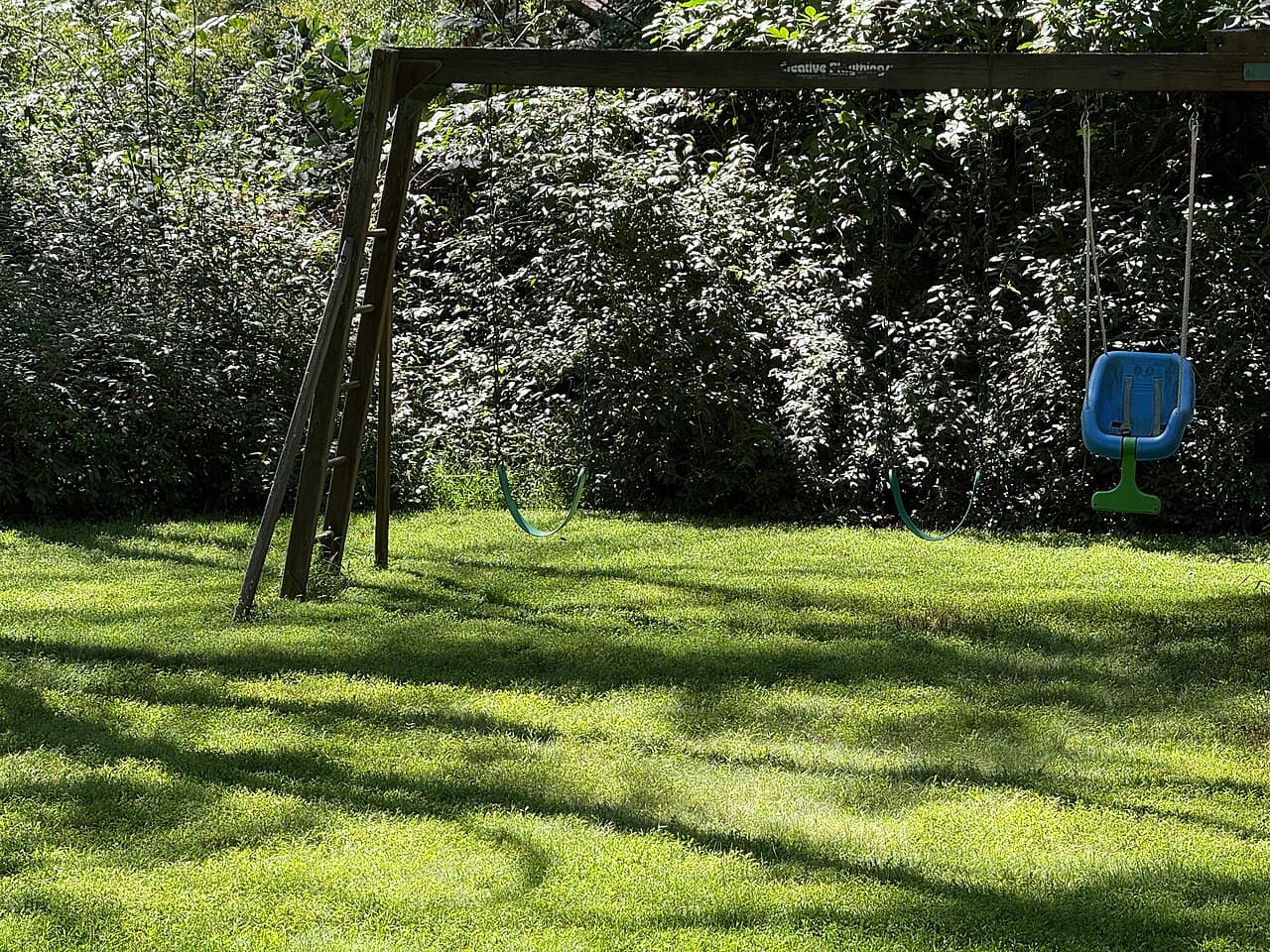
Find out whether the wood is treated
Before 2004, wood treated with chromated arsenicals, including chromated copper arsenate (CCA), was used in residential structures such as decks and playsets,[1] and manufacturers voluntarily stopped making it for homeowner uses in December 2003.[1] The Consumer Product Safety Commission puts it plainly: "The chemical contains arsenic."[2]
You usually cannot tell treated wood by looking, so treat an older wooden set as CCA unless you know otherwise. EPA says not to burn CCA or other preservative-treated wood in a residential setting, because of toxic chemicals in the smoke and ash,[1] not to reuse it in products such as mulch,[1] and to wear goggles and a dust mask when sawing it and wash your hands after handling it.[1] Homeowners can usually put it out with ordinary trash,[1] but state and local programs may have their own instructions,[1] so check with your hauler or locality.
Taking it apart
Plan on two people and an afternoon. A socket set, adjustable wrenches, a cordless drill with driver bits, penetrating oil, a hacksaw and a pair of stepladders cover most sets. The order matters more than the tools: take off everything that hangs first, then the slide, ladder and any fort decking, then the top beam while someone holds it, and the legs last. Working top down keeps the frame from swinging or toppling while it is half apart. Wear gloves for splinters and rusted edges.
Rusted bolts are the usual hold-up. Oil them and give them time; a bolt that still will not turn can be cut through with a hacksaw. Keep the hardware in a bucket or bag so it does not end up in the lawn.
The anchors and footings
Play equipment may need to be restrained with anchors to keep it from tipping over, and the manufacturer's instructions say how.[2] Corkscrew-style anchors usually back out of the soil with a bar through the eye. Legs set in concrete are a bigger job.
Virginia law defines excavation as moving earth with any tools, including digging and augering,[7] and says: "No person shall make or begin any excavation or demolition without first submitting a locate request to the notification center."[6] Virginia's contractor board tells homeowners to dial 811 before any digging project, DIY or professional, to have underground lines marked for free.[8] Swing sets often sit at the back of a yard where cable, gas or irrigation lines may run, so make the request and wait for the marks.
Where each part goes
Sort into piles as you go. Rules vary by locality, but the pattern is similar.
- Wood. In Fairfax County's special pickup, lumber goes out as bulk material, and bulk items must be no longer than 6 feet.[3] Cut long beams to length if your hauler has a limit.
- Metal. Metal items, including metal fencing and exercise equipment, go on a separate metal pickup in Fairfax County,[3] and piles should be separated by type.[3]
- Plastic slides and seats. These usually go with bulk trash or regular trash, depending on size; ask your hauler.
Fairfax County limits each pile to 2 cubic yards, about 6 feet long, 3 feet wide and 3 feet high, with a charge for more,[3] and county collection customers get 5 free special collections a fiscal year.[3] Your hauler or locality may set different rules, so check them; see why trash companies won't take bulky items for the reasons behind the limits.
If you have a truck, the landfill is often simpler. Fairfax County charges residents $98 a ton, with a $39 minimum, for bulk or unbagged trash at its sites for July 2026 to June 2027.[4] Around Blacksburg and Christiansburg, the Montgomery Regional Solid Waste Authority takes bulky waste charged by the ton[5] and runs a metals buyback[5] where steel frames may be worth taking separately. Its woody waste rate is for clean brush and wood with no nails,[5] which old playset lumber full of hardware usually is not.
Stop and call a pro if
- The set is bolted to a deck, a fence or the house, or a fort has a roof you would have to work on.
- Legs are set in large concrete footings near marked utility lines, or the marks show lines under the set.
- The wood is rotten enough that the frame could collapse while you work.
- There is an active wasp or hornet nest in the beams or tubes.
- You would have to saw a lot of old treated wood and would rather someone else handled the dust.
A junk removal crew can take down and haul most sets in one visit. For what that costs and who does it, see how much it costs to remove a shed in Virginia and who removes old sheds and playsets. Browse more junk removal and moving answers, see shed and playset removal businesses, or find junk removal businesses around Blacksburg. To get quotes, describe the swing set on Loclis with a photo, and local businesses quote on the same job.
Common questions
- Will my trash service take an old swing set?
- Usually only in pieces. Fairfax County's special pickup, for example, takes lumber as bulk material no longer than 6 feet and metal items on a separate truck, in piles of up to 2 cubic yards. Ask your own hauler or locality for its length and pile limits before you cut anything.
- How do I know if my wooden swing set is CCA-treated?
- You usually can't tell by looking. EPA says CCA-treated wood was used in playsets before 2004, and manufacturers stopped making it for homeowner uses in December 2003. If the set is older than that or you don't know its age, handle it as treated wood: no burning, goggles and a dust mask for sawing, and washed hands.
- Can I burn the wood from an old swing set?
- No, not if it is pressure-treated. EPA says not to burn CCA or other preservative-treated wood in a residential setting, because of toxic chemicals in the smoke and ash. Send it out with bulk trash or take it to the landfill instead.
- Can I give away a used swing set?
- Often, yes, if it is sound. Check it the way CPSC suggests checking any play set: broken or missing parts, bent tubing, splintering wood and rusted areas. Be honest with the taker about its age and condition and agree who takes it down and hauls it.
- Do I need to call 811 to pull out swing set anchors?
- For anything more than unscrewing a corkscrew anchor, plan on it. Virginia law defines excavation to include digging with any tools and requires a locate request before you begin, and DPOR's guide says to call 811 before any digging project, DIY or professional. The marking is free.
Sources
- [1] Chromated Arsenicals (CCA), U.S. Environmental Protection Agency. Checked October 27, 2026.
- [2] Outdoor Home Playground Safety Handbook, U.S. Consumer Product Safety Commission. Checked October 27, 2026.
- [3] Special Pickup, Fairfax County Department of Public Works and Environmental Services. Checked October 27, 2026.
- [4] Residential Disposal Fees and Regulations, Fairfax County Department of Public Works and Environmental Services. Checked October 27, 2026.
- [5] Disposal Guide, Montgomery Regional Solid Waste Authority. Checked October 27, 2026.
- [6] Code of Virginia § 56-265.17. Notification required prior to excavation or demolition, Virginia General Assembly, Legislative Information System. Checked October 27, 2026.
- [7] Code of Virginia § 56-265.15. Definitions, Virginia General Assembly, Legislative Information System. Checked October 27, 2026.
- [8] What You Should Know Before You Hire a Contractor, Virginia Department of Professional and Occupational Regulation. Checked October 27, 2026.
Want a pro to handle it?
Describe the job once. Licensed local businesses send quotes, and you pay only when you book one.
Get a quote from a local pro