How much does it cost to remove a shed in Virginia?
There is no set price: each company quotes from the shed's size and material, what it sits on, what is inside, how easy it is to reach, and the disposal fees. A small metal or resin shed on gravel costs least; a wood shed on a concrete slab with power to it costs most. Disposal is often the smallest part of the bill.
Free to ask. Local shops send quotes, and you pay only when you book one.
By Kasra Taheri, Founder, LoclisPublished
Researched and drafted with AI, then checked claim by claim against the sources listed below before it was published. Prices and rules change; the dates beside each source say when it was last checked.
Step by step
Read when to stop and call a pro, further down this page, before you start.
Step 1: Measure the shed
Note its length, width and height, what it is made of, and whether it sits on skids, gravel, blocks, piers or a concrete slab.
Step 2: Check for power and water
Look for a cable, conduit, outlet, light or hose line running to the shed, because a wired shed needs an electrician before anyone takes it down.
Step 3: Empty it, or say what stays
Clear out what you want to keep, set aside paint, oils and pesticides for a household hazardous waste collection, and tell bidders what is left inside.[8]
Step 4: Photograph it and the path out
Take photos of all four sides, the floor, the foundation and the route from the shed to where a truck or trailer can park.
Step 5: Decide what goes
Say whether the floor, the slab or piers, and any gravel base should be removed too, and whether the ground should be levelled afterwards.
Step 6: Ask for at least three written quotes
Give every company the same description so the prices compare, and be wary of one far below the rest.[6]
Step 7: Compare what each quote covers
Check each one for disposal fees, the permit, the utility locate request, the electrical disconnect and cleanup of debris.
Step 8: Agree the deposit and the contract
Keep the deposit small and get the scope, price, payment schedule and cleanup in a written contract before work starts.[6]
No one can give a fair price for removing a shed without seeing it, and no Virginia agency publishes a going rate. Each company prices the job from the shed's size and material, what it sits on, what is still inside, how far the crew has to carry the pieces, and what the landfill or transfer station charges. A small metal or resin shed on gravel is at the low end. A large wood shed on a concrete slab, with power run to it, is at the high end. Disposal fees are the one part you can check yourself.
What a quote is made of
Size and material. A resin or thin metal shed comes apart in panels and fills a trailer with little weight. A framed wood shed with shingles takes longer to dismantle and produces more, heavier debris. Material makes a big difference: EPA's planning estimate for concrete debris is 860 pounds a cubic yard,[2] against 169 pounds for clean dimensional lumber[2] and 731 pounds for composition roofing.[2]
The foundation. Skids and a gravel pad are quick. Concrete piers or a slab mean breaking concrete, more labour, and heavier loads. Ask for the foundation as a separate line, so you can decide whether it stays.
What is inside. A full shed is a cleanout plus a teardown. Emptying it yourself is the easiest saving.
Access. A shed beside the driveway costs less than one at the back of a sloped yard behind a fence, where everything has to be carried out by hand.
Power, water and paperwork. An electrical disconnect, a permit or a utility locate request each add time, and sometimes a second trade.
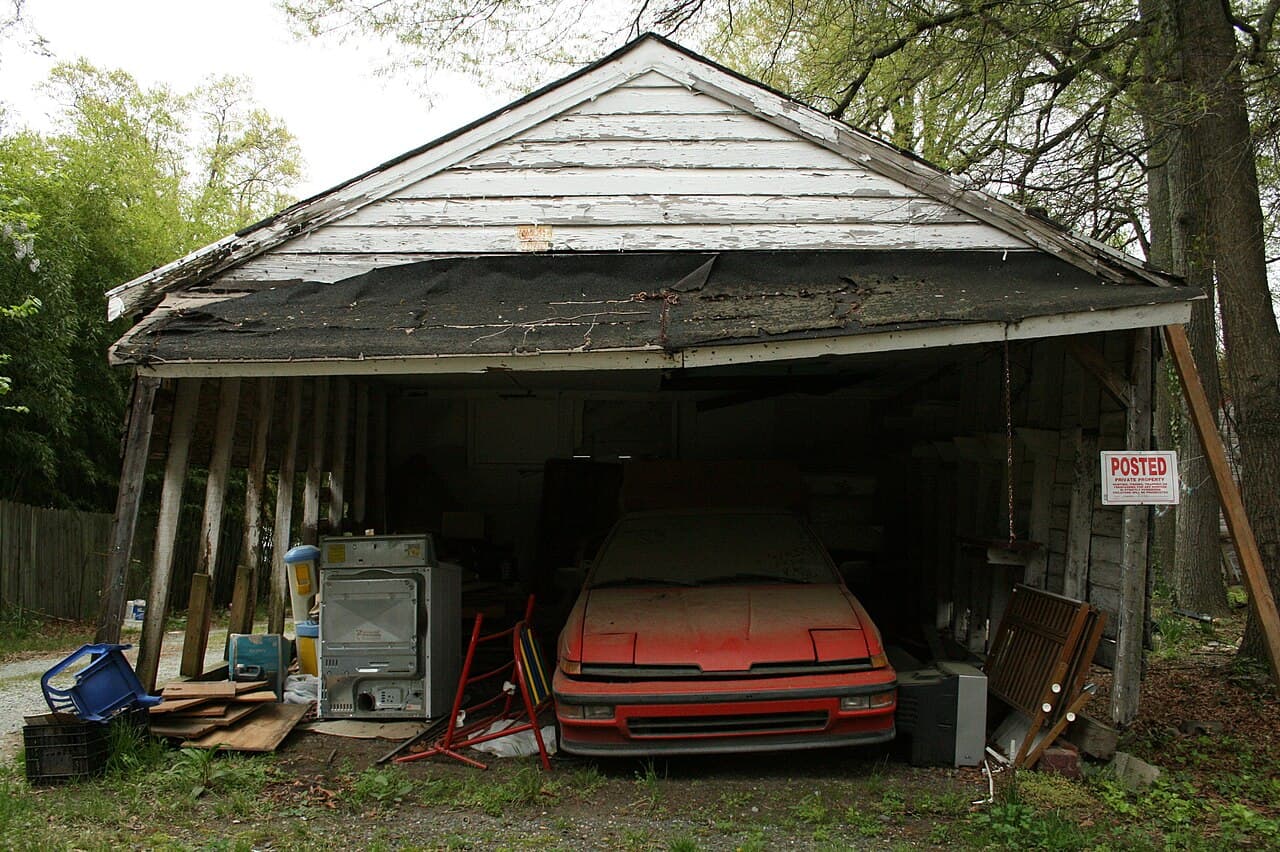
Disposal fees: the part you can check
Most public facilities charge by weight. Fairfax County charges residents $98 a ton, with a $39 minimum, for bulk or unbagged trash for July 2026 to June 2027.[1] For brick, concrete, dirt and rocks it charges $109 a ton with a $49 minimum, and takes only small amounts, up to 2 cubic yards a day per resident household.[1] Commercial haulers pay their own rates, and other localities set different ones, so treat these as an illustration rather than your price.
To see how weight becomes a fee: EPA's estimate for mixed construction and demolition debris is 417 pounds a cubic yard.[2] By that figure, 5 cubic yards of shed debris is about 2,085 pounds, just over a ton, which at a rate like Fairfax County's comes to about $100. Labour, the truck and anything heavy, such as a slab, are priced on top of disposal.
Permits, utilities and wiring
Virginia's building code requires a permit before the construction or demolition of a building or structure,[3] but it exempts one-story detached tool and storage sheds and playhouses whose building area does not exceed 256 square feet.[3] A permit is also required for work on electric wiring[3] and for removing or disturbing any asbestos-containing material during demolition.[3] Older sheds can have roofing or siding of unknown make, and EPA warns that "you can't tell whether a material contains asbestos simply by looking at it, unless it is labeled."[7] Your local building department can say what your shed needs; a quote should say who pulls any permit.
Taking down a structure counts as demolition under Virginia's utility damage law, which says: "No person shall make or begin any excavation or demolition without first submitting a locate request to the notification center."[5] DPOR's homeowner guide calls for dialing 811 to have underground lines marked for free.[6] The marking costs nothing, but digging or demolition may begin only once each utility has marked its lines or reported none in the area,[5] so build the wait into the schedule.
If the shed has power, budget for an electrician. Virginia requires a master tradesman licence as a condition of licensing for an electrical contractor,[4] and the circuit has to be disconnected and made safe before anyone takes the walls down.
Licences and the contract
Virginia's definition of a contractor covers anyone who, for a fee, undertakes the "construction, removal, repair, or improvement of any building or structure permanently annexed to real property"[4] and a Class C licence covers single jobs over $1,000 but less than $30,000.[4] A shed on a slab or piers, or a bigger teardown, can cross that line, so ask for the licence number and check it on DPOR's License Lookup.
DPOR's advice on pricing applies here too: get at least three written bids based on the same specifications,[6] and remember that an abnormally low bid probably means a mistake or missing work.[6] "Virginia law requires all licensed contractors to provide a written contract for residential work."[6] That contract should cover "complete cleanup and removal of debris and materials."[6] DPOR's rule of thumb for a down payment is "an initial deposit of no more than 10% of the total price or $1,000, whichever is less."[6]
Ways to bring the price down
- Empty it first. Sort what you keep, sell or donate. EPA notes that paints, cleaners, oils, batteries and pesticides can contain hazardous ingredients and need special care when you get rid of them,[8] so hold those for a collection day; around Blacksburg, the Montgomery Regional Solid Waste Authority holds household hazardous waste events twice a year for Montgomery County residents.[9] For paint, see how to dispose of old paint in Virginia.
- Keep the slab if it can serve as a patio or a base for a new shed.
- Sell or give away a sound shed to someone who will move it.
- Keep the metal separate. The same authority runs a metals buyback[9] where a steel shed may be worth taking in.
Stop and call a pro if
- A cable, conduit or light runs to the shed. That is a job for a licensed electrician first.
- The shed is attached to the house, a fence or a deck, or the roof is sagging.
- The roofing or siding might contain asbestos, or the shed is over 256 square feet and may need a permit.
- The slab is large or the yard has buried lines near the shed.
For taking apart a playset yourself, see how to get rid of an old swing set, and for choosing who to hire, who removes old sheds and playsets. Related costs are in what construction debris removal costs and what junk removal costs; browse more junk removal and moving answers, see shed and playset removal businesses, or find junk removal businesses around Blacksburg. To compare prices on your own shed, describe it on Loclis with photos, and local businesses quote on the same job.
Common questions
- Is it cheaper to take down a shed myself?
- Often, if it is a small metal or resin shed with no power and no slab, and you have a truck. You still pay disposal: Fairfax County, for example, charged residents $98 a ton with a $39 minimum for bulk trash for July 2026 to June 2027. A wired shed, a slab or anything that needs a roof climb is worth paying for.
- Do I need a permit to tear down a shed in Virginia?
- Virginia's building code requires a permit to demolish a building or structure but exempts one-story detached storage sheds and playhouses of 256 square feet or less. Wiring, asbestos-containing material or a flood zone can change that, so ask your local building department before work starts.
- Does removing the concrete slab cost extra?
- Usually, yes. Concrete is heavy, at about 860 pounds a cubic yard by EPA's estimate, it takes more labour and equipment to break up, and some facilities take it only in small amounts or at a higher rate. Ask for the slab as its own line on the quote.
- Does a shed removal company need a licence in Virginia?
- For removing a structure permanently attached to the property, Virginia's contractor law applies to jobs over $1,000, which need at least a Class C licence. Check any licence number on DPOR's License Lookup, and use a licensed electrician for any wiring.
- Can I sell the metal from an old metal shed?
- Sometimes. Some facilities, such as the Montgomery Regional Solid Waste Authority near Blacksburg, run a metals buyback. Whether it covers your hauling depends on the weight and the rate on the day, so call first.
Sources
- [1] Residential Disposal Fees and Regulations, Fairfax County Department of Public Works and Environmental Services. Checked October 27, 2026.
- [2] Volume-to-Weight Conversion Factors, U.S. Environmental Protection Agency, Office of Resource Conservation and Recovery. Checked October 27, 2026.
- [3] 13VAC5-63-80. Section 108 Application for permit (Virginia Uniform Statewide Building Code), Virginia Department of Housing and Community Development, via the Virginia Administrative Code. Checked October 27, 2026.
- [4] Code of Virginia § 54.1-1100. Definitions, Virginia General Assembly, Legislative Information System. Checked October 27, 2026.
- [5] Code of Virginia § 56-265.17. Notification required prior to excavation or demolition, Virginia General Assembly, Legislative Information System. Checked October 27, 2026.
- [6] What You Should Know Before You Hire a Contractor, Virginia Department of Professional and Occupational Regulation. Checked October 27, 2026.
- [7] Protect Your Family from Exposures to Asbestos, U.S. Environmental Protection Agency. Checked October 27, 2026.
- [8] Household Hazardous Waste (HHW), U.S. Environmental Protection Agency. Checked October 27, 2026.
- [9] Disposal Guide, Montgomery Regional Solid Waste Authority. Checked October 27, 2026.
Want a pro to handle it?
Describe the job once. Licensed local businesses send quotes, and you pay only when you book one.
Get a quote from a local pro