How do you move a gun safe?
Empty it, lock the door, strap it upright to a dolly rated for its weight and move it with at least two people, and hand stairs to a professional crew. Check the weight and the route first, and protect the floors. Makers call safes very heavy and awkward, and recommend a trained professional with proper moving equipment.
Free to ask. Local shops send quotes, and you pay only when you book one.
By Kasra Taheri, Founder, LoclisPublished
Researched and drafted with AI, then checked claim by claim against the sources listed below before it was published. Prices and rules change; the dates beside each source say when it was last checked.
Step by step
Read when to stop and call a pro, further down this page, before you start.
Step 1: Find the weight
Look up the safe's weight in the owner's manual, on its label or on the maker's site, add what is inside, and decide whether you need a pro.
Step 2: Empty it completely
Take out the guns, ammunition and any dehumidifier, and keep the firearms secured elsewhere while the safe is away.
Step 3: Measure the route
Measure every door, hall turn and stair, and compare them with the safe's width and depth.[1]
Step 4: Protect floors and frames
Lay plywood or floor runners along the route and pad door frames and corners.
Step 7: Strap it to a rated dolly
Use a dolly that supports the size and weight of the safe, and strap the safe to it.[1]
Step 8: Move with a crew
Use at least two people on level ground and a third to guide at turns, and stop if the safe starts to lean.[1]
Step 9: Hand stairs to a pro
Do not carry a heavy safe up or down stairs by hand; hire a crew with stair equipment.
The short version
Moving a gun safe is a heavy, awkward job, and the makers say so plainly. One manual states that "SAFES ARE VERY HEAVY AND AWKWARD TO HANDLE" and adds that "UTILIZING A TRAINED PROFESSIONAL WITH PROPER MOVING EQUIPMENT IS HIGHLY RECOMMENDED".[1] If the safe is small, the route is level and you have helpers, you can do it yourself with the right dolly. If it goes down a flight of stairs, hire a crew.
Plan before you lift
Start with the weight. Look in the owner's manual, on the label or on the maker's website, then add what is inside. A dolly, a ramp and a crew are all chosen from that number.
Then check the route. The manufacturer's own trick is simple: take the empty safe box and see if it will fit all the way through to its final location.[1] If you no longer have the box, measure the safe's width and depth against every door, hall turn and stair, and remember that a door that opens wide may not clear the safe's depth.
Clear the path. Lift rugs, lay plywood or floor runners over wood, tile and carpet, and pad door frames and corners. Keep children and pets in another room.
Empty the safe completely. Take out the guns, the ammunition and any dehumidifier or desiccant, and keep the firearms secured somewhere else while the safe is away. One maker strongly recommends that you do not store loaded guns,[1] which is worth remembering whenever the safe is open.
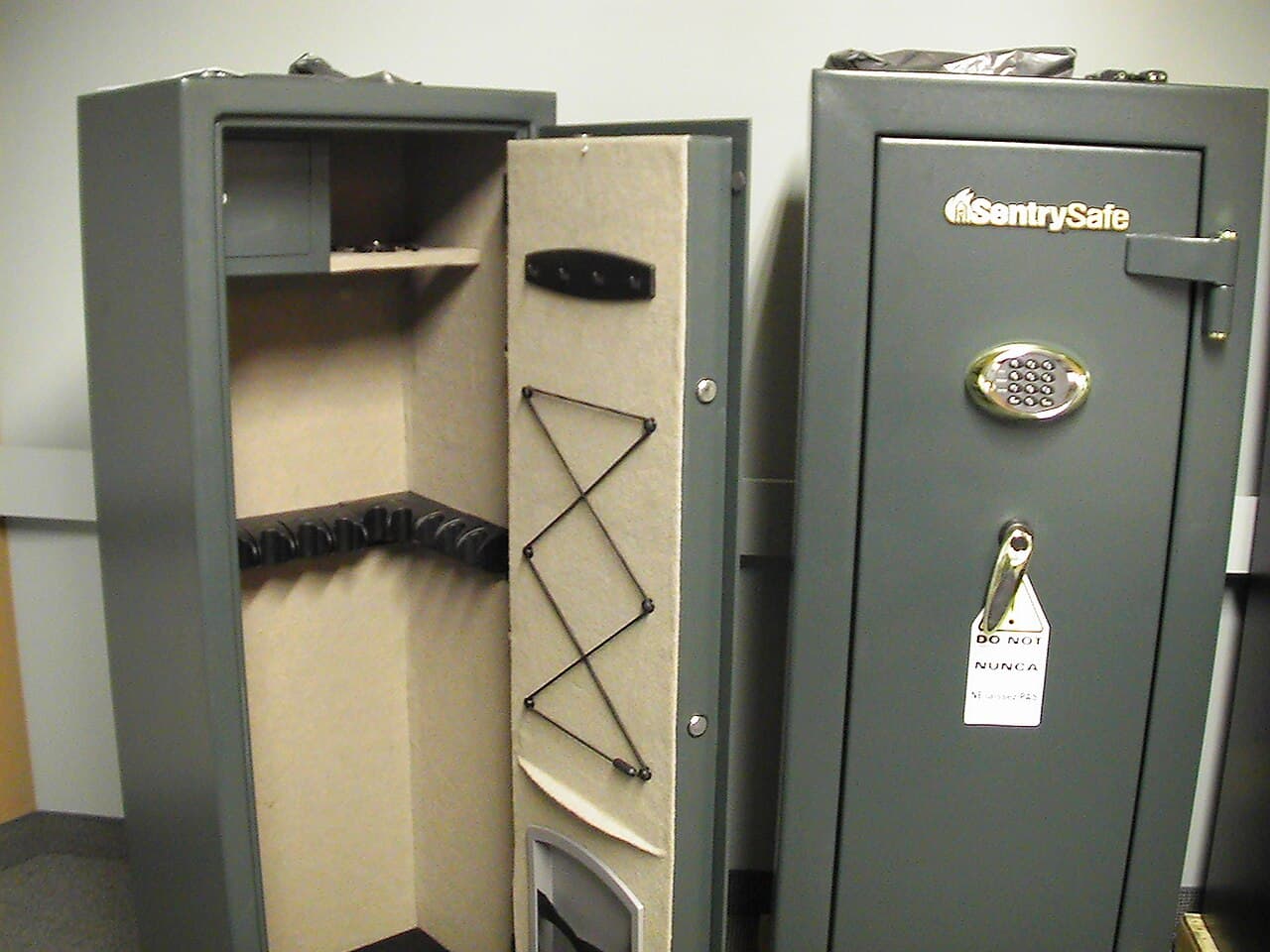
Unbolt, lock and strap
If the safe is anchored to the floor, take out the anchor bolts as your manual describes, with a second person steadying the safe. One maker's instructions say to have a person hold and stabilize the safe to keep it from tipping.[1]
Before the safe is tipped, close the door and put the handle in the locked position. SentrySafe's manual gives the exact instruction: "Close door and put handle in locked position."[2] Another maker says to make sure the door is closed and locked, because the door of your safe is heavy and presents a safety hazard until the safe is bolted down or secured properly.[1]
Tip the safe onto a dolly and strap it on. The same manual specifies using a dolly capable of supporting the size and weight of your safe.[1] A light hand truck is not enough for a safe of a few hundred pounds, and a rated dolly with straps is cheap to rent.
Moving it
SentrySafe says unbolting its gun safe from the shipping pallet is a two-person operation that should not be attempted without help.[2] That is the floor, not the ceiling. SA Consumer Products requires a minimum of two people to keep its safe stable during installation,[1] and a third person to guide the safe at turns and watch the doorways makes the move calmer.
Go slowly, keep the safe upright and stop if it starts to lean. Lean is how safes fall, and a falling safe is not something a person can catch.
Stairs are the point where a household move becomes a crew job. Stair-climbing equipment and trained handling matter more than extra muscle.
Setting it down
Pick the spot with the safe's job in mind. One maker recommends placing it in lower levels in the home, where fire temperatures are lower, and away from highly combustible materials.[1] On a concrete floor, the same manual recommends a moisture or protective barrier between the safe and the floor.[1]
Keep it level. If it seems unlevel, you may need to shim the bottom of the safe so the door does not swing open or close on its own.[1] The manual also warns not to open the door with the safe on an uneven or unstable floor.[1]
Then secure it. The maker says securing the safe to the floor is recommended,[1] and SentrySafe strongly recommends this safe be bolted down.[2] Check the manual first, because only certain types of safes are designed with this in mind.[3] Use the holes the manual names: Master Lock's rule is to only drill into the area of the safe that is noted in your manual, usually through the feet, and never drill through the back of a fireproof safe.[3]
Stop and call a pro if
- There are stairs. A safe that has to go up or down a flight, or around a tight turn, needs a crew with the right equipment.
- You cannot find the weight, or it is more than you and your helpers can control on a dolly.
- The safe is a large or fireproof model and the manual says to leave bolting or drilling to the maker or a locksmith.
- The floor is weak, wet or uneven, or the safe has to cross a deck or porch.
- You are moving it between homes. Put the safe's weight and the stairs in writing on the quote. In Virginia, a delivery acknowledgement you sign may not contain language that releases the carrier from liability, other than a statement that the property was received in apparent good condition except as noted on the shipping documents.[4]
Getting help
Related questions are in how to move a piano safely, how to protect floors and walls on moving day and whether to hire movers or just loading help. Browse more junk removal and moving answers or the moving businesses on Loclis.
When you are ready, describe the safe and the route once and local movers quote it.
Common questions
- How many people does it take to move a gun safe?
- At least two for a small safe, and often more for a large one. One maker, SA Consumer Products, requires a minimum of two people to keep the safe stable during installation, and SentrySafe calls unbolting its safe from the pallet a two-person job. Use a third person to guide at turns, and hire a crew for anything on stairs.
- Should I lock the safe before moving it?
- Yes. Close the door and put the handle in the locked position before the safe is tipped, as SentrySafe's manual says. The door is heavy, and another maker warns that it is a safety hazard until the safe is bolted down or secured.
- Can I leave the guns inside?
- It is better not to. Empty weight is the number a dolly and a crew plan around, and guns add to it and shift as the safe tips. Keep firearms securely stored elsewhere during the move, and unload them as the maker's firearm rules say.
- Do I have to bolt the safe down again?
- Makers recommend it. SentrySafe strongly recommends bolting its safe down, and Master Lock notes that only certain types of safes are designed for it. Use the holes the manual names and never drill through the back of a fireproof safe.
- What should I do if movers damage the safe or my floors?
- Write the damage on the delivery receipt before you sign and photograph it. In Virginia, a delivery acknowledgement you sign may not contain language that releases the carrier from liability, other than a statement that the property was received in apparent good condition except as noted on the shipping documents.
Sources
- [1] Haven Series SA5925HX, SA5930HX and SA5942HX Gun Safe Instruction Manual (102020), SA Consumer Products (Sports Afield Safes). Checked October 27, 2026.
- [2] SentrySafe Gun Safe Owner's Manual (401147), Sentry Group. Checked October 27, 2026.
- [3] Bolting Down Your Safe for an Added Layer of Protection, Master Lock. Checked October 27, 2026.
- [4] Va. Code § 46.2-2162, Carrier liability, Code of Virginia, Virginia General Assembly. Checked October 27, 2026.
Want a pro to handle it?
Describe the job once. Licensed local businesses send quotes, and you pay only when you book one.
Get a quote from a local pro