How do I seal a concrete driveway?
Pick a dry stretch of mild weather, clean off oil and dirt, fill cracks, let the slab dry for at least a day, then spray or roll on a breathable penetrating sealer evenly at the coverage rate on the label, with no puddles. Keep cars off for the wheel-traffic time the label gives.
Free to ask. Local shops send quotes, and you pay only when you book one.
By Kasra Taheri, Founder, LoclisUpdated
Researched and drafted with AI, then checked claim by claim against the sources listed below before it was published. Prices and rules change; the dates beside each source say when it was last checked.
Step by step
Read when to stop and call a pro, further down this page, before you start.
Step 2: Test whether it will take sealer
Drip a little water on several spots; if it soaks in, the surface is porous enough to accept a penetrating sealer.[1]
Step 4: Pick the weather
Plan for air and slab temperatures within the label's range, such as 50 to 90 °F, with no rain or heavy dew expected for 24 hours.[1]
Step 5: Clean the driveway
Sweep, wash and scrub off dirt, then treat oil and grease stains with a concrete cleaner or oil stain remover and rinse well.[1]
Step 6: Fix cracks and joints first
Seal moving cracks and joints with an elastomeric joint sealant and fill other cracks wider than 1/64 inch, letting the filler cure as its label says.[4]
Step 7: Let it dry
Let the slab dry for as long as the label says; Baracade Silane 40 WB, for example, asks for at least 24 hours of drying after rain or other moisture.[5]
Step 8: Protect what is next to it
Mask grass, plants, shrubs and asphalt along the edges, and protect windows, cars and other nearby objects from overspray.[5]
Step 9: Work out how much you need
Measure the driveway in square feet and divide by the label's coverage rate, for example 75 to 150 square feet per gallon, so you buy and use the right amount.[1]
Step 10: Try a test patch
Seal a small, out-of-the-way area first and allow 5 to 7 days for the product to fully react before judging the look and the water beading.[4]
Step 11: Apply it evenly with no puddles
Flood the surface with a low-pressure sprayer, roller or broom, distribute it evenly and do not allow the material to puddle.[4] Start at the garage and work toward the street so you never step on wet sealer.
Step 12: Add a second coat only if the label asks
Some penetrating sealers want the second coat while the first is still wet; Quikrete's waterproofing sealer gives 5 to 10 minutes, applied at right angles to the first.[1]
Step 13: Keep traffic off
Keep feet and cars off for the times on the label; Baracade WB 244, for example, lists 4 to 6 hours for foot traffic and 10 to 12 hours for wheel traffic.[4]
To seal a concrete driveway, clean it, repair the cracks, let it dry, then put on an even coat of a breathable penetrating sealer in mild, dry weather and keep cars off until it cures. Most of the work is prep. Most problems come from sealing a damp slab or putting on more than the label calls for.
Pick the sealer before you pick the day
For a plain driveway that sees road salt, a breathable silane or siloxane penetrating sealer is a good fit. Baracade WB 244 is made to protect concrete from water and salts, especially in freeze-thaw climates,[4] and Baracade Silane 40 WB from water intrusion, deicing chemicals and freeze-thaw exposure.[5]
There are two broad kinds on the shelf:
- Penetrating (silane, siloxane). A penetrating water repellent such as Baracade WB 244 soaks in and leaves no gloss or shine.[4] It does not change the look much, which suits a broom-finished driveway. For Euclid's Baracade, Euco-Guard and Chemstop penetrating sealers, re-application is not usually needed for at least 5 years.[8]
- Film-forming (acrylic). Most acrylic sealers will darken concrete and leave some gloss,[9] which people like on colored or exposed-aggregate concrete. But the most common acrylic sealers do not offer exceptional chemical or stain resistance.[9]
Film sealers can need topping up much sooner. INCRETE Clear Seal Water-Base, which goes on as an even, continuous film, recommends a light maintenance coat every 1 to 2 years.[7]
A penetrating sealer is not for non-porous, sealed or painted surfaces,[1] so find out what is on the driveway before you buy. If it is a decorative surface with an acrylic film, see how to clean and reseal stamped concrete.
Check the slab and the forecast
New concrete needs time, and labels vary: Quikrete's waterproofing sealer asks for a minimum of 30 days on new concrete, and Baracade WB 244 asks for at least 7 days of curing.[1][4] If the driveway was poured this year, how long new concrete should cure covers the first weeks.
Weather matters as much as the product. A typical water-based penetrating sealer wants air and surface temperatures in a range such as 50 to 90 °F, with no rain or heavy dew expected for 24 hours.[1] Check the overnight low and the dew, not just the chance of rain, and pick a dry spell of mild days.
Prep is most of the job
Clean first. Sweep, then scrub and rinse the whole slab. Oil drips where the car parks are the usual problem; a concrete degreaser or oil stain remover, scrubbed in and rinsed, gets most of it out. A pressure washer helps if you keep the tip moving and do not hold it close enough to etch the surface.
Fix the cracks next. A sealer is not a crack filler. Seal moving cracks and joints with an elastomeric joint sealant and fill other cracks wider than 1/64 inch before sealing.[4] For how to do that, see how to fix cracks in a concrete driveway.
Then let it dry, for as long as your label says. Baracade Silane 40 WB is not to be applied to a wet surface and asks for at least 24 hours of drying after rain or other moisture,[5] which includes washing. A shaded or humid spot usually takes longer.
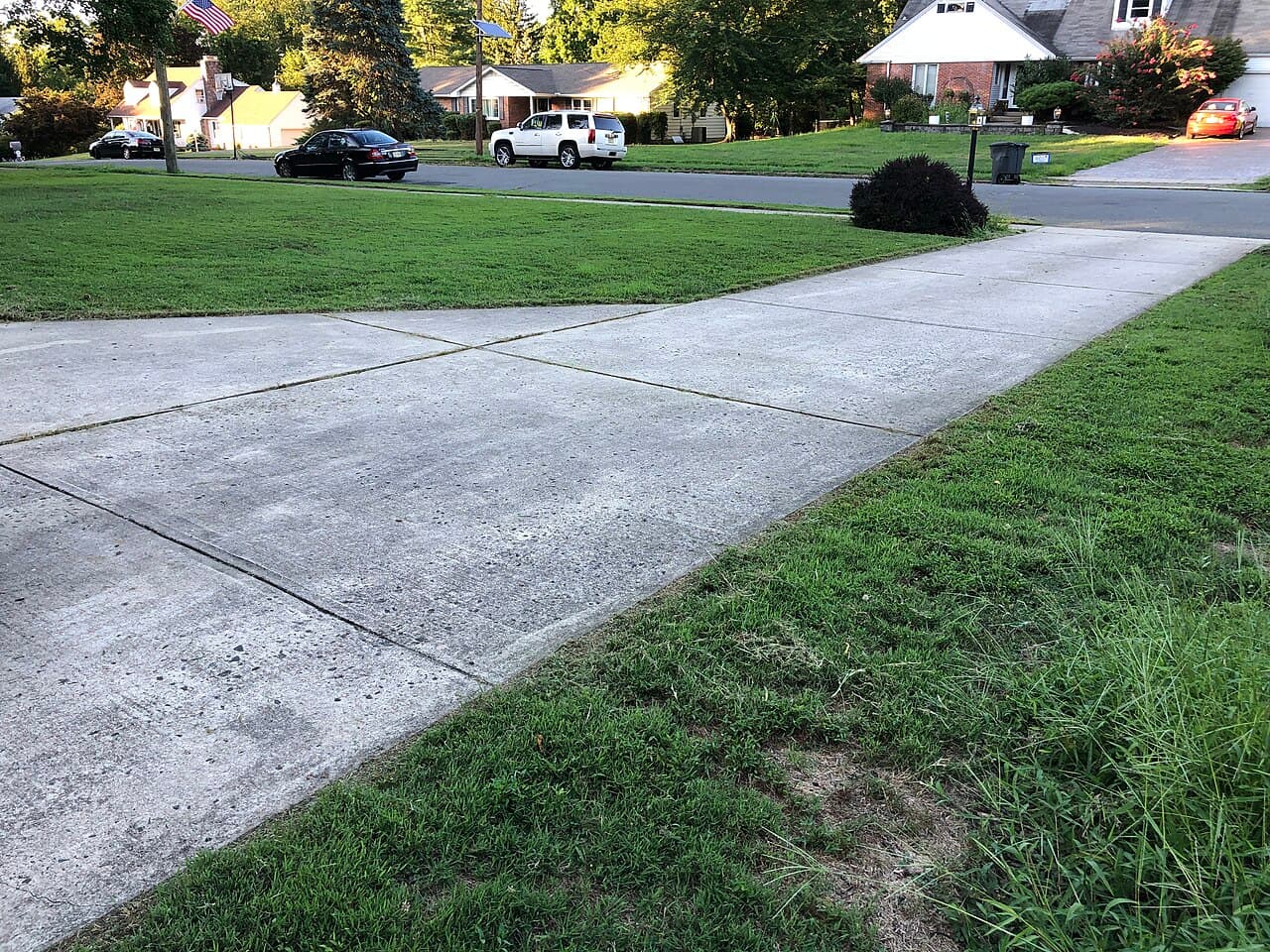
Applying it
Measure the driveway in square feet and divide by the label's coverage rate. Coverage varies by product and by how porous your concrete is: Quikrete's waterproofing sealer lists 75 to 150 square feet per gallon, Baracade WB 244 lists 100 to 150,[1][4] and an acrylic cure and seal lists 150 to 200 square feet per gallon.[2]
Check what equipment the label allows before you buy a sprayer. Quikrete's waterproofing sealer can be applied with a roller, brush or garden sprayer.[1] Baracade WB 244 allows a garden sprayer for smaller projects only when an airless sprayer is not available,[4] and Baracade Silane 40 WB, although water-based, calls for solvent-resistant equipment and gaskets.[5]
Apply it with a low-pressure sprayer, roller or broom, as your label allows, starting at the garage and working toward the street so you never have to walk on wet sealer. With a penetrating sealer, all of it should soak in with no build-up on the surface.[4] Brush out any puddles or excess on flat areas.[5] Follow the label on a second coat: some penetrating sealers want it while the first coat is still wet,[1][4] while a film sealer such as INCRETE Clear Seal wants the first coat dry tack-free before the second.[6]
Protect yourself and the yard. Wear impervious gloves such as nitrile.[1] Quikrete's water-based acrylic sealers also call for eye protection and use only in a well-ventilated area.[3] Cover plants and the bottom of the garage door, and move the cars.
Then keep traffic off for the label's times. Wheel-traffic times differ: Baracade WB 244 and Silane 40 WB list 10 to 12 hours,[4][5] while INCRETE Clear Seal and Clear Seal Water-Base list 6 to 10 hours.[6][7] Low concrete or air temperatures and high humidity extend drying time,[6] so sealing in the morning and keeping cars off overnight leaves a margin.
A Virginia rule to know. In the Northern Virginia, Fredericksburg and Richmond Volatile Organic Compound Emissions Control Areas,[10] state air rules limit the VOC content of coatings sold and applied there, including 400 grams per liter for waterproofing concrete and masonry sealers.[11] VOC content varies even among water-based products: Baracade WB 244 lists under 50 g/L, while Baracade Silane 40 WB, also water-based, lists 326 g/L.[4][5] Check the figure on your label.
Stop and call a pro if
- The product is solvent-based or marked for professional use. These can carry fire and fume warnings. INCRETE Clear Seal, an acrylic cleaned up with solvents such as xylene, says "Use with adequate ventilation. Keep away from all sources of ignition." and "For professional use only."[6]
- The surface is flaking or scaling over large areas. Sealer will not hold onto weak, peeling concrete; it needs repair first. See why concrete spalls.
- The slab has sunk, heaved or has cracks you can fit a coin in that keep growing.
- There is an old coating that is white, peeling or unknown, which may need stripping before anything new goes on.
- It is stamped, stained or colored concrete, where an uneven coat shows and a decorative concrete contractor can match the original product.
- The slab stays damp for days or water seeps up through it, which points to a drainage problem a sealer will not solve.
Getting help in Virginia
Loclis lists DPOR-licensed businesses with their licence number and class. Browse concrete sealing and resurfacing, look up concrete contractors in Blacksburg, or read more concrete and hardscaping answers, including what concrete sealing costs in Virginia and how often to seal concrete.
Describe the driveway once and licensed local concrete businesses quote the sealing.
Common questions
- What kind of sealer is right for a plain concrete driveway?
- For a broom-finished driveway that sees winter salt, a breathable silane or siloxane penetrating sealer made to protect concrete from water, deicing salts and freeze-thaw damage is a good fit. It soaks in and leaves no shine. Acrylic film sealers give a darker, glossier look that suits decorative concrete. Film sealers can need upkeep much sooner: INCRETE Clear Seal Water-Base, a film-forming cure and seal, recommends a light maintenance coat every 1 to 2 years.
- How long should new concrete cure before I seal it?
- Follow the sealer's label. Quikrete's waterproofing sealer asks for at least 30 days on new concrete; Baracade WB 244 asks for at least 7 days and says longer curing gives better sealer performance. If the driveway is under a builder's warranty, check what the contractor used and recommends first.
- Can I use a garden sprayer?
- It depends on the product, so read the application section of the label before you buy a sprayer. Quikrete's waterproofing sealer can be applied with a roller, brush or garden sprayer. Baracade WB 244 allows a garden sprayer for smaller projects only when an airless sprayer is not available. Baracade Silane 40 WB, although water-based, calls for solvent-resistant equipment and gaskets.
- How long before I can drive on a freshly sealed driveway?
- Use the label's wheel-traffic time. Baracade WB 244 and Silane 40 WB list 10 to 12 hours; INCRETE Clear Seal and Clear Seal Water-Base list 6 to 10 hours. Low concrete or air temperatures and high humidity extend drying time, so sealing in the morning and keeping cars off overnight leaves a margin.
- Does sealing fix cracks in my driveway?
- No. A sealer is not a crack filler. Seal moving cracks and joints with an elastomeric joint sealant and fill other cracks before you seal the surface. If the slab has sunk, heaved or is breaking up, sealing will not help.
- Are there sealer rules in Virginia?
- In the Northern Virginia, Fredericksburg and Richmond VOC emissions control areas, state air rules cap the VOC content of architectural coatings, including 400 grams per liter for waterproofing concrete and masonry sealers. VOC content varies even among water-based products, from under 50 g/L to 326 g/L on two silane sealers, so check the VOC figure on the label.
Sources
- [1] Concrete & Masonry Waterproofing Sealer (No. 8800-05) data sheet, The Quikrete Companies. Checked October 26, 2026.
- [2] Acrylic Concrete Cure & Seal, Satin Finish (No. 8730) data sheet, The Quikrete Companies. Checked October 26, 2026.
- [3] Clear Acrylic Sealers safety data sheet (SDS A5), The Quikrete Companies. Checked October 26, 2026.
- [4] BARACADE WB 244 technical data sheet, The Euclid Chemical Company. Checked October 26, 2026.
- [5] BARACADE SILANE 40 WB technical data sheet, The Euclid Chemical Company. Checked October 26, 2026.
- [6] INCRETE CLEAR SEAL technical data sheet, The Euclid Chemical Company. Checked October 26, 2026.
- [7] INCRETE CLEAR SEAL WATER-BASE technical data sheet, The Euclid Chemical Company. Checked October 26, 2026.
- [8] Penetrating Water Repellent Sealer Maintenance Procedures, The Euclid Chemical Company. Checked October 26, 2026.
- [9] Diagnosing 5 Common Concrete Sealer Problems, The Euclid Chemical Company. Checked October 26, 2026.
- [10] 9VAC5-45-520, Applicability (architectural and industrial maintenance coatings), Virginia Administrative Code, State Air Pollution Control Board. Checked October 26, 2026.
- [11] 9VAC5-45-550, Standard for volatile organic compounds, Virginia Administrative Code, State Air Pollution Control Board. Checked October 26, 2026.
Want a pro to handle it?
Describe the job once. Licensed local businesses send quotes, and you pay only when you book one.
Get a quote from a local pro