Should I hire a roofer or a siding contractor for soffit and fascia?
It depends on where the damage starts. If you are re-roofing, or the problem is the drip edge, the shingle edge or the roof decking, hire the roofer: Virginia's roofing licence covers roofing components installed with a roofing project. For soffit and fascia on their own, a siding or exterior carpentry contractor licensed for home improvement work is the usual fit. Check either one's licence with DPOR.
Free to ask. Local shops send quotes, and you pay only when you book one.
By Kasra Taheri, Founder, LoclisPublished
Researched and drafted with AI, then checked claim by claim against the sources listed below before it was published. Prices and rules change; the dates beside each source say when it was last checked.
Step by step
Read when to stop and call a pro, further down this page, before you start.
Step 1: Look from the ground
Walk around the house with binoculars and note peeling paint, sagging or stained fascia, loose soffit panels and gutters pulling away.[6]
Step 2: Check the attic edge
With a flashlight, look along the attic floor at the eaves for water stains, damp insulation or daylight where the soffit meets the roof.
Step 3: Note the roof's age
If the roof is near the end of its life or you are already planning a re-roof, plan the soffit and fascia work with it.
Step 4: Pick the lead trade
Roof-edge problems or a re-roof go to a roofer; soffit and fascia alone go to a siding or exterior carpentry contractor.
Step 5: Ask for the licence number
Look up each business on DPOR's website, since a number on a card or an ad does not prove the licence is valid.[3]
Step 6: Match the licence to the work
Confirm the licence carries the roofing (ROC) specialty for roof work, or home improvement (HIC) or a building classification for repairs to the house.[1]
Step 7: Get three written bids
Ask at least three businesses to bid on the same written scope so the prices can be compared.[3]
Step 8: Ask about lead-safe certification
For a house built before 1978, ask for the firm's EPA lead-safe certification before it disturbs painted fascia or soffit.[5]
Step 9: Spell out who does what
Put the gutters, drip edge, venting, painting and cleanup in the written contract, with the business responsible for each.[3]
Step 10: Keep the deposit small
Pay no more than 10 percent of the price or $1,000 up front, whichever is less, unless custom items must be ordered.[3]
Call a roofer when the soffit and fascia problem starts at the roof, or when you are re-roofing anyway. Call a siding or exterior carpentry contractor when the soffit and fascia need work on their own. The Board for Contractors says that if the work you are considering is valued at $1,000 or more, a valid Virginia Contractor’s License is required,[3] so whichever you choose, look the licence up with DPOR and make sure it covers the work.
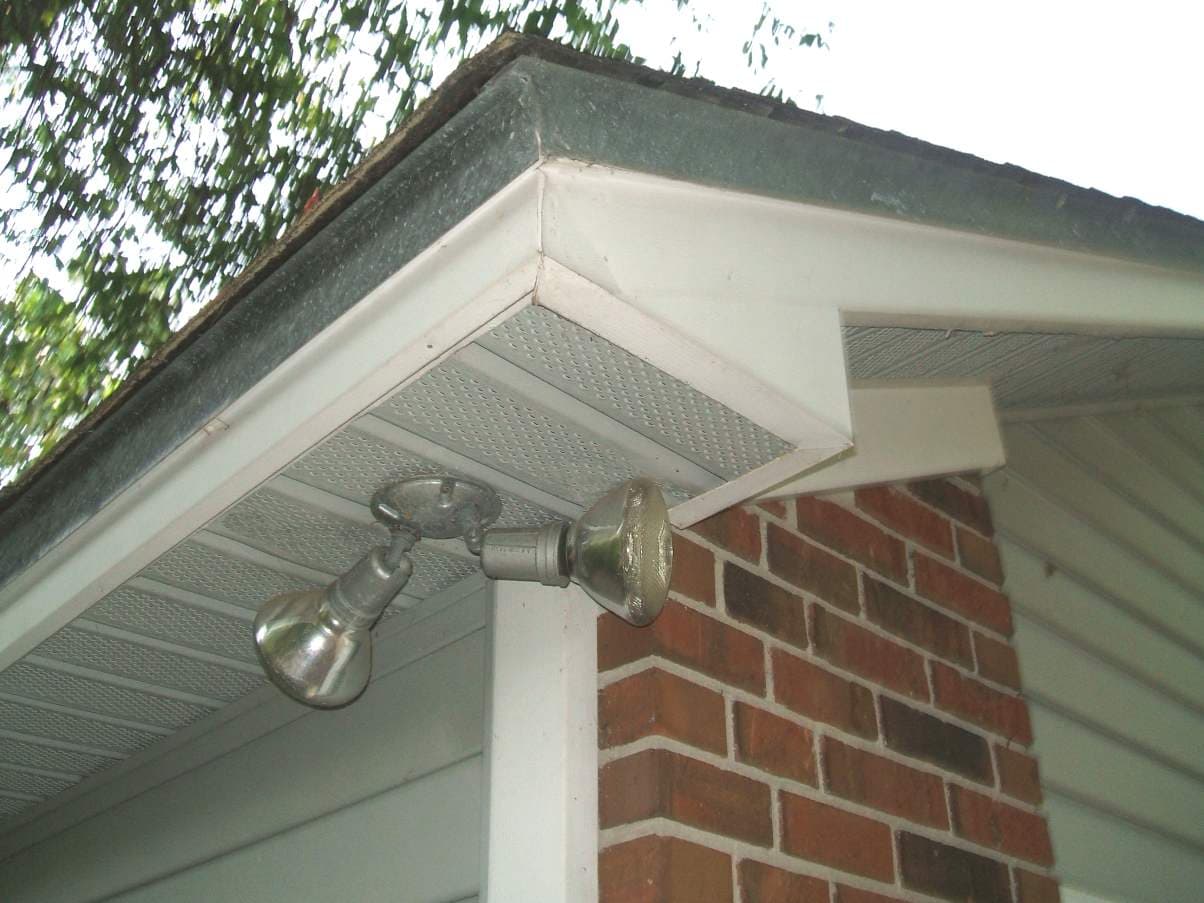
When the roofer should lead
Soffit and fascia sit where the roof ends, so some of their problems are roof problems. Virginia's Board for Contractors defines it this way: roofing contracting (ROC) covers the materials that make a watertight surface for roofs, and it includes roofing system components when they are installed in conjunction with a roofing project.[1]
Hire the roofer to lead when:
- You are re-roofing. Gutters come down and the roof edge is open, so it is the natural moment to replace soft fascia and tired soffit. Ask for it as a separate line in the roofing contract.
- The drip edge is missing, bent or rusted. Drip edge sits at the shingle edge, so replacing it means working on the roof.
- The rot comes from above. Stains running down from the roof edge, soft roof decking, or leaks at the eaves point to the roof, not the fascia.
- Ventilation is changing. Adding ridge vents or new soffit vents works best planned by one trade, so the air path from soffit to ridge is designed together.
Roof work is not a homeowner job; leave anything on the roof surface or at the shingle edge to a professional.
When a siding or exterior contractor should lead
For soffit and fascia on their own, the work is exterior carpentry and siding. Home improvement contracting (HIC) covers repairs or improvements to dwellings and townhouses,[1] and the RBC building classification also provides for that work.[1] The Board for Contractors' list of specialty services has no separate siding specialty,[1] so siding businesses are normally licensed under one of those.
Hire a siding or exterior contractor when:
- The roof is sound and the problem is rotted fascia boards, sagging or loose soffit panels, or holes animals made.
- You want vinyl soffit or aluminum fascia covers. Siding crews install these routinely.
- You are re-siding. Soffit goes up before the top course of siding, so it is usually one job.
- The wood needs paint more than replacement. Painting and wallcovering contracting (PTC) includes surface preparation, caulking and sanding before painting, inside and out,[1] so a painter may be the right call for sound wood with failing paint.
When it is a third trade
- Rotted rafter tails behind the fascia are framing. A contractor licensed for repairs to the house can do it; if the roof decking is soft too, the roofer will need to be involved.
- Animals in the soffit or attic need to be out before anyone closes the holes. See why birds or squirrels get into soffits.
- Older paint. Under the EPA's rule, anyone paid to disturb paint in a home built before 1978 must be certified, including sole proprietors.[5] That applies to roofers, siding crews and painters alike.
Licences and permits
Virginia sorts contractors by job size: Class C contractors take jobs over $1,000 but less than $30,000; Class B contractors take jobs of $30,000 or more but less than $150,000; Class A contractors take jobs of $150,000 or more.[2] Check the actual record, because "A license number in an advertisement or on a business card does not necessarily mean the contractor’s license is valid."[3]
The Board's own advice is that if you want only roofing or plumbing work, you may want to hire a contractor licensed in that particular specialty,[3] and that a general building contractor may contract for specialty work but must hold that specialty licence or have a specialty contractor do the work.[3] So when one business takes on both roof and soffit work, ask which licence covers which part. For more, see how to check a contractor's licence in Virginia.
Permits rarely decide the question. Under the Uniform Statewide Building Code, replacing an unlimited amount of roof covering or siding on a house needs no permit application where the design wind speed is not over 100 miles per hour,[4] and installation or replacement of trim and application of paint are exempt as well.[4] But a building official may require a permit for replacement siding and roofing in a locally designated historic district, and for exempt work in a special flood hazard area.[4] For roofs specifically, see whether you need a permit to replace a roof.
Getting the bids right
The Park Service's maintenance guidance notes: "With the exception of cleaning and minor repairs to gutters and downspouts, most roof maintenance work will necessitate use of an outside contractor."[6] Whoever you call, get at least three written bids or estimates using identical plans and specifications,[3] and write down who handles the gutters, the drip edge, any new vents and the painting. "Virginia law requires all licensed contractors to provide a written contract for residential work."[3] For what drives the price, see what soffit and fascia replacement costs; for siding firms in general, see what to look for in a siding contractor.
Stop and call a pro if
- You see water stains on ceilings or attic sheathing near the eaves, or the roof edge sags.
- The fascia is soft in more than a board or two, or the rafter ends behind it give under a screwdriver.
- Animals are living in the soffit or attic.
- The damaged eaves are above the first storey.
A short run of rot on a one-storey eave may be a job you can do yourself; see how to replace a rotted fascia board.
Getting it done on Loclis
Browse soffit and fascia businesses or roofing businesses, find exterior pros around Blacksburg, or read more exterior answers. Or describe the soffit and fascia job once, with photos, and licensed local businesses will quote it.
Common questions
- Can a roofer replace soffit and fascia?
- Yes, and it is often the simplest route during a re-roof. Virginia's roofing specialty covers roofing system components installed in conjunction with a roofing project. For soffit and fascia work on its own, check that the roofer's licence also carries a home improvement specialty or a building classification.
- Is there a siding licence in Virginia?
- No separate one. The Board for Contractors' specialty list has no siding specialty, so siding companies are licensed for home improvement contracting (HIC) or under a building classification. Look the business up on DPOR's website and confirm its licence class covers the size of your job.
- Who fixes rotted rafter tails behind the fascia?
- Rafter tails are framing, so this is carpentry for a contractor licensed for repairs to the house, often the same siding or exterior firm, or a general contractor. If the rot has reached the roof decking, the roofer usually has to be involved too.
- Should the gutter company do the fascia?
- A gutter installer may replace a few feet of fascia while gutters are down, but confirm that the business is licensed for the repair and that the contract lists the fascia work, the material and the paint. On larger runs, a siding or exterior contractor is the usual lead.
- Do I need a permit to replace soffit and fascia?
- Usually not. The Uniform Statewide Building Code exempts trim, paint and, on most houses, replacement roof covering and siding from permit applications. A historic district or a special flood hazard area can change that, and so can framing repair, so ask your building department if the scope grows.
Sources
- [1] 18VAC50-22-30. Definitions of specialty services (Board for Contractors Regulations), Virginia Administrative Code (Virginia General Assembly). Checked October 27, 2026.
- [2] Code of Virginia § 54.1-1100. Definitions, Code of Virginia (Virginia General Assembly). Checked October 27, 2026.
- [3] What You Should Know Before You Hire a Contractor, Virginia Department of Professional and Occupational Regulation, Board for Contractors. Checked October 27, 2026.
- [4] 13VAC5-63-80. Section 108 Application for permit (Virginia Uniform Statewide Building Code), Virginia Administrative Code (Virginia General Assembly). Checked October 27, 2026.
- [5] Lead Renovation, Repair and Painting Program: Contractors, U.S. Environmental Protection Agency. Checked October 27, 2026.
- [6] Preservation Brief 47: Maintaining the Exteriors of Small and Medium Size Historic Buildings, National Park Service. Checked October 27, 2026.
Want a pro to handle it?
Describe the job once. Licensed local businesses send quotes, and you pay only when you book one.
Get a quote for Roofing