Why are birds or squirrels getting into my soffit?
Because the eave offers a dry, sheltered cavity and there is a way in: a gap at a corner, a loose or missing soffit panel, a torn vent, rotted fascia, or a gap behind the gutter, often reached from an overhanging branch. Have the opening found, make sure no young or protected birds are inside, let the animals leave, then have it closed and repaired by a licensed professional.
Free to ask. Local shops send quotes, and you pay only when you book one.
By Kasra Taheri, Founder, LoclisPublished
Researched and drafted with AI, then checked claim by claim against the sources listed below before it was published. Prices and rules change; the dates beside each source say when it was last checked.
This is a job for a licensed pro in Virginia
This page explains what the work involves, the permits, what a licensed pro does and what drives the cost. It does not give step-by-step instructions, because this work needs a licence, a permit or both, and doing it wrong can injure someone. Before you hire, check the licence on Virginia's DPOR record.
Birds and squirrels get into soffits for the same reason they get into hollow trees: the eave is a dry, sheltered cavity, and something has given them a way in. Usually that is a gap at a corner, a loose or missing soffit panel, a torn vent screen, a soft fascia board they can chew through, or a space behind the gutter, often reached from a branch that hangs over the roof. The fix is to find the opening, make sure nothing is inside that cannot legally or safely be shut out, let the animals leave, and then close and repair it. That sequence, and the law around it, is why this is a job for wildlife and licensed home repair professionals rather than a weekend project.
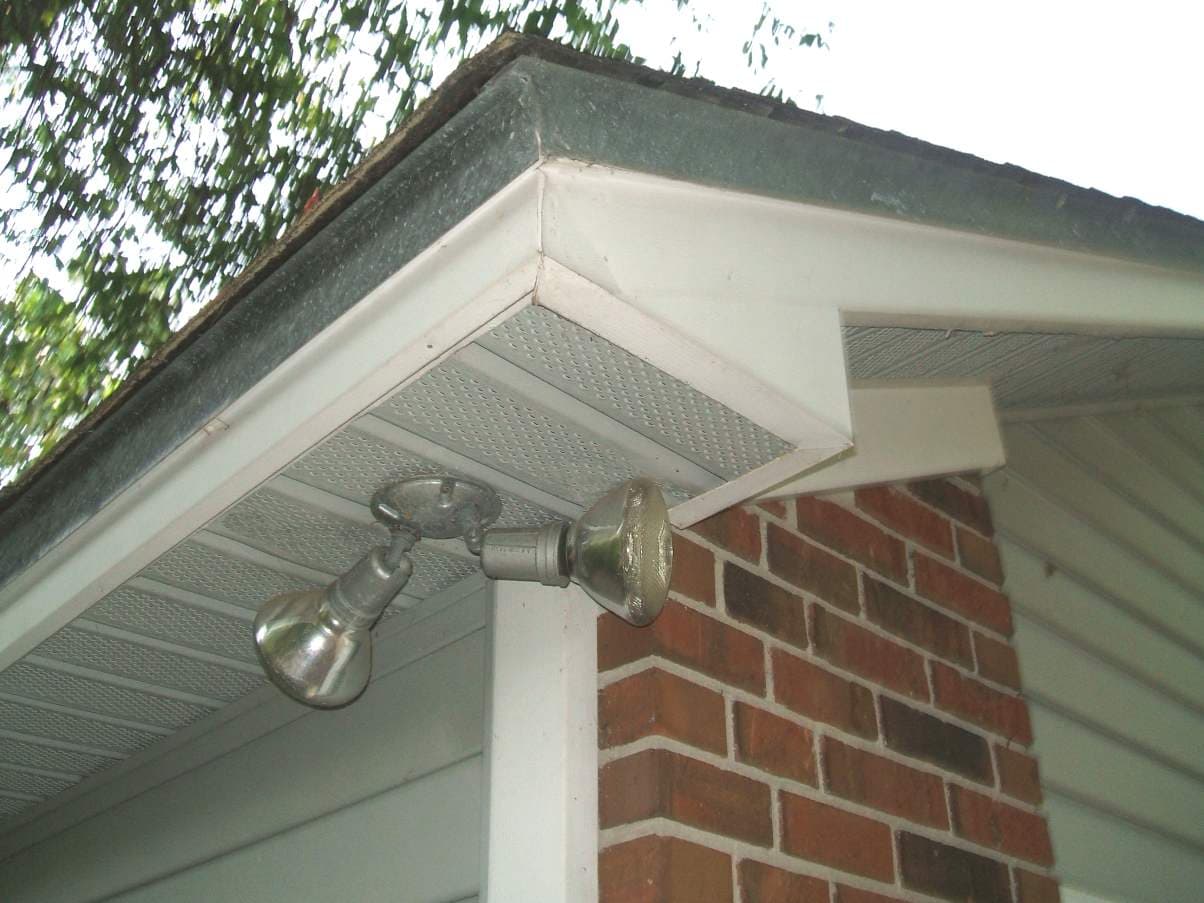
Why the soffit, and why now
Wildlife is looking for a nest site. Virginia's Department of Wildlife Resources puts the prevention advice simply: "Close up all openings under and into your buildings. Animals look for places to den and raise their young—don’t give them that opportunity."[2] It also tells homeowners to clear overhanging tree limbs and branches that may be giving wildlife access to the house.[2]
The openings are usually ones the house already has:
- Corners and returns. Where soffit meets fascia at a corner, or meets the wall at a gable, pieces shrink, sag or pull apart over time.
- Loose or missing panels. Vinyl soffit that has slipped out of its channel leaves a slot an animal can push through.
- Vents. Torn screens on soffit vents, or vents that were never screened.
- Rotted fascia. Soft wood behind the gutter is easy to chew or peck through; see how to replace a rotted fascia board.
- Gutters. A gap behind a sagging gutter, or a gutter full of leaves. Building scientists note that leaves and plant debris in gutters can encourage nesting by animals.[12]
Problems often show up in spring and early summer, when birds and squirrels are raising young, though a squirrel can move in at any time of year.
Work out who is living there
What you do next depends on the animal, so watch from the ground before doing anything.
Squirrels. DWR says the most common squirrels in Virginia attics are flying squirrels, which are nocturnal.[1] Gray squirrels are active by day, busiest at dawn and in the late afternoon,[3] and Fairfax County's wildlife staff note that they have 1 to 2 litters a year with 2 to 4 young per litter.[3] Chewed, rounded edges on wood or vinyl are a squirrel sign. DWR's advice is to plug the hole with wire mesh or metal sheeting once the animals have left, after making sure no young are left inside,[1] which is why the timing is left to a professional.[1]
Birds. Most nests are protected. "Under the MBTA it is illegal to destroy a nest that has eggs or chicks in it or if there are young birds that are still dependent on the nest for survival."[5] The U.S. Fish and Wildlife Service generally expects you to wait for a nest to become inactive, with no eggs or chicks and no longer used for breeding, before removing it.[5] The common exceptions in soffits are non-native birds: federal Migratory Bird Treaty Act protection has been removed for European starlings, pigeons, monk parakeets, mute swans and house sparrows,[4] but that does not make every bird in your soffit fair game. If you cannot tell what the bird is, wait until the nest is empty.
Woodpeckers. Holes drilled into fascia rather than gaps pushed open often mean woodpeckers. Woodpeckers are protected under state law and the federal Migratory Bird Treaty Act, and it is illegal in Virginia to destroy their nests or eggs, trap them or kill them.[6] DWR's first piece of advice is to have the house inspected for insect infestation first,[6] and the Forest Products Laboratory agrees: "Woodpecker holes often indicate insect infestation."[11]
Bats. Small dark droppings below a gap and activity right at dusk can mean bats. "From May through August, bats may have young still present in the inhabited space."[7] DWR also notes that it is illegal in Virginia to transport or relocate a bat anywhere other than the property where it was caught, or to poison one,[7] and that three bat species in Virginia are federally endangered.[7] Bats are a job for a professional; see how to know if you have bats in the attic.
What a proper fix involves
Once the space is empty, the fix is part animal-proofing and part carpentry. A wildlife professional confirms the animals and any young are out and closes the opening with a durable material, and a carpenter repairs or replaces the soft fascia or broken soffit so the patch has something solid to hold. Loose vinyl soffit, torn vent screens and gutters full of leaves are put right at the same time, and overhanging limbs are cut back by a tree service.
Do not trap and move the animals yourself. "It is illegal in the State of Virginia to trap and relocate an animal to another area."[2] For questions, DWR runs a toll-free wildlife conflict helpline at 1-855-571-9003.[2]
Leave the cleanup of a large nest or droppings to a pro, too. The Virginia Department of Health explains that the fungus behind histoplasmosis grows in soil with bird or bat droppings,[8] and advises: "If an area with bird and bat droppings needs to be cleaned, then a company that specializes in removal of hazardous waste should be utilized."[8]
When to call a licensed pro
Call a wildlife professional first if:
- You see or suspect bats, or animals are in the attic or the living space, not just the eave.
- Young are inside and the adults are not leaving.
- There is a large build-up of droppings or nesting material.
- Woodpeckers keep drilling, which points to insects in the wood.
The repair that follows is work on the house. The Board for Contractors says that if the work you are considering is valued at $1,000 or more, a valid Virginia Contractor’s License is required.[9] Home improvement contracting (HIC) covers repairs or improvements to dwellings and townhouses.[10] Look up the business on DPOR before you sign; see how to check a contractor's licence in Virginia. Eaves above the first storey or at the shingle edge are roof-edge work, so ask for that to be priced by a professional with the right equipment.
A wildlife business that traps for others needs the right permit: Virginia Cooperative Extension notes that people who regularly do nuisance wildlife trapping for others need a Commercial Nuisance Animal Permit from DWR.[4] For attic animals, see how to keep raccoons and squirrels out of the attic and whether trapping and relocating wildlife is legal in Virginia.
Getting help
Browse wildlife removal businesses or soffit and fascia businesses, find pest control pros around Blacksburg, or read more exterior answers. Once the animals are out, describe the soffit repair once and licensed local businesses will quote it.
Common questions
- Can I just seal the hole in my soffit?
- Only once you are sure nothing is inside. Sealing an animal in, or sealing young away from their mother, usually means a chewed new hole or a dead animal in the eave. A wildlife professional confirms the animals have left before the opening is closed, and a licensed contractor then repairs the wood behind it.
- Is it legal to remove a bird nest from my soffit in Virginia?
- It depends on the bird and the nest. Most native birds' nests are federally protected, and it is illegal to destroy one with eggs or chicks in it. Starlings, house sparrows and pigeons are not covered by the Migratory Bird Treaty Act. If you are not sure what species it is, wait until the nest is empty.
- Why are woodpeckers making holes in my fascia?
- Often because there are insects in the wood, such as carpenter bee larvae or carpenter ants, or because a male is drumming to claim territory in spring. Woodpeckers are protected and cannot be harmed in Virginia, so have the wood checked for insects first.
- Can I trap the squirrels and release them somewhere else?
- No. Virginia's Department of Wildlife Resources says it is illegal to trap and relocate an animal to another area. Excluding the animals after they leave is the usual fix; if they will not leave, call a wildlife control business.
- What if bats are in my soffit?
- Call a wildlife professional. Bats may have young inside from May through August, several Virginia species are protected, and their droppings can carry the fungus that causes histoplasmosis. Do not seal the opening until a pro has confirmed they are gone.
Sources
- [1] Problems with Squirrels, Virginia Department of Wildlife Resources. Checked October 27, 2026.
- [2] Help with Human-Wildlife Conflicts, Virginia Department of Wildlife Resources. Checked October 27, 2026.
- [3] Squirrel, Fairfax County, Virginia, Wildlife Management. Checked October 27, 2026.
- [4] Other Animals: Conflicts with Vertebrates, Home Grounds and Animals 2026 (ENTO-634-H), Virginia Cooperative Extension. Checked October 27, 2026.
- [5] Bird nests, U.S. Fish and Wildlife Service. Checked October 27, 2026.
- [6] Problems with Woodpeckers, Virginia Department of Wildlife Resources. Checked October 27, 2026.
- [7] Problems with Bats, Virginia Department of Wildlife Resources. Checked October 27, 2026.
- [8] Histoplasmosis fact sheet, Virginia Department of Health. Checked October 27, 2026.
- [9] What You Should Know Before You Hire a Contractor, Virginia Department of Professional and Occupational Regulation, Board for Contractors. Checked October 27, 2026.
- [10] 18VAC50-22-30. Definitions of specialty services (Board for Contractors Regulations), Virginia Administrative Code (Virginia General Assembly). Checked October 27, 2026.
- [11] Chapter 16: Finishing Wood, Wood Handbook (FPL-GTR-282), USDA Forest Service, Forest Products Laboratory. Checked October 27, 2026.
- [12] Gutters and Downspouts (Building America Solution Center), Pacific Northwest National Laboratory for the U.S. Department of Energy. Checked October 27, 2026.
Want a pro to handle it?
Describe the job once. Licensed local businesses send quotes, and you pay only when you book one.
Get a quote for Roofing