What are the signs of hail or wind damage on a roof?
Wind damage shows as shingles that are missing, torn, creased or lifted, often with exposed underlayment. Hail damage shows as random strike marks in different sizes, with a bruise you can feel in the shingle, and dented cars, fences, shutters or siding nearby. Check from the ground, photograph everything, and have a licensed roofer confirm.
Free to ask. Local shops send quotes, and you pay only when you book one.
By Kasra Taheri, Founder, LoclisPublished
Researched and drafted with AI, then checked claim by claim against the sources listed below before it was published. Prices and rules change; the dates beside each source say when it was last checked.
This is a job for a licensed pro in Virginia
This page explains what the work involves, the permits, what a licensed pro does and what drives the cost. It does not give step-by-step instructions, because this work needs a licence, a permit or both, and doing it wrong can injure someone. Before you hire, check the licence on Virginia's DPOR record.
The short version
Wind and hail leave different marks. Wind pulls shingles up, folds them and tears them away. Hail punches into them. Both can let water in, and the first sign is often a stain on a ceiling days later rather than anything you can see from the yard.
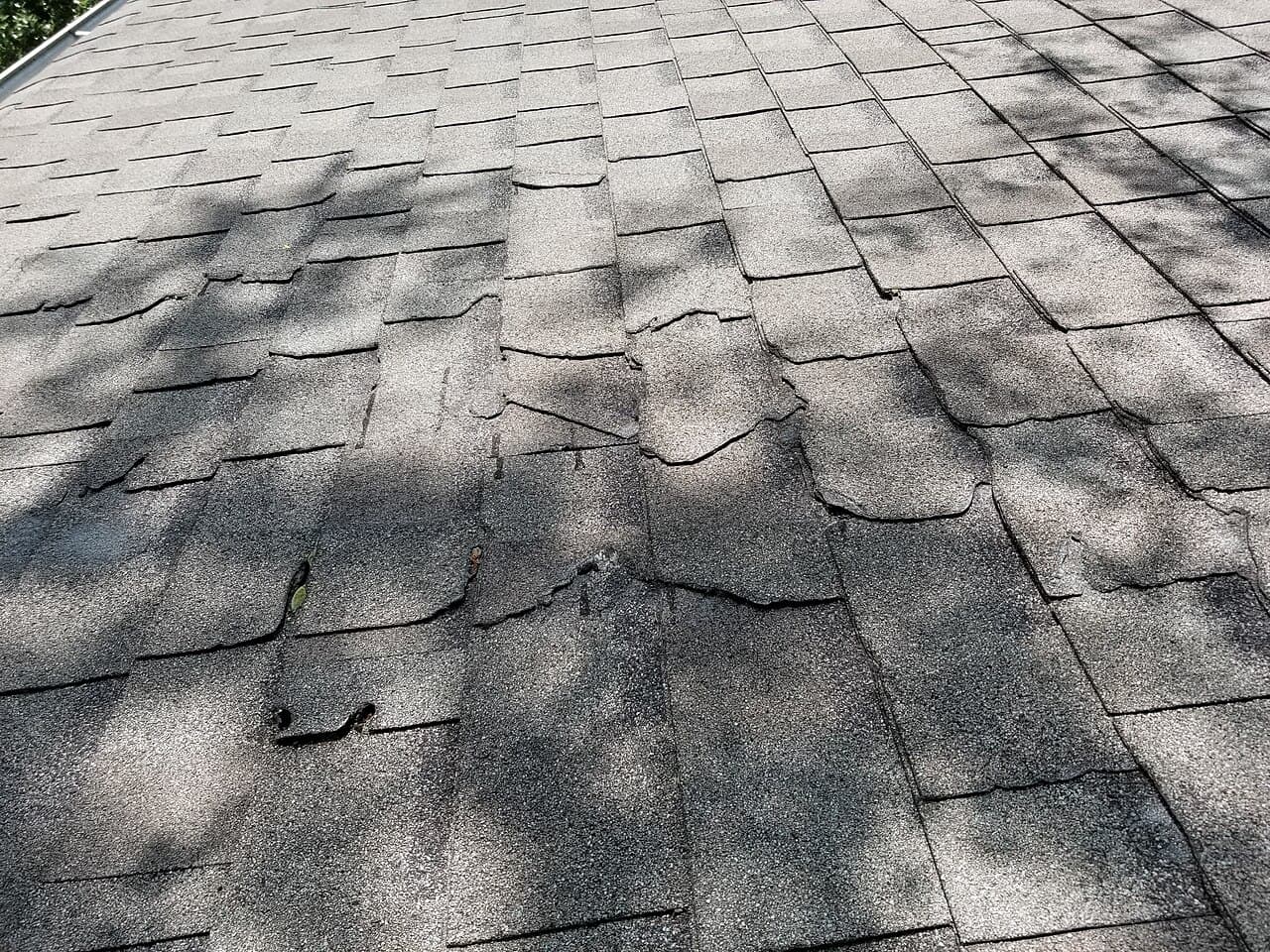
Signs of wind damage
Start with the obvious: gaps. During a hurricane, tornado, high winds, or hail storm, roof shingles can be damaged or blown off the roof, exposing the underlayment and the sheathing as the only protection against rainwater.[2] Exposed sheathing will eventually succumb to water damage.[2] Look for bare patches, dark felt or paper showing, and loose shingles lying in the yard, in gutters or against a fence.
Also look for shingles that are still on the roof but no longer lie flat: lifted tabs, creased shingles with a horizontal fold, and ragged torn edges. These matter because when shingles are missing or torn off, the roof structure and the building's interior are vulnerable to water damage and rot.[3] A damaged spot also weakens its neighbours, and nearby shingles are easily ripped off or blown away.[3]
Check the ridge, the edges and the corners of the roof, and the metal flashing around chimneys and vents, which can be bent or pulled loose.
Not every curled shingle is storm damage. When shingles become old and worn out, they curl, split, and lose their waterproofing effectiveness.[3] Curling that runs across the whole slope is usually age; a single shingle folded back with a fresh tear is usually wind.
Signs of hail damage
Hail marks have a particular look. Hail damage will result in a random pattern of strike marks in various sizes. If you see a pattern to the damage, it was not caused by a random phenomenon like hail.[1] Hailstones will also leave a "bruise" in the mat. Your fingers can usually detect in and around the crater.[1] That feel is the difference between a hail hit and a heat blister, which lacks it.[1]
Size matters, and the Nebraska Department of Insurance gives thresholds. Generally, hail must be 1 1/4 inches in diameter (roughly half-dollar sized) before causing damage to heavy composite shingles or wood shake shingles. Lightweight composite shingles may show damage after being struck by 1-inch diameter (quarter sized) hail.[1] Only deteriorated composite shingles will show hail damage due to hail less than 1 inch in diameter.[1]
You can learn a lot without going near the roof. Hail strong enough to damage a roof will cause damage to nearby cars, wood fences, shutters, and exterior siding.[1] Dented gutters, downspouts and vent caps tell the same story. A significant amount of shingle granules appearing at the end of downspouts may show potential damage. However, granule loss does not prove damage.[1]
What is probably not storm damage
Roofs age, and some of what looks like damage is not. The Nebraska Department of Insurance lists the lookalikes. As the outer edges of the shingle shrink faster than the interior, the edges tend to curl up or down.[1] Lichens or algae can grow on shingles in most weather conditions, which produces green, brown, orange or gray streaks.[1] A blister does not have the characteristic "bruise" that can be felt in a shingle that was struck by a hailstone.[1]
If you are not sure, that is what an inspection is for.
What to do from the ground
Walk the property and look, from a safe spot on the ground. Falls are the leading cause of work-related injuries and deaths among roofers.[5] A wet, storm-hit roof is no place for a homeowner. Binoculars or a phone camera with zoom help.
Photograph everything before anything is moved: the roof from each side, fallen shingles, dented gutters, cars, fences and siding. Check the attic and ceilings for stains, damp insulation or daylight.
If water is getting in, Virginia's Bureau of Insurance advises that you make all necessary temporary repairs, such as boarding up windows and patching holes in walls or roofs, as soon as possible, even if you have not yet seen the company representative.[4] That is a job for a roofer: see how a roof is tarped after storm damage. The bureau also says to take photographs to show the way things look before you begin cleaning and repairing, and be sure to keep receipts for all of your clean-up expenses.[4]
Before you call your insurer, check your deductible. Some homeowners policies contain a special deductible for wind or hurricane losses.[4] Wind deductibles can be triggered by a thunderstorm, tropical storm, or a hurricane.[4]
Getting a roofer to confirm
Ask a licensed roofer to inspect and put what they find in writing, with photos. In Virginia, if the work you are considering is valued at $1,000 or more, a valid Virginia Contractor's License is required for the license category in which the contractor is to work.[6] Be careful with anyone who knocks on the door right after a storm; see how to file a complaint about a storm-chasing roofer.
When to call a licensed pro
For the confirming, and for all of the fixing. Judging a roof means getting onto it, and a repair can mean replacing shingles, flashing or damaged decking. None of that is a homeowner job. Call a licensed roofer if you see missing or torn shingles, bare underlayment, a ceiling stain or any sign of daylight in the attic. This page does not teach the work.
To go further, see what to do when your roof starts leaking, who to call for a roof leak and whether to replace missing shingles or the whole roof. Browse roofing answers or find roofing repair businesses.
When you are ready, describe the damage once and licensed local roofers respond.
Common questions
- How big does hail have to be to damage a roof?
- It depends on the roof. The Nebraska Department of Insurance says hail generally must be 1 1/4 inches across, about half-dollar size, to damage heavy composite or wood shake shingles, while lightweight composite shingles may be damaged by 1-inch hail. Only deteriorated composite shingles will show damage from hail under 1 inch.
- Does granule loss mean hail hit my roof?
- Not by itself. Granules collecting at the end of a downspout may point to damage, but the Nebraska Department of Insurance says granule loss does not prove it. A roofer looks for bruised, cratered spots as well.
- How can I tell hail damage from an old, worn roof?
- Hail leaves strike marks in a random pattern and sizes, with a bruise you can feel in the shingle. Age shows up differently: curled or cupped edges, hairline cracks, and green, brown or gray streaks from lichen or algae. Blisters from heat lack the bruise a hailstone leaves. A pattern to the marks means it was not hail.
- Does my homeowners policy cover wind and hail?
- Usually, but read the deductible. The Virginia Bureau of Insurance says some policies carry a separate deductible for wind or hurricane losses, and that a wind deductible can be triggered by a thunderstorm, not only a hurricane. Ask your agent which applies before you file.
- Should I climb up to look for damage myself?
- No. OSHA says falls are the leading cause of work-related injuries and deaths among roofers, and a roof that has just been through a storm is slick and may be weakened. Look from the ground, from a window or with binoculars, and let a licensed roofer go up.
Sources
- [1] Hail Damage: Does My Roof Need Repair?, Nebraska Department of Insurance. Checked October 27, 2026.
- [2] Asphalt Shingle Roofs, Building America Solution Center, Pacific Northwest National Laboratory for the U.S. Department of Energy. Checked October 27, 2026.
- [3] Overview of Roofing Materials for Forest Service Facilities (Tech Tip 0071-2314-MTDC), USDA Forest Service, Missoula Technology and Development Center. Checked October 27, 2026.
- [4] Disaster Strikes Insured Homeowners Loss, Bureau of Insurance, Virginia State Corporation Commission. Checked October 27, 2026.
- [5] Protecting Roofing Workers (OSHA 3755), U.S. Occupational Safety and Health Administration. Checked October 27, 2026.
- [6] What You Should Know Before You Hire a Contractor, Virginia Board for Contractors, DPOR. Checked October 27, 2026.
Want a pro to handle it?
Describe the job once. Licensed local businesses send quotes, and you pay only when you book one.
Get a quote for Roofing