Why does my car battery keep dying?
A battery that keeps dying usually has one of three causes: it is worn out, something is draining it while the car is parked, or the charging system is not recharging it while you drive. Start with the terminals and the dashboard charging light, then have the battery and alternator tested together before buying another battery.
Free to ask. Local shops send quotes, and you pay only when you book one.
By Kasra Taheri, Founder, LoclisPublished
Researched and drafted with AI, then checked claim by claim against the sources listed below before it was published. Prices and rules change; the dates beside each source say when it was last checked.
Step by step
Read when to stop and call a pro, further down this page, before you start.
Step 1: Note when it dies
Write down the pattern: dead after sitting a few days, dead after short trips, dead only in cold weather, or dead while driving. The pattern points to the cause.
Step 2: Look at the dashboard
With the engine running, check whether the charging system indicator is lit. If it is, the car is telling you the charging system has a problem.[2]
Step 3: Check the terminals
With the car off, look at the battery terminals for corrosion and check that the cable clamps are tight and do not move when you push on them.[1]
Step 4: Clean any corrosion
Clean corroded terminals with a baking powder and water solution, wipe them with a damp towel, dry the battery, and coat the terminals with grease.[1] Wear eye protection and gloves.
Step 5: Walk around for loads left on
Check for a dome light, glove box light, trunk light or plugged-in device that stays on after you lock the car.
Step 6: Jump the car safely if you must
Turn off audio and lights, use a 12-volt booster only, and follow the jump-starting order in your owner's manual.[3]
Step 7: Drive it, then get it tested
After a jump, drive straight to a shop or parts store that can load-test the battery and check the alternator output in the same visit.
Step 8: Ask for the result in writing
Ask whether the battery failed, the alternator failed, or a drain was found, and ask for the readings on the invoice.
Three causes, one test
A car battery that keeps dying has almost always been worn out, drained while parked, or not recharged while driving. The battery stores energy; the alternator puts it back whenever the engine runs. If either one fails, or something pulls power when the car is off, you end up with a flat battery again a few days or weeks later.
That is why replacing the battery on a guess so often fails. The fix is to work out which of the three you have, and the cheapest way to do that is a combined test of the battery and the charging system.
Match the pattern to the cause
Dies after sitting for days, starts fine after a jump and then runs normally. This points to a drain while parked (a light, a stuck relay, an aftermarket accessory) or to a battery that can no longer hold a charge.
Dies after a run of short trips. Starting the engine takes a lot of energy, and a ten-minute drive may not put it all back. Add heated seats, defrosters and lights, and a healthy battery can run down over a week or two.
Dies on the first cold morning. Cold exposes a weak battery. Battery performance degrades in cold conditions and may prevent the engine from starting.[3] An older battery that has been marginal for months often fails at exactly this point.
Dies or stalls while driving, or the dashboard light comes on. That is the charging system. The charging system indicator comes on when there is a problem with the charging system.[2] Do not shut the engine off at a stop on the way to the shop: if you need to stop temporarily, do not turn off the engine. Restarting the engine may rapidly discharge the battery.[2]
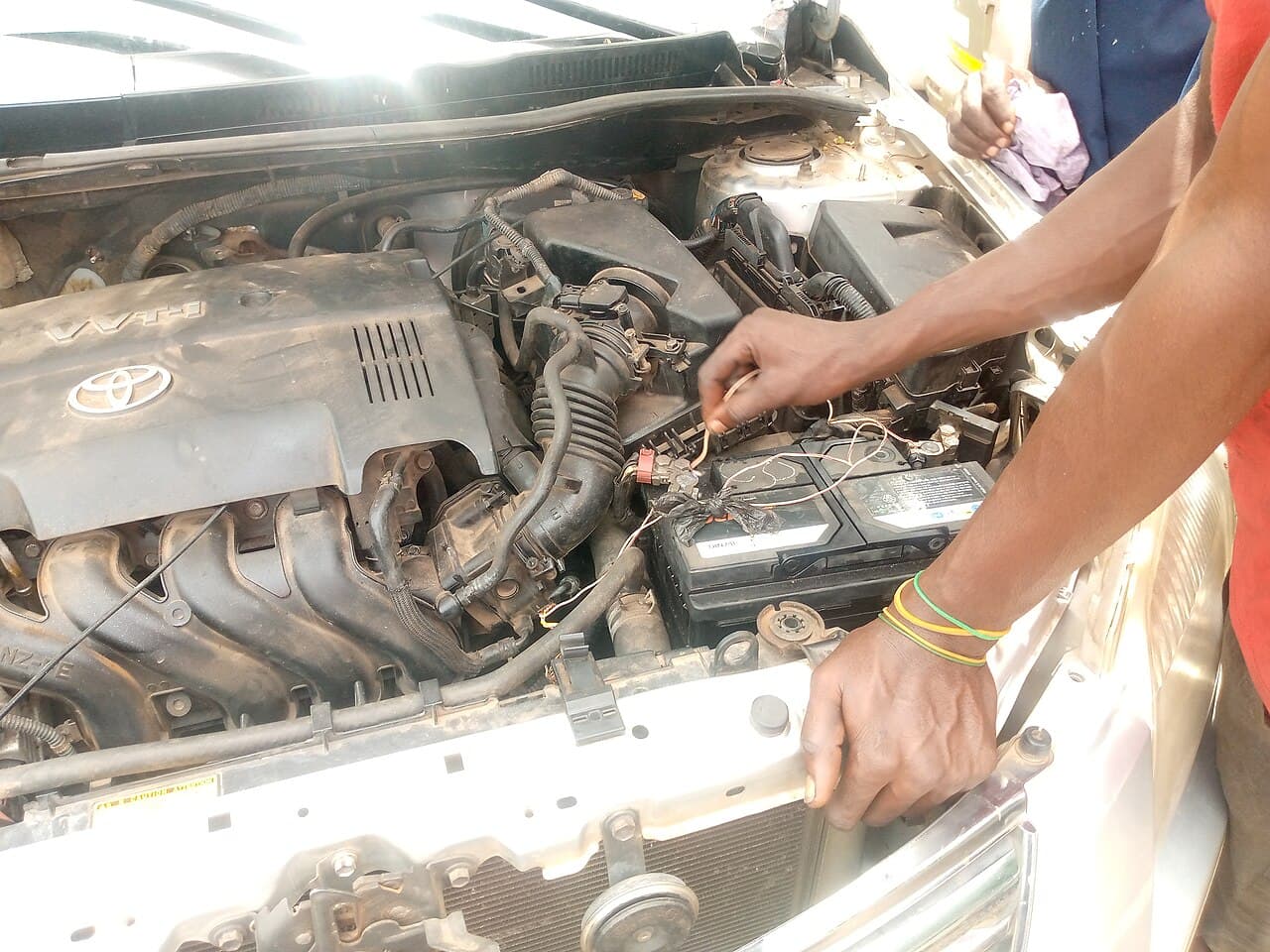
What you can check yourself
Start with the battery you can see. Check the battery terminals for corrosion monthly.[1] A crusty or loose clamp can stop the battery from charging and from starting the car even when the battery itself is fine. Push on each cable clamp with the car off: it should not move.
If the terminals are corroded, clean the battery terminals by applying a baking powder and water solution, wipe them with a damp towel, and dry the battery.[1] Coat the terminals with grease to help prevent future corrosion.[1]
Take care while you do it. The battery gives off explosive hydrogen gas during normal operation, and a spark or flame can cause the battery to explode with enough force to kill or seriously hurt you.[1] No smoking, no tools laid across the terminals, and wear eye protection and gloves.
Then look for things left on: a glove box or trunk light that does not switch off, a phone charger or dash camera on a socket that stays live, or a door that does not quite latch and keeps the interior light on. These are common and free to fix.
If you need a jump
Turn off the power to electric devices, such as audio and lights.[3] Use a 12-volt booster battery only,[3] and follow the connection order in your owner's manual, because the order and the grounding point matter and vary by car. Once the engine runs, have your vehicle inspected by a nearby service station or a dealer,[3] rather than assuming the jump solved it.
A jump gets you to a shop. It does not tell you why the battery went flat.
Get the right test
Ask for a battery load test and an alternator output test in the same visit. Many parts stores and shops do this quickly. If both pass, the problem is most likely a drain while parked, which takes more time to trace because a technician has to measure the current the car draws when off and pull fuses one at a time. That is diagnostic labor, so agree on the time in advance.
In Virginia, a shop must give you a written estimate on request. On request, before any repair work for which you may be charged more than $25, the shop must give you a written statement of the estimated labor, the estimated parts, a description of the problem or work and the estimated completion time.[4] Ask for the test results on the invoice. For prices on a replacement, see what a car battery replacement costs in Virginia.
Stop and call a pro if
- The charging light is on while you drive. Get the car to a shop with the engine running; do not keep driving for days.
- The battery case is swollen, cracked or leaking. Do not handle it yourself.
- A new battery died too. The cause is elsewhere: the charging system or a drain.
- Fuses keep blowing or you smell something hot or burning. That is a wiring fault, not a battery problem.
- You have a hybrid or electric vehicle, or a battery under the seat or in the trunk. The high-voltage system is not a DIY job, and the 12-volt battery may have its own procedure.
Getting help in Virginia
If you suspect the alternator, read what alternator replacement costs in Virginia. Browse local shops under automotive repair or read more automotive repair answers.
When you are ready, describe the problem once and local shops will quote the test and any repair.
Common questions
- How do I know if it is the battery or the alternator?
- A lit charging system indicator while the engine runs points to the charging system, not the battery. A car that starts fine after a charge but is dead again days later points to the battery or a drain. The reliable answer is a test that checks both the battery and the alternator output in one visit.
- Can a new battery keep dying too?
- Yes. A new battery cannot fix a charging fault or something drawing power while the car is parked, and it will go flat the same way the old one did. If a new battery dies, ask the shop to test the charging system and look for a drain.
- Does cold weather kill car batteries?
- Cold makes a weak battery show itself. Honda's HR-V owner's manual says battery performance degrades in cold conditions and may prevent the engine from starting. A battery that was marginal in autumn often fails on the first hard freeze.
- Is it safe to keep jump-starting the car?
- As a short-term measure to reach a shop, yes, if you follow the procedure in your manual. As a routine, no: a car that needs repeated jumps has a problem that needs a diagnosis.
- Will the shop give me a written estimate for the diagnosis?
- On request, if you may be charged more than $25, Virginia law requires a written estimate of labor, parts, a description of the work and the estimated completion time. Ask for it before the work starts.
Sources
- [1] Checking the Battery (HR-V 2024 Owner's Manual), American Honda Motor Co.. Checked October 28, 2026.
- [2] Indicator Coming On/Blinking (HR-V 2024 Owner's Manual), American Honda Motor Co.. Checked October 28, 2026.
- [3] If the Battery Is Dead (HR-V 2024 Owner's Manual), American Honda Motor Co.. Checked October 28, 2026.
- [4] Va. Code § 59.1-207.3, Written estimate for repair work required upon request, Virginia Law, Code of Virginia. Checked October 28, 2026.
Want a pro to handle it?
Describe the job once. Licensed local businesses send quotes, and you pay only when you book one.
Get a quote for Automotive